Cider Days, Part One

We knew we would have a huge apple harvest when the tree limbs started bending under the weight of the apples.

I picked off many, many, many little green apples, but I didn’t get the ladder out and cull the high branches. I should have!
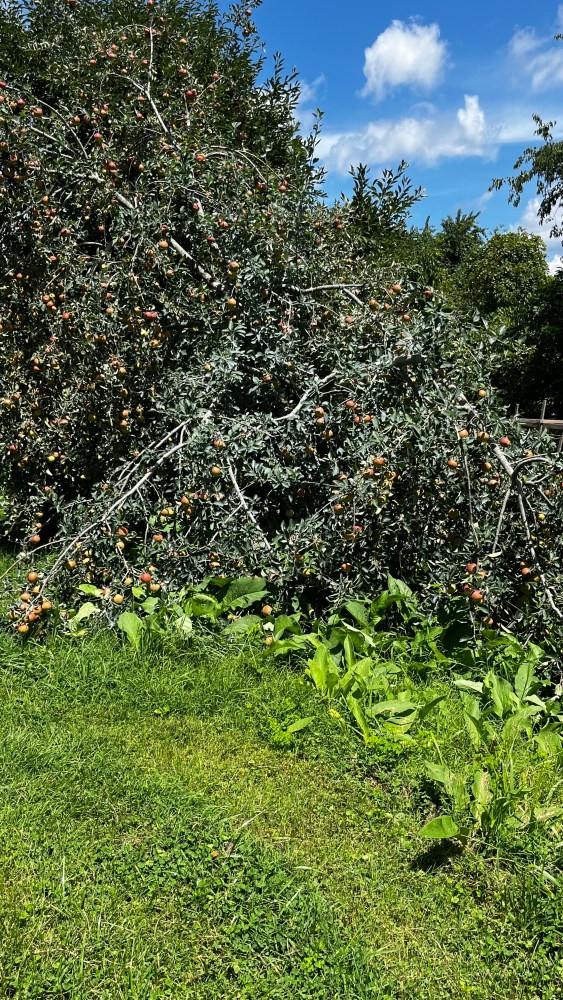
This poor Winesap tree used to stand tall and reach for the sky. Now it may be bent and weeping forever…

In mid-August the main Winesap branch broke right off, and we had to emergency-pick seven five-gallon buckets of half-ripe apples. We had to prop up several other branches on other trees and pick others before they were quite ready. By late August I had 10 bags of pie filling in the freezer, yet I had not enough time to even think about making a fresh pie. All I managed were a couple of crisps.

We knew we had too many apples and that the answer was cider.

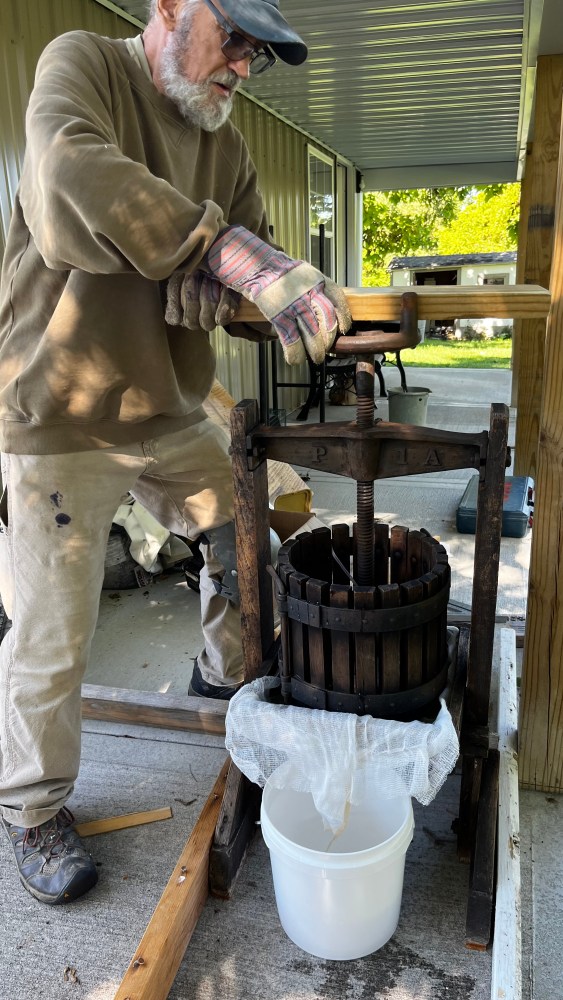
We had a vintage press that we’d never even thought of using. In fact, a couple of years ago Mr. H.C. varnished a tree round and added it to the top of the press. Suddenly it became a high table with benches out on the porch instead of dust catcher.

One evening as we were staring at it, Mr. H.C. said, “I think there’s another piece to this up in the attic.” Sure enough, within 15 minutes, we were staring at the other vintage piece–a hopper. Both were made by Red Cross Manufacturing Co. in Bluffton Indiana, probably around 1920-40. We spent the better part of the next week cleaning the cobwebs and crud with a garden hose, a power washer, and an air hose. We did a final rinse with vinegar and water; bought some cheesecloth sacks; some sanitizing tablets; and couple of new buckets. We were ready for the grand experiment…

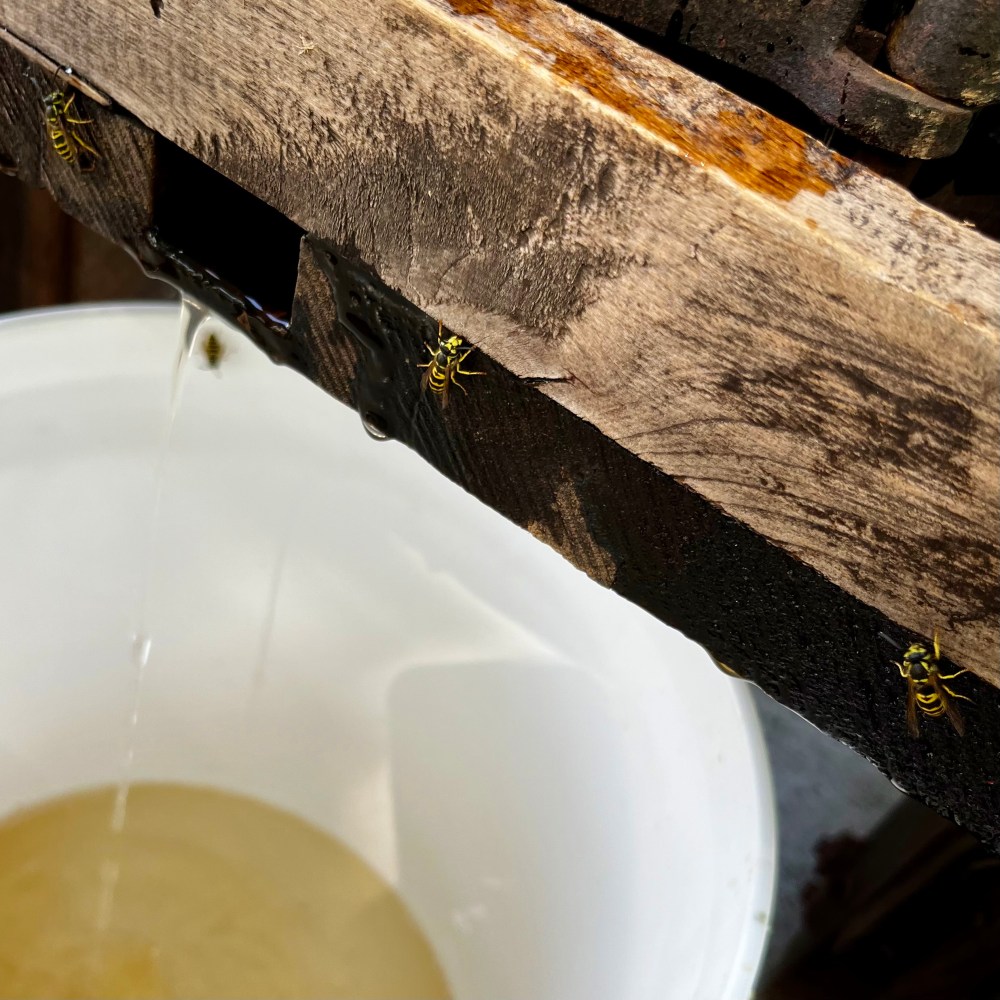
What we didn’t know was that the chopper/hopper was made for grapes. It really didn’t like to chop up the apples as they should be. So we had to chop the apples by hand–the smaller the better–before the hopper would grind them at all. And it really didn’t like the hard, green semi-ripe apples. So we used pears, and the other ripe apples that had bad spots and we just cut out the bad spots. We cut, and chopped, and pounded, and pressed for about 10 hours over two days. And no one got stung.

We ended up with about 2 gallons of pear cider, and about 4 gallons of an apple-pear mix. I canned ten quarts, and pasteurized the rest for half-gallon containers. (To pasteurize cider, heat it to 160 degrees for 30 minutes.)
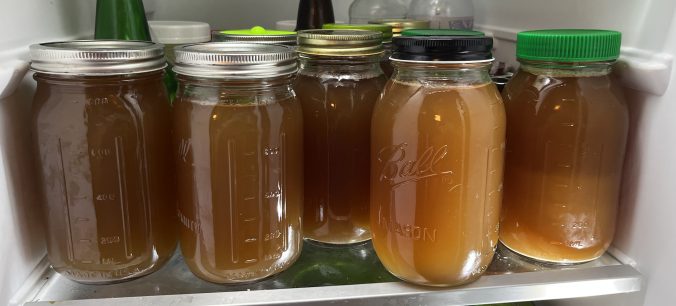
But we still had so many more apples, and honestly? We were exhausted.

Yes. We did this to ourselves. What were we thinking? But truthfully, this is the first year it’s ever been like this. We think it is a combination of a very good year for Pennsylvania apples (Every wild tree is loaded with apples!) and that our trees are just now coming into a very fruitful maturity–5 to 7 years.

So we started an internet search to find a local cider press… Stay tuned for Cider Days, Part Two

Bees and Blossoms and Frosts

The apple trees are in full bloom

After a week of 70 degree temperatures, the cold winds came blowing.

Two nights ago the low was 28 degrees; last night it was 30 degrees. We’ve been glued to our phones, watching as the frost warnings come and go. It’s always interesting when our weather apps forecast different temperatures.

According to several state orcharding sites, blossoms can survive temperatures above 28 degrees. It’s been close. Tonight after sundown we sprayed with kelp and fish fertilizer, hoping it will fight the cold. Although the forecast was just changed to a low of 34 degrees…

One pear tree has tiny little red pears on it, which is a really good sign, and there are tiny cherries on the sour cherry tree–as well as an interesting little spider on a blossom.

Any fruit we get this year will be better than last year, when it snowed in May, and we ended up with about ten scabby apples, no pears, no cherries, and no peaches.

But for now we’re just enjoying the blossoms and hoping…

Every day is Earth day…

sunrise

And did you know that every Earth Day has a theme? According to earthday.org, this year’s theme is “Invest In Our Planet.” The mission is simple, “Get Inspired. Take Action. Be a part of the green revolution.”

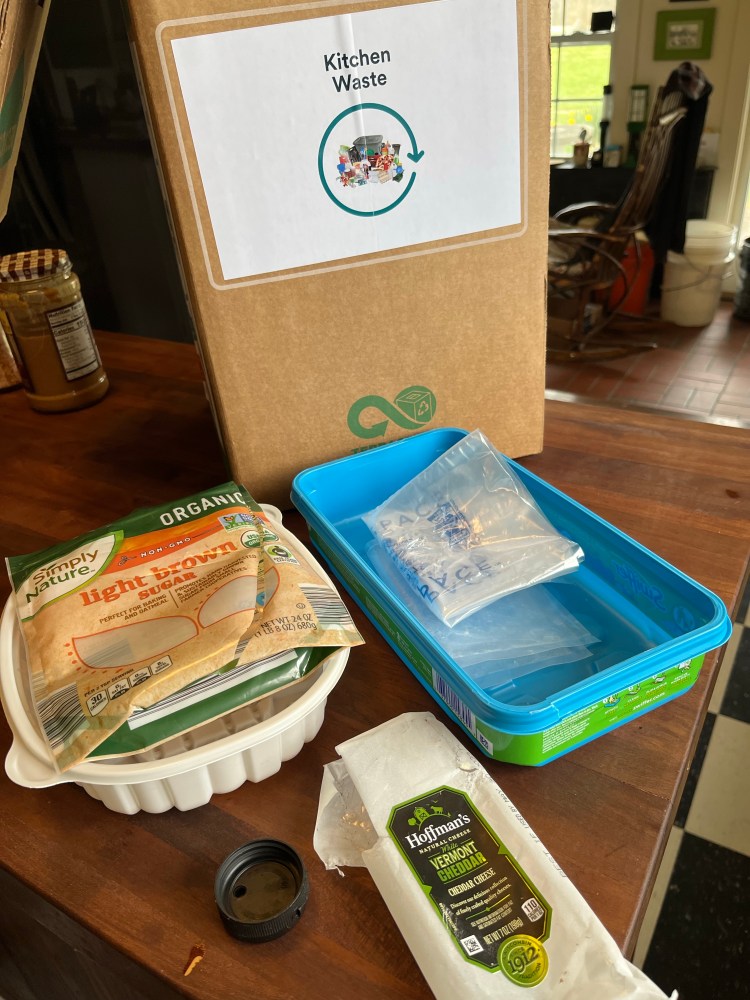
So mostly to just feel like I’m taking action for the stewardship of this earth, last month I ordered a Zero Waste Box from TerraCycle for the food packaging waste that is 90% of our garbage. The company has recycling boxes for just about anything—beauty products, garage waste, batteries, drink bottles, styrofoam… You can check out their website here: https://www.terracycle.com/en-US/.

Our small rural recycling center is limited. They take only 1 & 2 plastics, tin cans, cardboard, and paper. No glass. No aluminum. We save the glass and make quarterly trips into a glass recycling place run by the Pennsylvania Resource Council. We bag up the aluminum and give it separately to the guys who drive our garbage truck. They told Mr. H.C. that they kept it separate and sell it to an aluminum buyer. We were desperate, so we believe them. I guess. Cardboard and paper we either burn or shred and use in the garden as mulch. Food scraps are composted. So that left food packaging, meat scraps, and 3 through 7 plastics that went into our garbage bags. Oh, and kitty litter. (If anyone has any good ideas on how to environmentally dispose of kitty litter, please tell me.)

I bought the Zero Waste Box because I was just disgusted at the amount of food packaging waste we had. Mr. H.C. was unhappy about the high price of the box. I get it. It was more than I would normally spend, so I told him it was an experiment. But at some point, we consumers have to admit that we are complicit in greenhouse gas emissions. Of course, the big oil and gas companies are the worst offenders, but “…45% of global greenhouse gas emissions comes solely from the production of things we use and buy every day.” That quote is from an article “How Buying Stuff Drives Climate Change” by Renee Cho. Here in rich first-world-America we are really guilty: yes, I’m trying to make you feel guilty and think about all that stuff you put in the trash. Think about where it ends up. And our grocery store shelves are filled with food wrapped in plastic and cellophane. We’d better start taking responsibility for it, hadn’t we?

I paid $124 for the small Zero Waste Box that is 11″ x 11″ x 20″. I’ve been cramming stuff in for 7 weeks now, and it is almost full. If I really wanted to, I could dump it out and compress the stuff down a little more and maybe get 8 weeks. That is $15.50/week, and the return mailing is post paid. That doesn’t seem outrageous to me. But even better, our local library has a similar box in their front lobby where I’m going to be taking my stuff after this box is full. They are collecting plastics to be made into an outside bench.

Consider what else you can do to “invest in our planet.” And if you have to pay a little bit more, then consider it your “tax” for earth stewardship. I’ve also recently given up buying plastic baggies. I tried it one other time with some wax covered cloths and bags and they kind of worked for awhile, but I needed large bags for freezing breads, so I succumbed. But this time, I’ve found the answer, I think. These are compostable, and they work in the freezer too. And when I finish with my Finish Powerball Quantum Dishwasher pods, I’m going to be trying out the no-waste packaging of Dropps Dishwasher Pods.

Here’s your Earth Month challenge: Do something to make a difference, and tell me about it in your comments. It can be planting trees, planting a garden, making your own toothpaste, laundry soap, deodorant, face cream. It could be carrying your own silverware around so you don’t have to use plastic utensils. It can be seeming like a weirdo to the check out people at Walmart when you say, “Could you please put everything in this bag? I’m trying to cut down on my plastic use.” The last two times I’ve done this, I’ve actually come away pleased that I started a good conversation about it.

And I’m working on that kitty litter…