The attitude of gratitude : Hannah Coulter and I

I wrote this in 2012, but it seems appropriate to republish it now. Wendell Berry, 1934-2026. May your words and your actions inspire people for years to come…

Hannah Coulter by Wendell Berry has just shot up to the top of my Best Books I’ve Ever Read List. As a librarian, I’m asked a lot (mostly by kids) what my favorite book is. I always hedge. How can one pick a favorite book, when there are so many great reads, so many books, so little time…

But I hadn’t yet read Hannah Coulter.

Yes, yes, I know. This is supposed to be a blog about the cottage, but the subtitle is the circle of life; if anyone knows how to write about the circle of life, Wendell Berry does. His writing is lyrical, a pleasure to read and savor, yet so truthful as to bring pain… My fingertips ached with the beauty of his thoughts, transferred with such clarity into the thoughts of a woman, Hannah Coulter.

Hannah is in her seventies, a widow who has lost two husbands; she has lived her life on a farm in rural Kentucky, her children have grown up, gone to University, and gone from the farm. This is her memoir, but it is more. It is a mourning of the rural life, lost to modernity; it is a mourning of the loss of community that modernity brings; yet, it is also a celebration of love, faith, trust, and the hopes of the human heart.

I’ve been scraping the paint off the cottage this weekend, and that has given me time to ponder the circle of life. The paint was peeling terribly on this weather-beaten, sun-scorched side of the house, yet the warmth of the autumn sun made it lovely weather for scraping — scraping old paint from siding that was probably put on and painted originally by my grandfather. And then re-sided and rearranged by Michael’s dad, Joe. Yet they never knew that this place made by their hands would someday be also lovingly touched by their children’s and grandchildren’s hands… Here is what Hannah says about that…

“As I went about my work then as a young woman, and still now when I am old, Grandmam has been often close to me in my thoughts. And again I come to the difficulty of finding words. It is hard to say what it means to be at work and thinking of a person you loved and love still who did that same work before you and who taught you to do it. It is a comfort, ever and always, like hearing the rhyme come when you are singing a song.” Chapter 14, The Room of Love

I remember making applesauce with Nanny, my grandmother, in her kitchen. She was peeling the apples with a perfect stroke so that the peel dangled in one long piece from the apple. I was awkwardly scraping the apple and only getting little bits of peel to fall into the sink. “It’s all in learning how,” she told me gently. “I couldn’t do it when I was young either. You’ll be able to do it with practice.” I think about that every time I peel an apple in one piece.

Education was important in our family. My grandfather and his brother both left the family farm together to go college and become teachers. But Pa was always a farmer; even while working as a principal, and later, as the superintendent, he farmed. Cows first, then apples, then peaches. Here is what Hannah has to say about education…

“The big idea of education, from first to last, is the idea of a better place. Not a better place where you are, because you want it to be better and have been to school and learned to make it better, but a better place somewhere else. In order to move up, you have got to move on. I didn’t see this at first. And for awhile after I knew it, I pretended I didn’t. I didn’t want it to be true.” Chapter 15, A Better Chance


Yet most of us have gone from our home places to the Great Away, and we are inclined to think (or be taught) that it is just the nature of growing up and moving on. Life ever changes and if we are to get on in this world, that’s just the way of it. I know very few who stayed. And now that I am back in my home place, I envy the rootedness of those who stayed. I envy them their place in the community — not their standing or their accomplishments — but their place. Their membership. Here is what Hannah has to say about that…

This was our membership. Burley called it that. He loved to call it that… The work was freely given in exchange for work freely given. There was no bookkeeping, no accounting, no settling up. What you owed was considered paid when you had done what needed doing. Every account was paid in full by the understanding that when we were needed we would go, and when we had need the others, or enough of them, would come…The membership includes the dead… The members, I guess you could say, are born into it, they stay in it by choosing to stay, and they die in it. Or they leave it, as my children have done… And so an old woman, sitting by the fire, waiting for sleep, makes her reckoning, naming over the names of the dead and the living, which also are the names of her gratitude.” Chapter 11, The Membership

I have given up my membership once, twice, three times maybe, and now I am about to give it up again and move back where I started. A circle. A wandering circle. And though I will miss friendships and those left behind, there is also an excitement. And herein, I think, is part of the problem. We are always searching for the new, the exciting, the next big thing. Eve probably picked that first apple and gave it to Adam because she was bored with the same old grapes every day for breakfast. What we know, we know, and it has become the routine, the boring. What has become of steadfastness, neighborliness, rootedness to a place, community? Here is what Hannah has to say about that…

“The old neighborliness has about gone from it now. The old harvest crews and their talk and laughter at kitchen tables loaded with food have been replaced by machines, and by migrant laborers who eat at the store. The old thrift has been replaced by extravagance and waste. People are living as if they think they are in a movie. They are all looking in one direction, toward ‘a better place’ and what they see is no thicker than a screen. The houses in Port William and even on some of the farms are more and more being used as temporary lodgings by people who temporarily, as they think, can do no better.” Chapter 22, Next?

20121121-220306.jpg
When I was finished scraping the paint from one small section, I found an old brush and began to paint primer over the bare wood. As I was covering over the ugly, patchy, half-scraped wood, I wondered what are the differences between those of us who leave and those of us who stay?
Mr. Berry believes that to our detriment, and perhaps our demise, rural life has never been seen as desirable in society, in education, in culture. Indeed, when one of my good city friends discovered I was originally from Greene County, she shouted, “You’re a Hoopie!” Indeed, when I was in high school, the ultimate insult was to call someone a Farmer. Indeed, when my kids were in high school they shook their heads (as did I) over the kids who were choosing to stay. Here is what Hannah has to say about that…

Oftentimes after it no longer matters whether things are clear or not, they become clear. After not liking school at all, Caleb had got to liking it too much… He liked knowing the things he was learning… He was, maybe you could say, tempted by it. And I know, I can almost hear, the voices that were speaking to him, voices of people he had learned to respect, and they were saying, ‘Caleb, you’re too bright to be a farmer.’ They were saying, ‘Caleb, there’s no future for you in farming.’ They were saying, ‘Caleb, why should you be a farmer yourself when you can do so much for farmers?’… These were the voices of farm-raised people who were saying, ‘Caleb, why go home and work your ass off for what you’ll earn? Things are going to get worse for farmers.’ And they were true prophets.” Chapter 17, Caleb.

We leave for so many reasons — a new chance, new friends, a better job, a better place, marriage, escape — for good reasons and for bad ones. But sometimes we expect that someplace else will be better or different, when we really just need to see in a new way. Expectations, Hannah says, are most often a bucket of smoke…

Life may surprise us, it may not turn out how we expect, but always we are asked to see what is and call it good. And until we stop breathing, there will always be surprises. Here is what Hannah says about that…

“Life without expectations was still life, and life was still good…The world that so often had disappointed us and made us sorrowful sometimes made us happy by surprise. You think winter will never end, and then, when you don’t expect it, when you have almost forgotten it, warmth comes and a different light. Under the bare trees the wildflowers bloom so thick you can’t walk without stepping on them. The pastures turn green and the leaves come.” Chapter 19, The Branches.

And as I was scraping away years of dried paint, I was thinking how can I write these things without those who know me thinking that I am being regretful, or feeling guilty, or making them feel guilty? But there is no guilt — just thankful thoughts about what was and what is. And here is what Hannah says about that:

“The chance you had is the life you’ve got. You can make complaints about what people, including you, make of their lives after they have got them, and about what people make of other people’s lives, even about your children being gone, but you mustn’t wish for another life. You mustn’t want to be somebody else. What you must do is this: ‘Rejoice evermore. Pray without ceasing. In every thing give thanks.’ I am not all the way capable of so much, but those are the right instructions.” Chapter 15, A Better Chance.

Yes, indeed, those are the right instructions…

___________________
All the Words We Know: a book review, of sorts…

Dear friends and readers, WordPress just notified me that my subscription is about to expire. My first post on this blog was May 22, 2012. That’s a long time ago! But my last post here was in July…So I’ve decided that I can no longer afford the expense for an on-again/mostly off-again blog. This will be my last post. And when you read it, you will understand why. Perhaps some other time, I’ll write again. But it will be in a different format. Thank you all for reading all these years. Stay hopeful. Stay grateful. Stay humble.


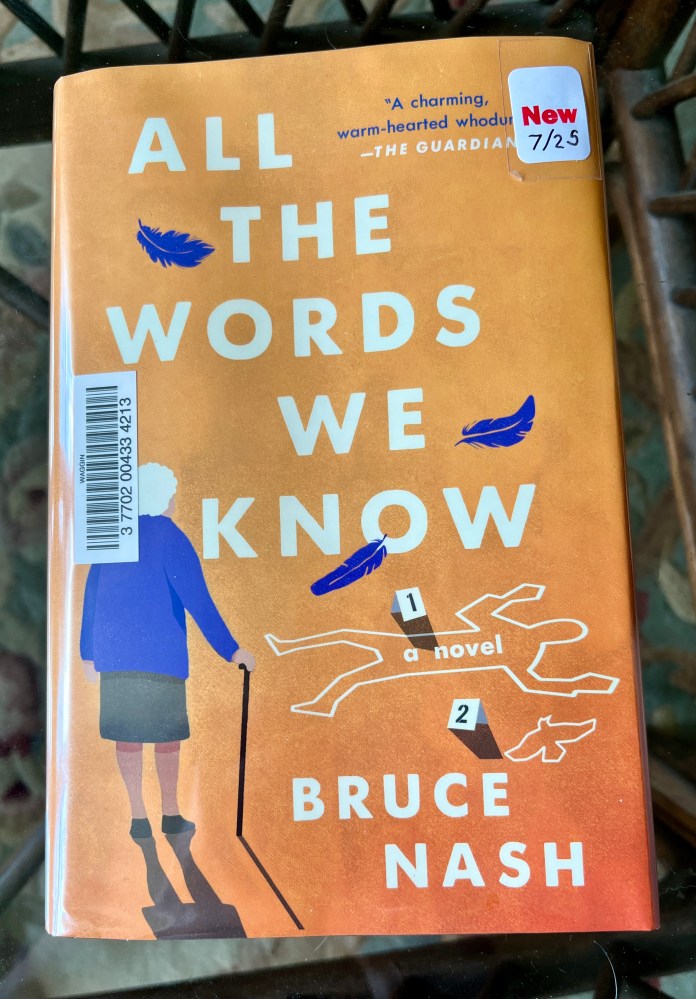
It’s never good to be in a rush at the library. But there i was, with only twenty minutes before an appointment and books to be returned, so i didn’t have much time to choose. The obvious selections are there by the circulation desk–six long rows of new books, faced out, so one can easily judge by the cover. The title? The splashy artwork? The author’s name?

The last two out of three books that i selected from these shelves have been winners, so the odds seemed pretty good. And this title jumped out: All the Words We Know by Bruce Nash. Never heard of him. Seemed to be a cozy mystery with an old lady on the cover. But it was the title that drew me in–All. The. Words. We. Know.

i have always loved words. Always have i loved words. Words i have always loved.

reading. writing. poems. novels. scrabble. word-games. magazines. books. libraries. bookshops. stories. lists. talking. thoughts. journals, crosswords. so, yes, give me All the Words We Know… Due in three weeks.

Only later, in the evening, as i opened it to read the blurb, did i realize that it was about a woman with dementia in a nursing home where residents are dying suspiciously. She has up days and down days, so sometimes she can remember what she knows, and sometimes she forgets what she should remember.

It’s not the subject i would have chosen. i closed the book. i shut my eyes. i should have known a book about old ladies and words wouldn’t be my kind of book.

Words are in such short supply here these days. These days words are in such short supply here. Here there is such a short supply of words.

My husband is losing his words.

He was always a man of few words. But the words he had were kind words, good words, sweet words, and now there is silence. and struggle. the silent words float up into the clouds and fall back down like rain from my eyes.

And so. Do i really want to read a whole novel about someone else losing their words and forgetting?

i decide to try the first few pages and see how i feel. Yes. This is why i’ve mostly been reading happy-ending-escapist fiction.


Rose (at least she thinks that is her name) is funny. If she forgets a word, instead of silence, she just throws another word in there. (Word Salad, anyone?) And since she is not running the country, it’s humorous. The elevator is the revelator, and next to it are the Fiery Escape stairs. There’s Angry Nurse, the Scare Manager, and the fellow in the wheelchair who doesn’t live there. In the cafeteria are pictures of sharks on the walls, and there are meatballs every night for dinner. The pictures on her whatitsname are pictures of the Dresser family–her son, her daughter, her granddaughters, and her two husbands, one of whom has his head torn off in the photo.

But all is not right at the nursing home. Her best friend, who cheats at Scrabble, is found dead in the parking lot from falling out her window. Rose loses her own beautiful room–with the window overlooking a garden to a room with the window overlooking a parking lot. And the man who takes her old room dies mysteriously after she has visited him one evening and held his hand. Maybe.

Rose’s musings take the form of disjointed thoughts, word play, puns, and occasional brilliance. Sometimes I stopped and read a paragraph out loud just for the joy of it. Here’s an excerpt from her thoughts after her room is downgraded.

“When they murder me, when they push me out this window and I am on my back in the parking lot with my head broken staring at the sky, I will be wearing a nice pantsuit. Pant suit. Pants suit. I like to look my best. The Scare Manager looks his best too, I’ll give him that. He makes an effort. If he murders me, at least we will both look the part. He looks quite handsome, in fact. I don’t think it’s just the new medication. Although I can’t be sure, obviously. As well as his expensive gold watch, he wears a shiny new leather jacket. And pants, of course. Not leather pants, but pants. He would not murder me with no pants on. Would not, with no pants on, murder me. That would be unprofessional. That would not be Best Practice. That would not meet Benchmarks.”

In her own broken way, Rose solves the mystery, brings the villains to justice, heals her family, and, yes, gets her own nice room with the big window back. Her own back window in the nice big room. And here’s what Rose has to say about it all:

“Things never change, until they do. Nothing ever happens, then things happen very quickly. It’s about time. Everything about this place is different, even if it isn’t. Everyone seems happier, about their room at least, or about the wall that they sit against in their wheelchair, or whatever. None of us may have much more in our accounts, but what we have at least flows in a new direction. One day recently there was a quiz night, and someone got an answer right. There is even some talk of the meatballs having improved.”

The thing is, this book made me laugh. Losing your words isn’t funny. Until it is. Maybe, just maybe, i need to have a different attitude. It’s about the sun glaring in your eyes. Or your eyes glaring at the sun. You can shut your eyes and enjoy the warm, or you can go blind glaring at it. If only i could remember this thought, instead of forgetting it when i need to remember.

But i will say, along with Rose — to enjoy this book, you really do need to like words. You do need to really like words to enjoy this book.


The End
of This.
The Beginning
of Something New.

Binge-reading Ishiguro…

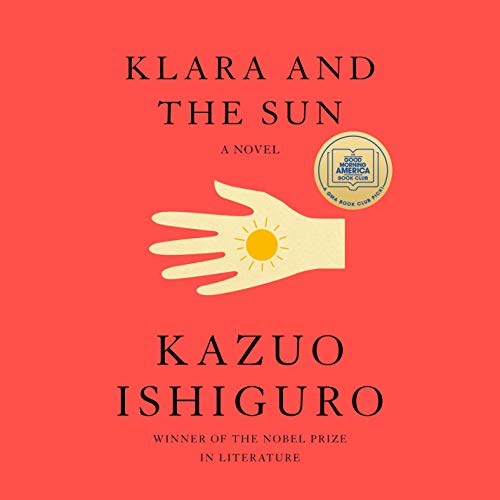
If you watched 60 Minutes the other night, you might have seen a disturbing episode on Artificial Intelligence. Anderson Cooper interviewed Yuval Noah Harari, a philosopher and historian of the future (and author of Sapiens) about what technology may bring. You can watch the episode, “The Future of Sapiens” here. As I watched uneasily, I couldn’t help thinking of the two novels by Kazuo Ishiguro that I had just finished: Klara and the Sun (2021), and Never Let Me Go (2005)

I read Klara and the Sun first, based on a glowing NYT book review. I was stunned with the beauty and simplicity of the writing in what is an intricate and complex plot. Set sometime in the near future, Klara is–for lack of a better word–an automaton, or Artificial Friend. These Artificial Friends are marketed toward the older child/young teenager to serve as a friend, companion, or nanny. As technology moves forward, new models of Artificial Friends replace older ones, and stores continually push the new product, the newest model. Klara has already had her chance in the store window and has now been shoved back toward the middle of the store, when the young girl, Josie, and her mother purchase her. Klara’s storekeeper assures the hesitant mother that Klara’s model is actually preferred by many because of their sentience and compassion. Indeed, the humanoid robot Klara seems, at times, more of a compassionate character than the humans she lives with. It is a familiar, yet chilling world, in which the haves give up some of what makes them human in order to have more, and the have-nots face the choice of keeping their humanity at the expense of always being considered less. What would you do, as a parent, to make sure your child succeeds in life? And what does success look like? Indeed, what does being human look like? This is a 5-star read.

I had to be on the wait list for Never Let Me Go, but to be honest, it is my favorite of the five I have read so far. (I have not seen the movie–I watched the trailer, immediately after finishing it, and the first scene was not even in the book…so I’m not going to watch it, at least for awhile.) This novel, also set in the near future, raises similar issues–What does it mean to be human? Just because we can use genetic engineering, does it mean we should? I’m not going to give you a plot summary because there would be spoilers. It’s the type of novel that uncovers what is actually happening a little at a time, page by page. To give a plot summary would be to ruin the tense, dystopian atmosphere that Ishiguro has mastered in Never Let Me Go. This is a 5-star read that is hard to put down. Don’t pick it up if you have anything important to do….


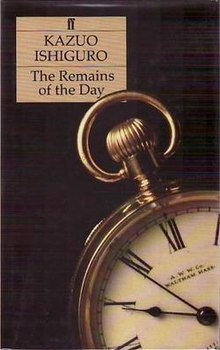
In between the two dystopian novels, I read The Remains of the Day. I’m ashamed to say I’d never read it, and it’s one of the few times I saw the movie without reading the book first. I guess Anthony Hopkins and Emma Thompson persuaded me…The film came out in 1993, so the only thing my aging brain could recall about it was an older English butler who worked for a Nazi sympathizer. I was glad that was all I could remember; for this is a brilliantly nuanced memoir of how we can so easily fool ourselves with our own thoughts and memories.

The aging Mr. Stevens is still the butler in charge of the grand old English manor, Darlington Hall, but the old Lord Darlington has died, and the manor has been purchased by a rich American who really has no idea of how things should be run properly. He suggests that Stevens take a vacation, a road trip, and even provides the roadster. As Stevens travels from Darlington Hall near Oxford to the West Country, he relives his life and his relationships with seeming honesty and (sometimes) painful introspection. I think that this is probably not a book for everyone. It is a quiet, introverted book, and not much happens plot-wise. But the language transported me, a modern American, to a time gone by in England. What follows is a particular paragraph that is likely to let one know if one would enjoy this book.

“But this small episode is as good an illustration as any of the hazards of uttering witticisms. By the very nature of a witticism, one is given very little time to assess its various possible repercussions before one is called to give voice to it, and one gravely risks uttering all manner of unsuitable things if one has not first acquired the necessary skill and experience.”

Kazuo Ishiguro, The Remains of the Day

And if that resonates, here is another:

“One need hardly dwell on the catastrophic possibility of uttering a bantering remark only to discover it wholly inappropriate.”

Kazuo Ishiguro, The Remains of the Day

Ah yes, the wholly inappropriate bantering remark… This is a 5-star read, and yes, I’m going to watch the movie again soon.

After the third Ishiguro novel, I was excited to read The Buried Giant. It was billed as an Arthurian fantasy or fable, and I have always been a fan of classic fantasy and myth. The Mists of Avalon, The Last Enchantment...yes, I read them both and loved them, and I think that’s why my expectations were high. I suppose we should be wary of great expectations, for I was actually disappointed in this one, and I’m not sure why. The plot is fine: an aging dragon breathes out the mist over the land that keeps people’s memories foggy. This was Merlin’s last enchantment to keep the Angles and the Saxons at peace. Indeed it has worked all these years, for no one can remember to hold a grudge, but neither can anyone remember their children, or love, or why they live as they do. The aging couple Axl, who was a peacekeeper in Arthur’s court, and his wife, Beatrice (whom he irritatingly calls Princess) set out on a journey to find the son they vaguely remember. On their journey they are joined by a warrior, a young boy, and Sir Gawain–each of them on their own journey to reclaim memory. Each one of them has clarity about the past at different times, but they are all the epitome of the Unreliable Narrator. The reader is never sure if what is remembered is true or mist. Ishiguro himself said he was writing about collective memory and how societies cope with traumatic events by forgetting. Reading this book is like having a conversation with someone who has Alzheimer’s. It’s well-written, but I never felt much empathy for any of the characters. It was as though having their own struggles with memories made them keep everyone–even the reader–at arms length. I give this one three stars.


When We Were Orphans takes the reader back to England in 1923, where we are introduced to Christopher Banks, a young man who has just graduated from Cambridge and is about to embark on his long-dreamed of career as a police detective. And though you might see this billed as a detective novel, it is not. The reader really only hears vaguely about his career and the cases that have made him famous. What we have instead is another theme on our memories and how they often fool us into misinterpreting facts and the world around us. It’s called cognitive bias, and this article by Charlotte Ruhl says that “…it results from our brain’s efforts to simplify the incredibly complex world in which we live.”

The first few sections of the novel take us back and forth between England and young Christopher’s childhood in Shanghai, where he lived with his parents in the International Settlement. (An aside–this novel’s rich details about early twentieth century Shanghai make it worth reading just for the exotic locale.) When he was nine, his father disappeared, and a few months later his mother was kidnapped. Young Christopher is sent back to England where he is sent to boarding school and raised by an aunt (whom we never meet).

Twenty-some years later, after Christopher has established himself as a renowned detective, he returns to Shanghai, in the midst of the Sino-Japanese war (ca. 1937) to solve the disappearance of his parents. His return to China begins the dreamlike episodes of the book, for up until now, the reader has assumed that everything Christopher has told us is true. And it is true according to his memory, but his memory is also that of a nine-year-old boy who has experienced great trauma. I’m not a literary critic; I’m not even an ex-English major who sees the symbolism for the light at the end of the dock; but when Christopher returns to Shanghai, he is transported back to that nine-year-old life and refuses to see the changes and the differences to this new city at war. What makes him think that his parents are still alive after all these years? And the truth, when it comes out, might be even stranger… This is a 5-star read, too.

I think next I will read An Artist of the Floating World. Does anyone have any suggestions? My suggestion to you is to pick up one of his books. He won the Nobel Prize for Literature in 2017, and he isn’t called Sir Kazuo Ishiguro for no reason.