 Last week my son-in-law lent me a book called Perfect English Farmhouse by Ros Byam Shaw. Ms. Shaw is a foremost English interior designer and has written several books: Perfect English Cottage; Perfect English; Living Colour; Old House, New Home; as well as Perfect English Farmhouse.
There were several items of entertainment and enjoyment in her book, as well as some inspirational pictures and good color ideas, so in order to adequately discuss these books, I tried to order Perfect English Cottage from the local library. There was only one copy in all of Allegheny County and it was on the holdshelf… So I forked out $$ and bought it, hoping I wouldn’t be sorry.
I will confess to loving decorating books, but I. don’t. purchase. them. I read them from my local library. Otherwise I would overspend my already large and out-of-control book budget. There is not a single decorating book on my bookshelves, unless you count Shelves, Closets, and Cabinets, a no-decorating how-to DIY. There is a lot of pressure to love this book.
I love antiques, real stuff made from real wood, real fabric, real metal, and my house is filled with them. Every one has a story. I’m a 100% kind of person — 100% cotton, 100% wool, 100% old. And here’s the thing : we think 1800s are old! When the English say old, they mean medieval — not like in the US where 100 years is old; some of these farmhouse kitchens have leaded glass windows from the 15th century. Makes the 40s cottage seem downright modern!
AGA Ranges
Every kitchen in this book has a wonderful old enameled cast iron stove called an AGA. Oh, I drooled on Pedro’s book! Turns out, one can still buy them!
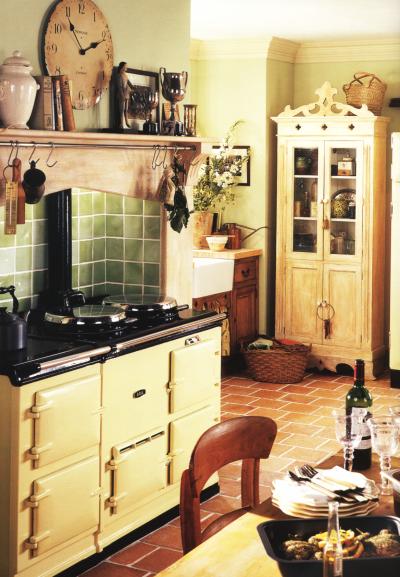
This is a photo of an Aga from MurphyHeating.com.
They were originally designed and built in Sweden in the early 20th century and became a hit in England from 1925 on. They are never turned off, which makes them an extra heater in the kitchens of chilly England and Northern Europe. Chefs love them; Jamie Oliver says, “I think the AGA makes people better cooks; they’re generally technically better cooks because they understand cooking.” Each AGA has at least three ovens — a roasting oven, a baking oven, and a slow-cook oven. Devotees say they take the place of toasters, slow cookers, tea pots, and clothes dryers. I’ve never seen a demonstration, but they surely are beautiful. Perhaps luvly is the better word.

They come in gas, propane, or electric and some of them have dual fuel options — electric oven, gas “hobs”. (Burners, for all of us Yankees!) This photo is from the AGA website.
Just look at this pistachio one! There’s also one in English Racing Green! and Aubergine! Each of the traditional cookers is hand made in England after it is ordered and then shipped to you in pieces and installed by the dealer. There are nine AGAs for sale on EBay right now, and they vary in price from $1050 to $12,250 — a little over budget no matter how cheaply we got the cabinets, the doors, and the windows — A girl can dream…
Earthy Walls and Paint Shadows
One of the pictures in the book that made me laugh out loud was a photo in the chapter called ‘House of Leather’. The house is 130 years old and “…Much of Matt and Jax’s work on the house consisted of stripping off layers of ancient paint and wallpaper, and they have left this wall unpainted like a mottled map, showing the history of the various colours and patterns that have decorated it in the last 130 years.” Can you imagine? Our cottage is about 65 years old, and we are complaining about scraping off four layers of paint and one of wallpaper… And this wall they left made it into a very elegant decorating book. I love it! I have walls like this! So now I know that we can just leave the walls in the bathroom.

Bathroom wall — looks like old Italian plaster, eh?
They are kind of swirly, yellow avocado and pink–definitely looks like old Italian plaster! Holes might be a problem, but then again, they can just be covered with wall art and towels, yes?

Paint shadows around this closet showed us the original moldings. That doesn’t mean we aren’t going to paint over the shadows though…
In a similar scenario, Botelet Farm is a third generation B&B in Cornwall. As son Richard was redoing an upstairs bedroom, he found a paint shadow of a mantle that his parents had removed when they were “modernizing” in the fifties. The old paint showed the details of what had been taken off. He wasn’t sure what to do with it, so it got left like that for a time. (My kind of reno!) After a while, he decided he liked it that way and just left it. We have those too! As a matter of fact, the paint shadows show how the trim over the doors and the windows used to be, and that has helped us decide how to do the trim around the doors. And look at our fireplace… The Cottage Book
The Farmhouse book was lots of fun — I loved many of the rooms and the general simplicity of most of them. The cottage rooms are less stark, but actually, just as shabby. Maybe more so. It just isn’t what I expected. This book is not about cozy, light-filled, chintz-covered cottages. There are saggy rocking chairs with torn upholstery; there are antique pieces with big varnish blotches front and center; and old upholstered chairs draped with scarves, quilts, and antique textiles. I should take comfort in this. I have shabby antiques and sagging rocking chairs. In fact, we are wondering how to make this look better:

That is NOT a varnish blotch on the drawer! (And the fake brick linoleum will soon be gone…)
I’ll be honest here: I don’t put stock in perfect things. But I would like the bottom of this kitchen island to look a little less shabby. (I think by the time we’re finished with it, it will.) If I had a lovely old cupboard with an unsightly varnish stain right in the front, I would fix it — no matter what it did to the ‘antique value’. And I can stand a lumpy rocker, but if photographers were coming to feature my home in a decorating book, I would get out my staple gun and staple up the hanging undergarments.
That’s not to say, I didn’t like any of the vignettes in the book — many of the rooms were charming with spectacular harvest tables, luvly painted kitchen “dressers”, and huge old stone and brick fireplaces. But I’ve got a decorating book for sale, half price…
(I’d like to show you some of the pretty rooms, but I don’t want to violate any copyright laws, and I’d be scanning the book to put up photos illegally. I actually requested permission from the publisher, but I am too impatient to wait for their answer. If they ever give me permission, I’ll repost this with photos of the charming spaces.)





 the circle of life