30. A Stillness in Time

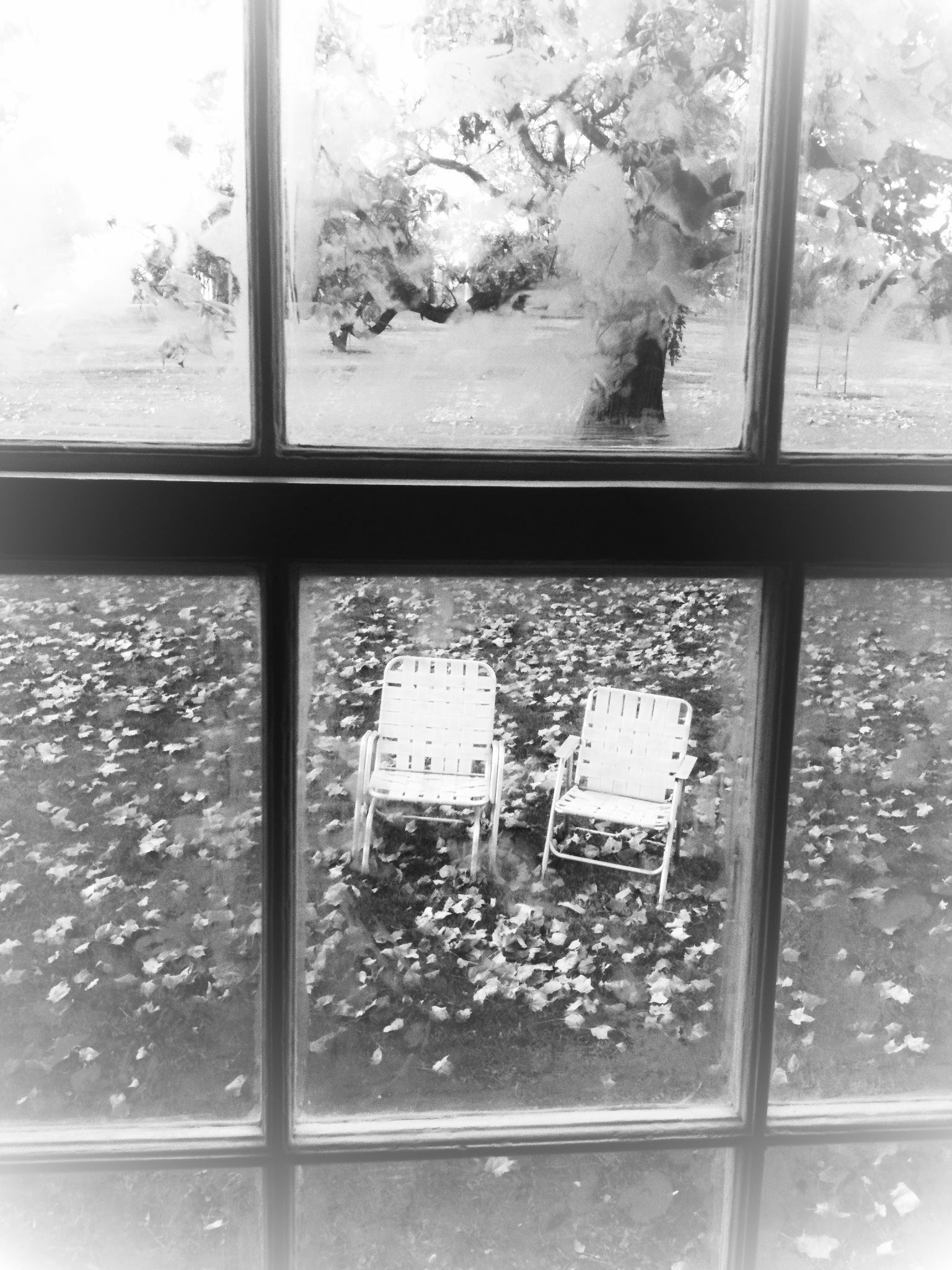
I’ve been experimenting with black and white photography these past two weeks. Perhaps it is a bit ironic that as autumn’s colors are at its most glorious, I’m choosing black and white. It could be that my camera can’t capture the beauty of fall; but I think it is more of a mood. I hear friends say how much they love fall and its coolness, but I miss the sun and the warm. The last gasp beauty of the bright, God-painted trees can’t make up for the gray, cold rain.

Is it just the absence of color that creates the different moods of black/white/gray photos? Is it the lack of color that makes the observer focus on form, line, and shape? What gives the dreamlike, still, unearthly qualities to black and white photography?
20121016-084816.jpg

As I was reading about the feelings that black & white photos evoke, one phrase keeps rumbling in my mind — that it creates a sense of stillness in time. Being here at the cottage does that for me as well, so the two have merged in this post. It is a stillness, a peace, a quietude that is not in my “other” life. It is almost as if time is standing still when we are here.

There is something else that a black and white photo implies — simplicity. I’m not sure why… Is it because it reminds us of a simpler time? Or is it that the colors don’t get in the way of what we see? Details and shadows all become clear, yet at the same time, shrouded in mystery…a metaphor for life, for God.

20121016-161026.jpg

Life is simplified here at the cottage: work and jobs are left behind; meetings and responsibilities are rare; we don’t have much technology, just our cell phones and a television to watch Steeler games. We are focused on here, today, now, and what we have to accomplish — our purpose, for now. To everything there is a season, and a time for every purpose under heaven.–Ecclesiastes 3:1.

20121016-162922.jpg

In Mere Christianity C.S. Lewis writes,

The moment you wake up each morning, all your wishes and hopes for the day rush at you like wild animals. And the first job each morning consists in shoving it all back; in listening to that other voice, taking that other point of view, letting that other, larger, stronger, quieter life come flowing in.

Simplicity,
Stillness of time,
Season of quiet,
Circle of life,
Listening to that other voice —
Black and white photos fit Apple Hill Cottage well.

(Don’t worry, I’ll be back to colors next week.)

29. Being Thankful for Failure Takes a Better Man than I

I don’t fail very often any more; and it certainly isn’t because I’m great at everything I do. No, it is much more because at age 59 and 11/12 I’m fairly aware of my limitations, and I stick to what I do well, or at least, what I’m pretty sure I won’t botch badly. I don’t try high diving or skateboarding or basketball; I don’t try to fix my own computer or my leaky roof; I don’t do my own taxes (although I’m tempted) or read Nature magazine. (What a misnomer that title is!)

But as the laborer at the cottage, I’ve been trying some new things, with a modicum of success. My confidence was up (inflated, even) until this past weekend.

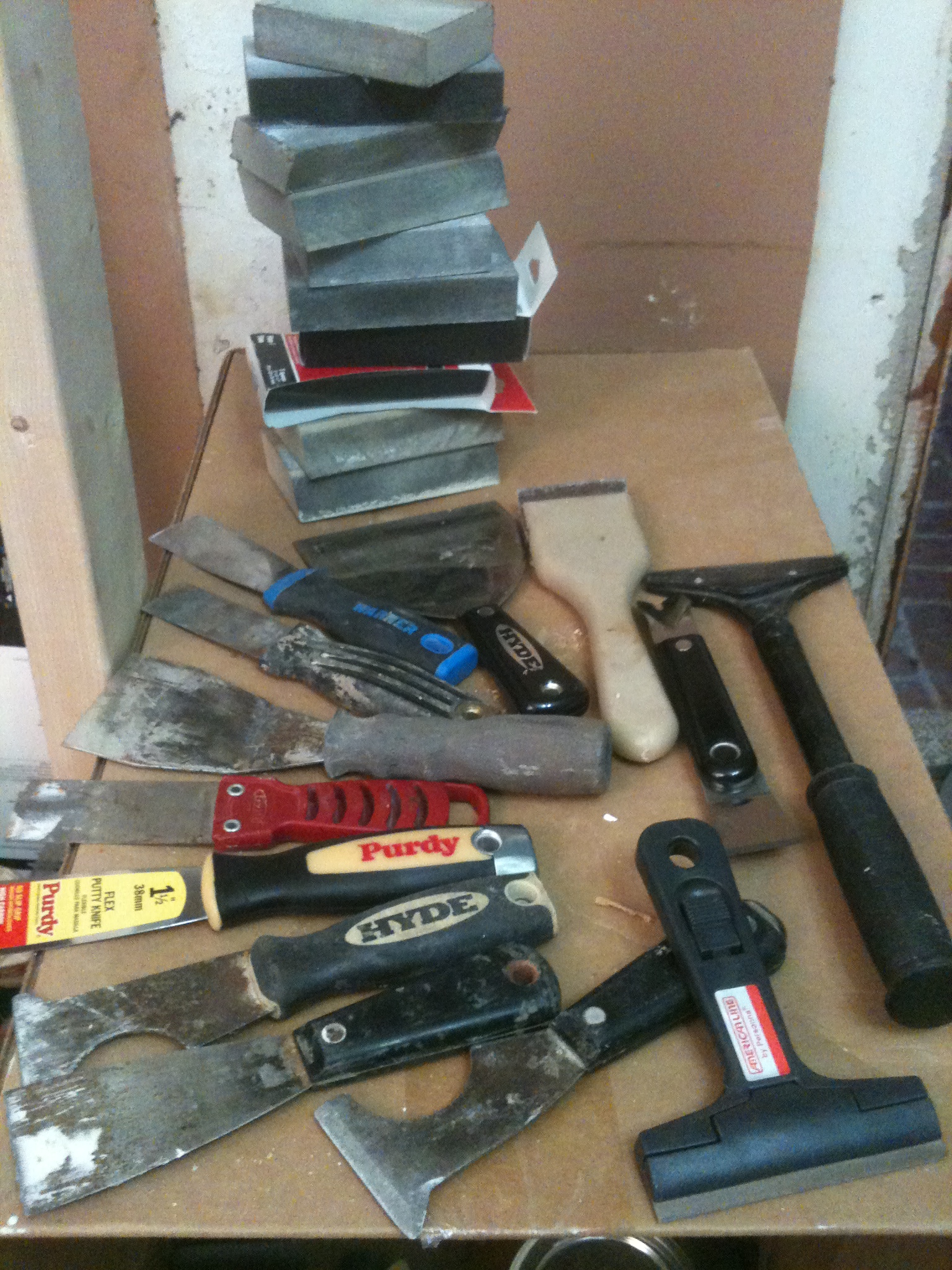
I’ve been sanding the old windows that will go above the kitchen sink. I took out the glass — pane by pain (no blood though) — scraped, sanded, and primed. Eventually it was time to replace the glass; the correct term is reglazing and there used to be people who did this as a profession. They were called glaziers. They have my utmost respect.

I was about to do a real DIY blog post entitled, “How to Reglaze your Old Wood Double Hung Windows.” Notice that is not the title of this post. I took lots of photos and even cleaned my fingernails. I had visions of About.com contacting me and asking me to do regular DIY posts.

You might be asking “Why would you be so sure you could do this?” A very good question! Here are some random answers:

  • I am fairly good at artistic endeavors: I can sew, knit, and scrapbook. I have made a couple of quilts. I can do passable graphics, and I’m really good at using scissors and coloring.
  • I am particular and neat about my final work, tending toward perfectionism. (This could have been a warning sign…)
  • I am very good at reading directions.
  • I nailed the first part of the glazing process.

I have about twelve good photos from that first part, which is called the back bead. In effect, it sets the glass in place and seals the inside. It is easy. You just make snakes of the glazing putty, push the glass in, put in the points to hold the glass, and scrape off the excess putty. Would you like to see my pictures???

This slideshow requires JavaScript.

I worked on the second part of the process, which is the outside of the window (I kept reminding myself it was the outside and hardly anyone would see it)  for two hours. This is one pane; there are 6 panes per window and 4 windows = 24 panes. I pulled up the snakes and started again at least three times. I angled the glazing tool 100 different ways. When Michael came in from his own window project and asked how it was going, I’m not sure I answered him. Yes. Juvenile. He took the glazing tool from my hand and said, “Well, let’s see…”

When the going gets tough, the tough go take a nap. Two hours of napping and the longest, hottest shower I could take, and Voila! Michael has the entire window finished.

Technically, I am delighted that he could do it, and it looks great. I am glad to have a talented husband. The thing is, I’m supposed to do the unskilled labor and leave the jobs that only he can do (and there are a lot of those!) for him. I was supposed to be able to do this… This is a lesson in humility.

Oh, I know that Dr. Seuss sent his first book in and it was rejected multiple times. Madeline L’Engle‘s book A Wrinkle in Time (which later won the Newbery Award) was rejected 29 times. It took Thomas Edison 10,000 times to get the filament right on his first light bulb…I KNOW ALL THAT! And these failure quotes that you are about to read — I’ve read them all a dozen times. They are platitudes: boring, insipid, and … true.

“There are no secrets to success. It is the result of preparation, hard work, and learning from failure.” — Colin Powell

“Failure is only the opportunity to begin again, only this time more wisely.” — Henry Ford

“I have not failed. I’ve just found 10,000 ways that won’t work.” — Thomas Edison

“All my successes have been built on my failures.” — Benjamin Disraeli

 “If you have made mistakes, even serious ones, there is always another chance for you. What we call failure is not the falling down, but the staying down.” — Mary Pickford

“Failure doesn’t mean you are a failure…it just means you haven’t succeeded yet. ” — Robert Schuller

“I’ve missed more than 9000 shots in my career. I’ve lost almost 300 games. Twenty-six times I’ve been trusted to take the game winning shot and missed. I’ve failed over and over and over again in my life. And that is why I succeed.” — Michael Jordan

and my personal favorite:

“Success is the ability to go from failure to failure without losing your enthusiasm.” — Winston Churchill

Yes, that’s what happened; I certainly lost my enthusiasm and never regained it.

The ironic thing is that we had just had a discussion about fear of failure in church the day before! God asked Moses to lead his people out of slavery, and Moses politely declined at first. “Send someone else, God. I’m not really good at what you want me to do…” We all fear failure, but as those quotes above point out, failure is always a lesson. It could be a lesson in hard work, or lack of preparation; it could be an opportunity for a second chance, or to encourage creativity and enthusiasm;  it could be a lesson in losing gracefully or developing patience; or it simply could be to learn humility.

Moses went to Pharaoh to ask for the people’s freedom. Seven times (at least) he went. Can you imagine what he was feeling that last time? “Oh no, Lord! Do I have to go again???” God chose Moses, so His strength would shine through Moses’ weaknesses and failures. Failure is not only all those lessons above; it is a God-given gift! So we won’t live proud. So we can be thankful for those failures.

I’ve got three more windows to work on. I will certainly do the inside seal, but I’m not sure if I’ll try the outside bead of putty again. Perhaps I just need to practice…or perhaps it is a skill I won’t ever master. I need to know for sure, though, don’t I?

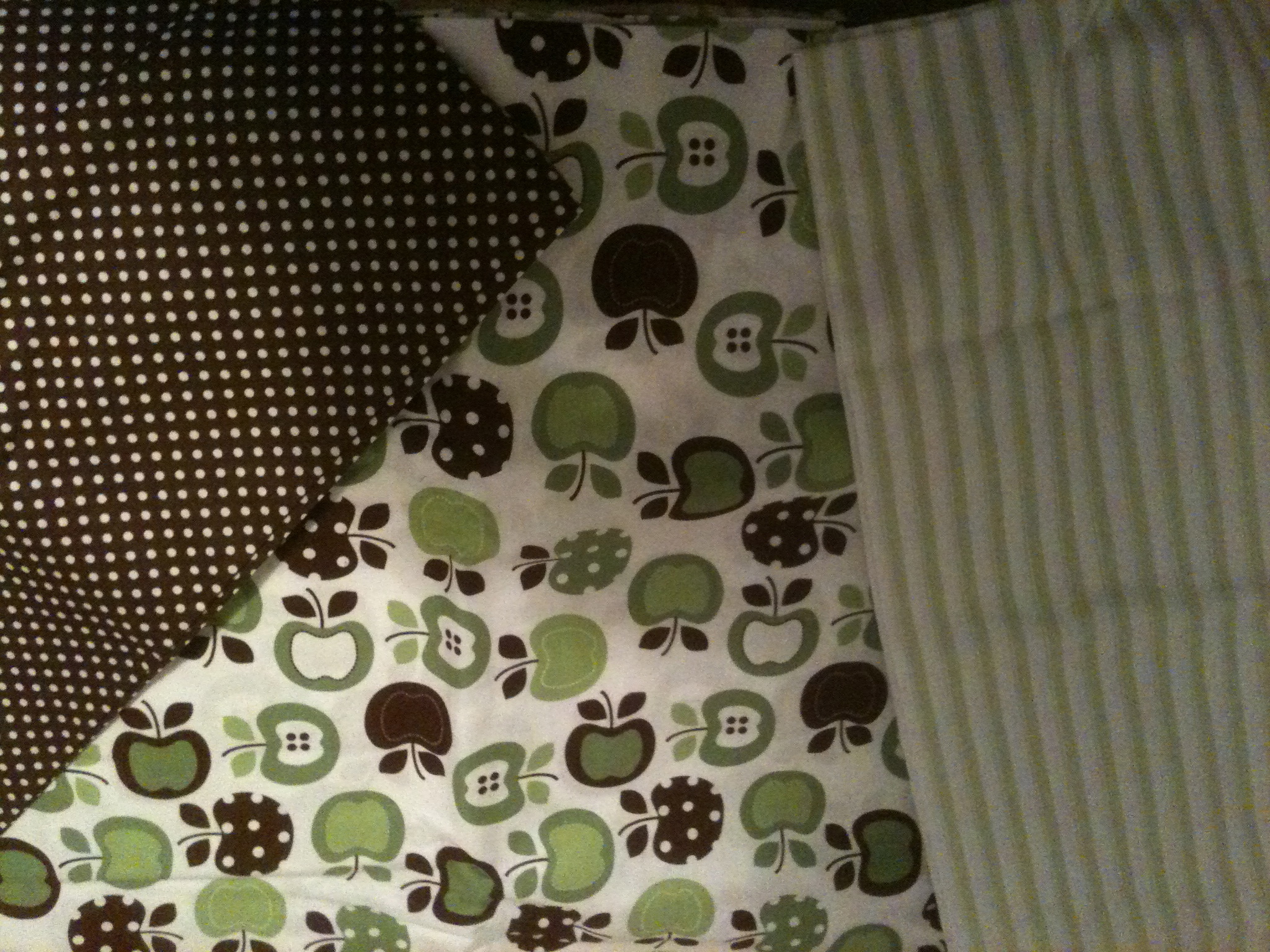
In the meantime, I’m sewing some shelf liners from this great apple fabric I ordered. No fear of failure with this project!
Apple fabric

24. Charlotte’s Lot

We’ve been watching Charlotte on our porch for the last three weeks.

She’s been there. Spinning and waiting, waiting and spinning; I could learn patience from her.

She hasn’t moved more than an inch or two in all these days, unless she goes off dancing midweek and then comes back on weekends to pretend that she hasn’t gone anywhere.

She does her spinning and waiting on the porch, very close to the steps. Her spot is protected, although she faces north and when it’s windy, she certainly rides the north winds fairly well. You can see that she isn’t a very good writer yet — or perhaps “It is quite possible that …(she) has spoken civilly to me and that I didn’t catch the remark because I wasn’t paying attention…”

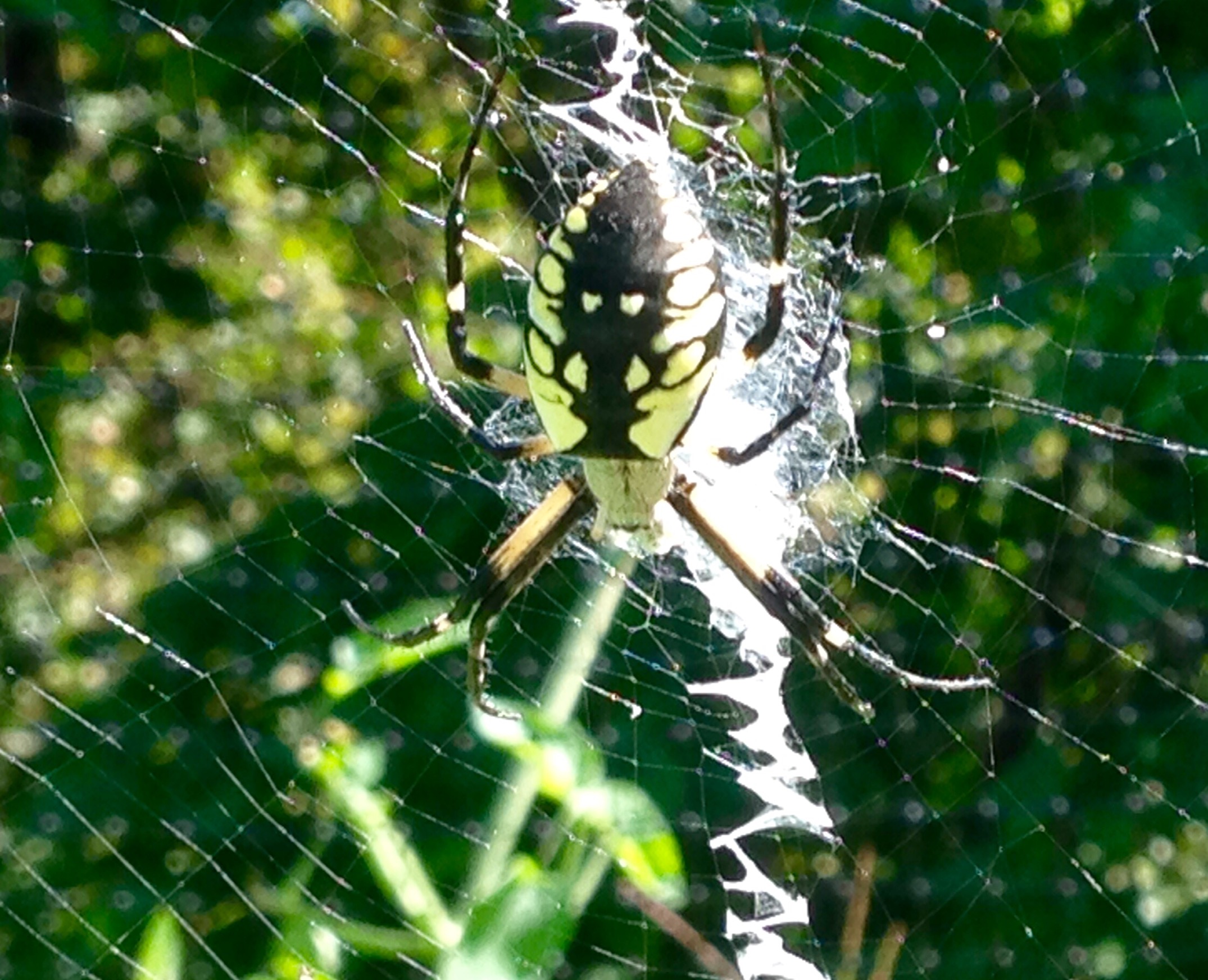
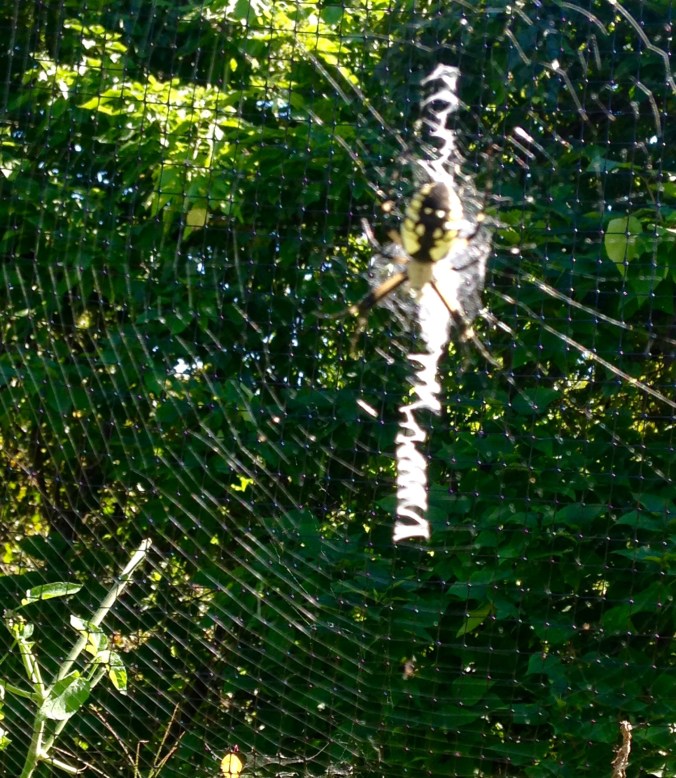
The first time we met her, we I was not expecting a friend. In fact, I considered, uh, getting rid of her somehow. But the more I thought about it, the more I liked the idea of knowing where she was — right there on the porch by the steps in plain sight. She is an ordinary black and yellow garden spider (argiope aurantia), but neither of us think she is ordinary at all.


Michael started throwing her bugs last weekend. She doesn’t act grateful, but how do I know what grateful is for a spider? I do wonder if she wonders why she gets all these good treats on the weekend. She won’t bother with stink bugs though; apparently no one likes stink bugs.

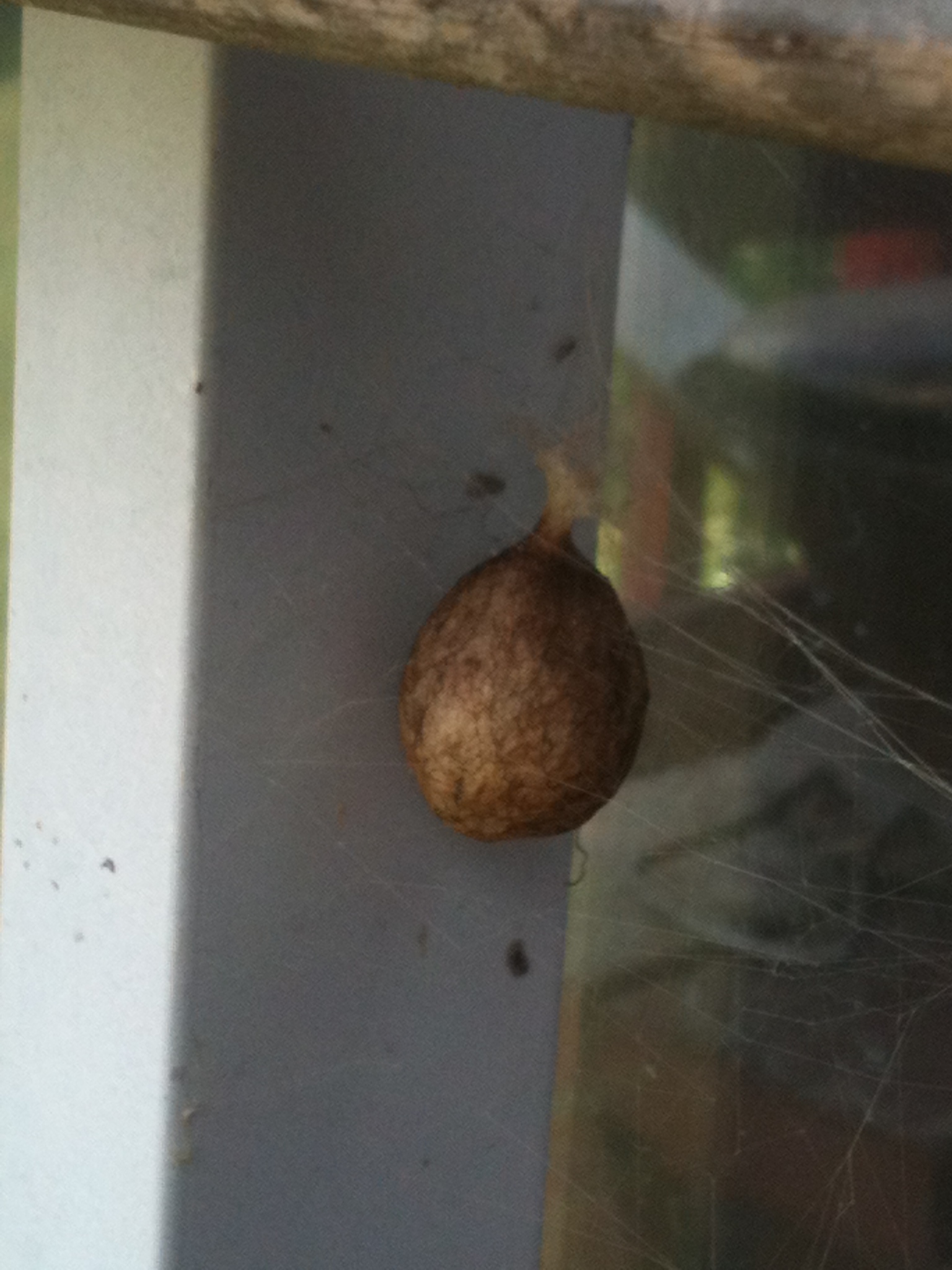
This weekend, overnight, a little something appeared in the top corner of her domain. At first look, we thought it was just a big, rolled up treat, saved for winter.
But then I remembered the real Charlotte, her namesake, and realized:  Of course, it is her egg sac, filled with hundreds thousands of tiny spiders. More potential friends! If only they ate stink bugs…

I’ve looked it up, and I know that once Charlotte has laid her egg sac, she will die. But her children will hatch and stay in the egg sac until spring. At first I thought that maybe we could move them to a nicer spot for the winter? (Away from the house!) But baby spiders fly away on little balloon strings — the real Charlotte called her relatives aeronauts — so perhaps that isn’t necessary and they will fly away on their own?
Charlotte and her children eat lots of nasty insects — aphids, flies, mosquitoes and the like — and they hardly bite friendly humans at all. Especially ones who throw them food…

I don’t remember reading Charlotte’s Web as a child. But I do remember reading it out loud with my children. When we finished the book, I closed my eyes and thought, ‘that’s the perfect book.’ A young, runty, good-for-nothin’ pig is saved twice by friends: the first time by Fern, a young girl who is trying to “rid the world of injustice”; and the second time by a spider whose life was a mess, but who told Wilbur that “…by helping you, perhaps I was just trying to lift up my life a trifle. Heaven knows anyone’s life can stand a little of that.”

English: BLACK & YELLOW GARDEN SPIDER. RAINY D...

This crisp, clear picture of a black and yellow garden spider was not taken by me, although this is the first time I’ve put in someone else’s photo. I just wanted you to see how lovely they really are! (Photo credit: Wikipedia)

I’ve been re-reading G.K. Chesterton‘s essay on fairy tales, “The Ethics of Elfland” in Orthodoxy.  This essay is deep and complex, and I have to go back and re-read every single paragraph to get it — and even then I can’t say I get it. There could be a month’s worth of posts just on this essay, and I won’t go into detail except to say that everyone should read it. Janey Cheney from Redeemed Reader summarized it like this: “…Here’s what he learned from generic, plot-driven, ages-old fairy tales: 1) The world is magical; 2) the world is meaningful; 3) the world is beautiful; 4) the world is worth our gratitude; 5) the world is to be cherished.”
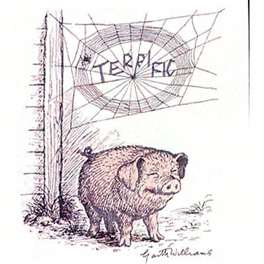
I would add that these truths are not just descriptive of fairy tales, but any story, written or told, lived or loved, true or not. E.B. White knew it. The words Charlotte wove in her web to describe her friend Wilbur were: Some Pig; Terrific; Radiant; and  Humble — all words of love between friends. All words that describe magic, meaning, beauty, and gratefulness. And when Charlotte wrote those words about Wilbur, he became what she wrote about him.

I’ve rambled a long way from Charlotte appearing on the corner of our porch — a seemingly insignificant trifle (and one that truthfully didn’t thrill me at first) — but this much has been made clear once again:  As busy adults we forget the magic, the miracles, the beauty that are all around us. In the middle of the book, the wise Dr. Dorian tells Fern’s worried mother, “Children pay better attention than grownups.” That is also his quote at the beginning of this post — Fern’s mother asks him if he really believes that animals talk — and he replies that they very well could have spoken to him, he just wasn’t listening.

So listen. Be childlike. Turn off whatever needs turning off and  hear the quiet. Be thankful for the ordinary. Cherish the mundane. Be grateful for the spectacular. Don’t miss a miracle because you weren’t paying attention.

(Thanks to Janie Cheaney from Redeemed Reader on the post The Invasion of Fairyland — it sent me back to re-read Chesterton’s essay.) All other quotes are from one of the best children’s books of all time, “Charlotte’s Web” by E.B. White.  And I have to include the last lines — “It is not often that someone comes along who is a true friend and a good writer. Charlotte was both.”