The DIY era is generally considered a good thing, right? In this age of instant how-to information, anyone can do anything.
And lately I’ve been wondering if that is a good thing.
I’ve had lots of time to think on this. In fixing up two old houses, Mr. H. C. and I have also been fixing other peoples mistakes. And all the time I’m thinking, ‘If you couldn’t do it right, you should have called a professional!’
The running joke at the cottage is that it was wired by Joe’s Electric. And we laugh and say its a good thing Joe was Mr. H. C.’s dad, otherwise he would come in for a lot of criticism.
Here at the city house we aren’t related to the painting crew that was here before we bought the house; consequently, the former owner has definitely been criticized. Several times. The painting crew must have been made up of ten year olds — nothing against ten year olds — and much of the other work done on the house was slipshod as well. But since I’m doing the painting, that’s what I’m noticing.
Whoever painted the basement took a giant brush and five gallons of gray latex basement paint and slopped it over everything. Door knobs. Door hinges. Metal floor drains. Electrical outlets and the covers. The lock and chain on the door. Not to mention the concrete floor.
There are slops, drips, and globs everywhere. Bristles from the brush left in the dried paint. Corners of trim left unpainted because it was, well, hard. And suddenly, it is my issue. If I just paint over the mess, now I’ve become the sloppy painter that I’m criticizing. And frankly? I don’t want the next owner complaining about me and my workmanship.
- Any DIY-er knows to take off door hardware when the door is painted. Don’t they?
- Any DIY-er knows to never use latex paint on metal. Don’t they?
- Any DIY-er knows not to use oil-based paint on top of something already painted in latex. Don’t they?
- Any DIY-er knows to take stray bristles out of the wet paint before it dries. Don’t they?
This is what worries me. What if the DIY trend is just acceptable mediocrity under the guise of pride in accomplishment?
I’m a DIY-er from way back — I helped build my first house starting in 1978, before the first Home Depot even opened its doors — so I’m including myself in this. In the interest of saving money, or pride in accomplishment, or whatever else drives us to do it ourselves, are we accepting a lesser quality than hiring someone who knows how to do it really well?
A few weeks back a blogger posted a photo of a coffee table she had painted. It looked lovely, though the photo was taken outside and there were shadows on the table. A professional furniture painter commented (very rudely) that regular people should not take on projects they can’t do.
Rudeness and Inappropriateness aside, I get what he meant. He is a professional who has honed his skill for many years and is trying to make money at it. And here come the amateurs saying Hey. We can do that! Let’s just buy some chalk paint. Or better yet, let’s make our own…

My chalk-painted chairs, $5 each from St. Vinnie’s, and painted with DIY chalk paint.
I’ve done it. In fact, I do it all the time. Why should I pay someone else money when I might be able to do it?
Do you think it might be part of our national character? After all, most all Americans came here from somewhere else because someone we’re related to thought they could do better themselves.
But I digress.
As a recovering perfectionist (and married to one who is not yet recovered) I suggest that if a thing is worth doing yourself, it’s worth doing well.
Mr. H. C. is a professional who has been called in many times to rescue homeowners who got in over their heads. And I think it’s great that they had the humility to admit they couldn’t do it. I wish the former owner of our city house had called in some professionals.
When Mr. H. C. considers doing something sub-standard, he usually says, “No, it’s against my morals to do that.” I always usually smile when he says that, because, really? That’s the way everyone should work all the time. No matter what you are being paid, no matter who you are doing the work for, no matter how much (or how little) time you have to do the project. It should be “against our morals” to do sub-standard or sloppy or careless work.
If not for yourself, at least for the people who come after you, who have to fix your mistakes…

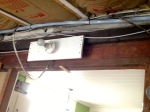

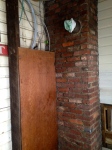
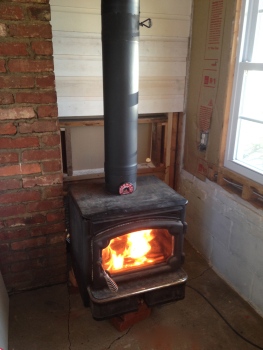 Mr. H.C. was just itching to get the wood stove hooked up into that chimney, but the contractor guy in him couldn’t bear to pay someone else big bucks for something he thought he could do. So we ordered chimney liners online from
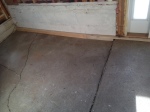
 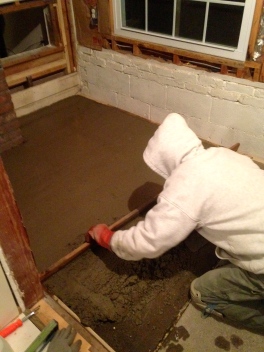 We had planned to put down concrete over concrete to level the floor and then some concrete board over the concrete to keep any cracks from showing up in a couple of years. But the cement board idea didn’t work, so we just laid a new layer of concrete. The laying/grouting/sealing of the tile did not go smoothly; I won’t go into details, but it certainly looks beautiful to us. (Did I mention we chose to do this project during the coldest week of the winter?)
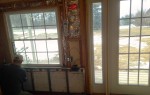
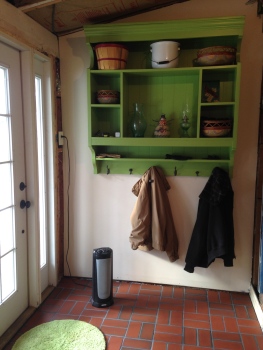 One wall is finished with an old pine hutch top that has been repainted and repurposed into a mudroom staple — shelves and hooks for jackets. I painted it Blooming Grove green to bring the kitchen color out into the adjoining mudroom. The walls behind the wood stove are now covered in metal studs and Hardiebacker board (fire-resistant for the walls next to the wood stove) and some sort of tile will go over it. Soapstone is the material of choice, but $$$ matter. We’ve gone shopping at the big box stores and found nothing of interest, and we’ve had a long dry spell at our favorite Restores.


 the circle of life