Tikkun Olam: where would i begin?

Just this morning my Bible reading brought me to chapter one of 1 Peter, where two verses jumped out at me: Be holy because He is holy (1:16) and …love one another deeply, from the heart. (1:22) They loomed large because they feel so impossible for me these days. I confess to having difficulty in loving my neighbor–and I use the word neighbor loosely. Kind of like asking Jesus, Who is my neighbor? and getting the reply that you know, but you don’t want to hear… What! Those people who call themselves Christians, yet still voted for Trump? They are my neighbors? Yes. That’s really how I feel… (And that is, realistically, almost half this country???)

My ruminations led me to remember the book  Adopted by Kelley Nikondeha;  so I pulled it from my bookshelf and started paging through it again, a couple of years later, in this time of Covid-19 and anger and racial division and conspiracy theories and chaos.

It didn’t take long to find the chapter I remembered, “Repair.” She writes about a Jewish term, tikkun olam, which means “repair of the world.”  Tikkun olam calls us to do what we can to sacrificially act for the good of our neighbors, even if those neighbors might be our enemies. Even if those neighbors are belligerent about mask wearing; even if those neighbors have a nasty-language-sign in their yard; even if they somehow think the person in the White House is good for the country. How can I love them when I think what they believe is abhorrent? (For a Jewish discussion on the concept, you might enjoy this article from My Jewish Learning.)

Nikondeha then relates several stories of the Batwa tribe in Rwanda who, when faced with having their harvest of carrots stolen from their neighbors, gave them potatoes too. When they were falsely accused of stealing cabbages, they gave twice as many cabbages back. Can you hear in these stories of one of the most difficult messages from Jesus:

…But I tell you, Do not resist an evil person. If someone strikes you on the right cheek, turn to him the other also. And if someone wants to sue you and take your tunic, let him have your cloak as well. — Matthew 5:39-40

Perhaps we ignore this instruction because it is just too difficult to wrap our heads and hearts around? There are many difficult “red-letter” passages in the New Testament, but none so absolutely unachievable as this one. Don’t fight back, instead say yes, here, hit me again. Someone is suing you for $5,000? Give them $10,000. Your neighbor’s car just died? Give them your second car that you just finished paying off. Forgive the person who treated you so grievously a few years ago that you haven’t spoken to each other since. Wait; don’t just forgive them, invite them to a luxurious feast at your house…

It’s radical, this concept of tikkun olam. But just think of what needs repairing in this world. More accurately, in our own small worlds–our families and our communities.

I suggest that another reason we ignore the reparations that we need to make is because they are SO HUGE as to be daunting. This is not only Love your Neighbor (which is hard enough!) but this is Love your Enemy. How can we do this? Where could we start? The poet philosopher Lao Tzu wrote, “The journey of a thousand miles begins with one step.”

Yes, this is the road right outside my door…

Jesus’ version of this thought is recorded in the gospels of Luke and Matthew–the parable of the mustard seed: “For truly I say to you, if you have faith like a grain of mustard seed, you will say to this mountain, ‘Move from here to there,’ and it will move, and nothing will be impossible for you.” (Matthew 17:20) ESV

Although probably no one actually stole your carrot or cabbage crops, it is likely that someone stole your political yard sign. Or it is likely that your neighbor (or family member) voted for the other side. I suggest that to repair America, we need to take that first step toward tikkun olam. And the road begins right outside our door…


thirty biblical reasons to vote democratic in 2020: #13 Pro-life?

“In the same way, let your light shine before others, so that they may see your good deeds and give glory to your Father in heaven.” — Matthew 5:16 (NRSV)

“And I will give you a new heart, and a new spirit I will put within you. And I will remove the heart of stone from your flesh and give you a heart of flesh.” — Ezekiel 36:26 (ESV)

Painting by Leah Saulnier, The Painting Maniac

So there’s an elephant here in the room. A reader asked about it a few days ago, and I said I would get to it. So here’s the elephant (an appropriate metaphor for the GOP, yes?)

Most Christians who vote for Trump are voting for him because of one issue: abortion. I have thought long and deep about this issue. My sweet husband would not be here if his 17-year-old-unmarried mother had not chosen, at great personal cost, to give him life and adoptive parents. On the other hand, I did not become a believer until I was in my forties–too late to prevent the abortion I had in my twenties. I know that I am forgiven for that sin, but it still does not wipe away the grief and sadness I feel today for that lost child. I understand the passion of those who are pro-life because I am too.  I used to be a one-issue voter but not any longer. So here are some thoughts*:

    • Abortion has been with us forever. Laws about it will not make it go away. Laws did not keep God’s people in the Old Testament from breaking them. What makes us think that our laws are any different?
    • God’s laws are meant for believers. It is a sin for a believer to have an abortion, yes; but not everyone who lives in this country is a Christian who believes that God has made all life sacred. Can we force our laws and beliefs on them? What this really tells me is that we Christians have failed. God calls us to love people, to tell them about Jesus, and when they accept Him, God gives them a new spirit; they need to believe abortion is killing a child before it becomes a sin to them. It is actually easier for us to say, ‘Let’s make a law against it’ rather than try to witness Christ to them.
    • Pro-life means more than protecting life in the womb. Pro-life means supporting families and not tearing them apart in immigration camps. Pro-life means supporting poor women who simply can’t afford to lose the job they just got and will have to give up because they are pregnant. Pro-life means being pro-people of color who live in the hard section of town. Pro-life means not ending health insurance plans for those who can’t afford it. Pro-life is against the death penalty and assault rifles. Pro-life means being supportive of mental health treatment and addiction programs, and prisoner re-training programs…Dr. Lodovico Balducci, an M.D., writes in his article, “Why I’m pro-life but not pro-Trump”  why pro-life means more than the abortion debate:

Under our American brand of capitalism, human life has become a commercial good that can be disposed of when it ceases to serve the prevailing power. If you doubt that, look at the administration’s willingness to sacrifice the lives of the poor, the front-line workers and the aged during this pandemic to “open up the economy.”

  • Can we overlook all the other “abominations” of this president’s policies and character in favor of one issue?
  • Our founders and writers of the constitution guaranteed us freedom of religion. That means freedom for Christians, freedom for Jews, freedom for Muslims, freedom for Hindus, freedom for atheists… We cannot codify Christian moral laws as the absolute. We can do our best to follow those laws, and we should do our best to witness to others, so they also can live in the freedom of grace and truth that we have. But we cannot legislate Christian laws in a plural society.  Instead of trying to force our Christian values on those who don’t believe (which makes us look like morality police) we should let our lights shine before others, so they can see our good deeds, and our joy, and want what we have… (See Matthew 5:16 above.)
  • As Christians, we are not to judge unbelievers, only our brothers and sisters in Christ. For what have I to do with judging outsiders? Is it not those inside the church whom you are to judge?1 Corinthians 5:12 (ESV) That’s why we get called hypocrites all the time. If we spent more time loving people into the kingdom instead of judging their behaviors, the world might be knocking down our church doors to get in.

This post is longer than usual, and I hope that if you have even the smallest doubt about casting your vote for the current president — if you are that one-issue voter — then this will encourage you to look into his policies more closely. Stephanie Krider resigned her post as Executive Director of Ohio Right to Life because she could not support his reelection. She said, ” I can’t look at any of his behavior and see evidence of the Holy Spirit in his life. Nothing about his words or actions are kind or gentle or faithful or full of self-control.”

We aren’t to judge his actions by the same standards as ours because he obviously is not a believer. But we can sure as heck vote him out of office…

*These are my thoughts, and if you’ve read this far, I hope you can tell that I’ve struggled with this issue, and what I’ve written down is my humble attempt to get readers to think about it too. Just today I heard Republican pro-life former governor John Kasich say that he is voting for Joe Biden because at this moment in time we have to be Americans first. That Joe Biden is reasonable. He listens. He is good at reaching out to everyone. He just might be a peacemaker. And this country needs that now more than anything.

The unexpected, unwanted lesson — Learning and letting go

This is a sermon I’ve been writing to myself. It may not apply to you. Just saying…

Silly me. I thought at my advanced age, lessons in life were already learned. I’m old enough now to be the one offering sage advice rather than stressing over just what this lesson is supposed to teach me.

I know better than that really. The road we travel is never guaranteed to be smooth no matter how new or old your vehicle, no matter what season. It is the season of potholes after all.

And the journey we’re on is always guaranteed to teach us something–if only we pay attention to the curves. Interstates are boring after all.

But this one — it was tough. I was blindsided by it and maybe still haven’t recovered. So I’m writing my way through it and trying to see it through a mirror of objectivity, which might be an impossibility since mirrors are reflections of what we ourselves see.

I try to believe the best of everyone. I try to be kind, and in turn, I think others should be kind. I try to deal with those who aren’t on a limited basis. Life is too short to be bothered by unkind people, don’t you think?

In February I took an online writing course. I was looking forward to it and eagerly did the first few assignments. And then…

The instructor sent me back a detailed critique. I wanted critique. Tell me that the scene didn’t work because the dialogue was unrealistic; tell me that there was too much description, not enough description, whatever specific critical analysis you’ve got. But don’t say general ugly words. When I read them, I was stunned. They had no purpose except to insult. I read them again. I was not only astonished that an instructor would write such things to a student, I was crushed.

eat your wordsI know that I should not care what some unknown person wrote to me under the guise of criticism. But I did.

Suddenly I doubted whether I should even be writing. I had been praying for answers as to whether I should continue writing this already-overlong piece of fiction; perhaps this was the answer? I put down my pen and unplugged my keyboard. I didn’t open WordPress. I didn’t open Scrivener. Instead of writing on a blog, a fiction project, and a non-fiction project, I wrote nothing.

And during this six weeks of quiet, I rediscovered that I do need to write. The writing may never turn into a novel. It may never be published. Yet whatever our creative outlets are–writing, art, music, storytelling, sewing, gardening, woodworking–they are neglected at peril to our own well-being.

I have been trying to banish the fear and ugliness that instructor dumped on me. I don’t know why the words were so unpleasant, but I have used prayer to try to forget them.  It isn’t easy for me to let things go; I’m a dweller. I dwell on what I should abandon and leave behind. Conveniently, the sermons at church these past few weeks have been walking us through the book of James, and I have listened with my heart to his apt words:

Consider it pure joy my brothers and sisters, whenever you face trials of many kinds, because you know the testing of your faith develops perseverance. Let perseverance finish its work so that you may be mature and complete, not lacking anything.  –James 1:2-4 (NIV)

Trials of many kinds. That means trials of all sizes and extents — from the huge life-altering events to the smaller every-day grouches that throw off one’s plans for the hour, day, or week. And please note what perseverance does — it makes us mature and complete, not lacking anything. What would be without trials?  Spoiled children, selfish and demanding, lacking character and wisdom. In just a few more verses, James tells us what will happen when we do persevere:

Blessed is the one who perseveres under trial because, having stood the test, that person will receive the crown of life that the Lord has promised to those who love him. — James 1:12 (NIV)

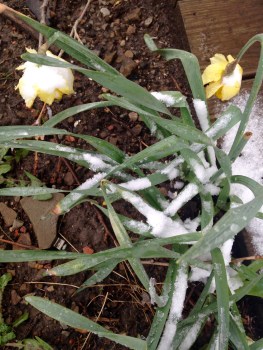
Having passed the test by not giving up, brings us God’s approval; not necessarily human approval, because human approval passes away with the seasons. It’s your fifteen minutes of fame, and pretty much only serves your pride; God’s view of our perseverance is like snow on daffodils– they droop in the snow, but when the sun comes out they stand taller and appear more golden than ever before. (Yes, there’s been a lot of snow on daffodils around here lately.)

That brings me to human approval. I’m guilty of wanting it. I’m guilty of being very unhappy when there is discord between humans I am close to. Heck, I’m even guilty of disliking it when people I don’t like dislike me. Or something I’ve done. Or something I’ve written.

But we can’t allow meanness or unkindness to win, and by dwelling on it, or taking it too seriously, we allow it too much power over our lives. By listening to churlish words, I allowed my own confidence to be shaken. I gave those words power.

Yet the truth is that words do have power, and if we read further in the book of James, he tells us that:

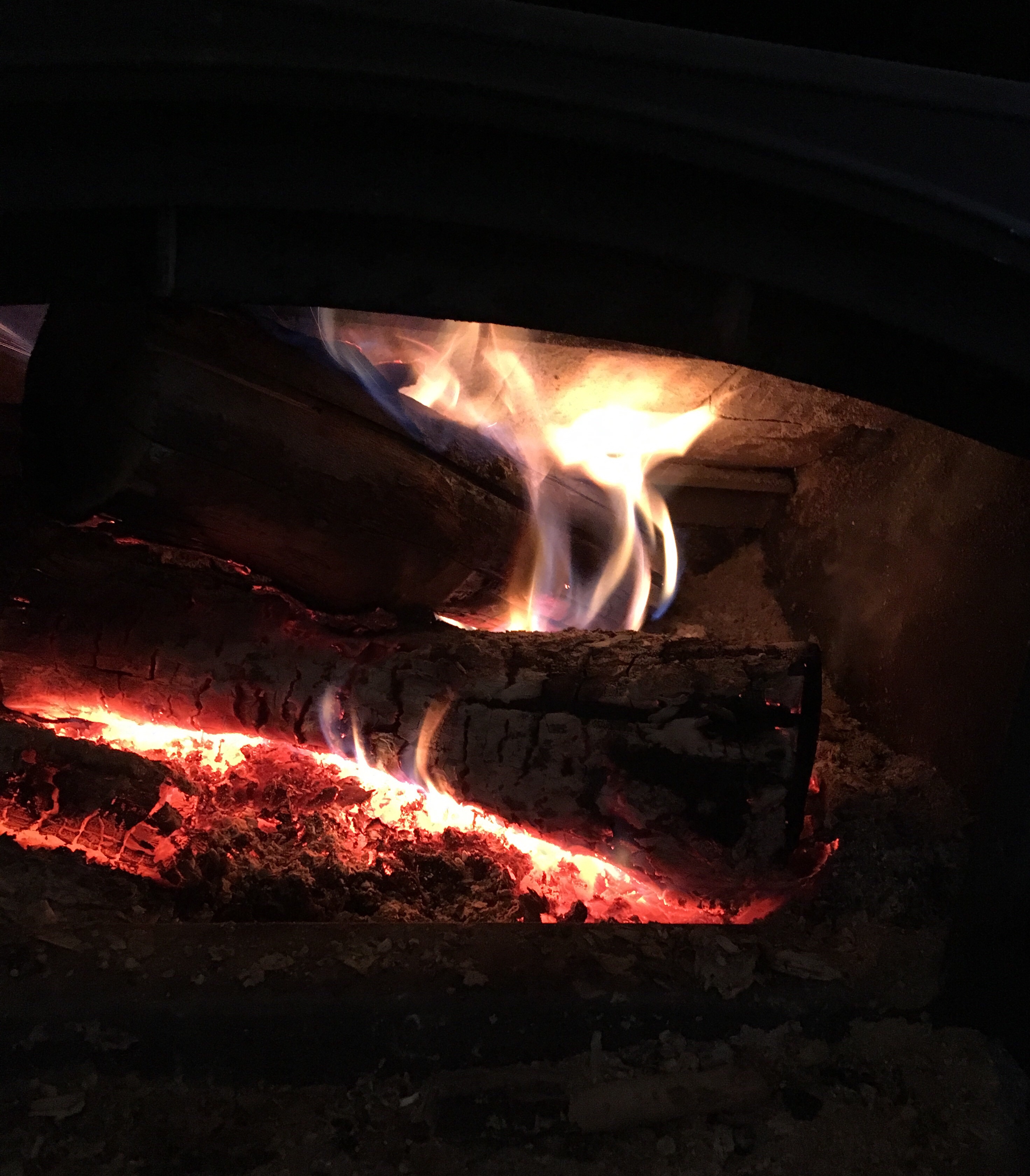
the tongue is a small part of the body, but it makes great boasts. Consider what a great forest is set on fire by a small spark.The tongue also is a fire, a world of evil among the parts of the body. It corrupts the whole body, sets the whole course of one’s life on fire, and is itself set on fire by hell. All kinds of animals, birds, reptiles and sea creatures are being tamed and have been tamed by mankind, but no human being can tame the tongue. It is a restless evil, full of deadly poison. — James 3:5-8 (NIV)

James doesn’t mince words. Our tongues are small, but vile, and cannot be controlled; he compares our tongues to a fire that can set the entire forest ablaze. We’ve all set wildfires with words; just because I was on the burnt end this time, doesn’t mean I can forget the times when I lit the match.

There are several lessons here.

1) Don’t let others’ words or actions derail you from your own goals or make you lose confidence. Be not afraid.

2) Don’t dwell on it; move on. Know that your perseverance will bring you maturity and strength.

3) Aim to please God, not humans. Forgive the imperfect humans that surround you, for you too, are imperfect.

4) There will always be curves ahead and potholes in the road, no matter what season. This journey is a pilgrimage and the way we travel is the substance of our lives. The words we say, the kindnesses we do, the love we show–that’s what counts. Those potholes will always be there — the significance is in how we deal with them.

5) Pray. We aren’t meant to drive off into the sunset alone.