the lazy person’s guide to growing spinach

Plant seed in the early days of lovely September
when you need a break from canning tomatoes.

Pinch off baby leaves in October, November, December
Stir them with lemon in buttered potatoes.

Mulch with straw and hope for a mild winter.

I have tons of favorite spinach recipes. I was the kid in elementary school who took everyone’s spinach. Remember in 3rd grade when you had to clean your plate and Mrs. Gray checked every tray to make sure it was empty of food? Hmm…. that might be proof that I’m old….

I would rather eat spanakopita than brownies.

I’m a sucker for any meal that ends in Florentine.

When forced to buy greens, whether for cooking or salads, I always choose spinach, because, raw or cooked, chopped or whole, in eggs, on sandwiches, in dips, or just sautéed with onions or mushrooms… It’s always delicious.

But the curly Bloomsdale spinach that you can only get these days by growing your own is far superior to grocery store flat-leaved spinach.

Tonight we are just having it sautéed in olive oil and drizzled with lemon saba and salt and pepper. Simplicity at its finest.
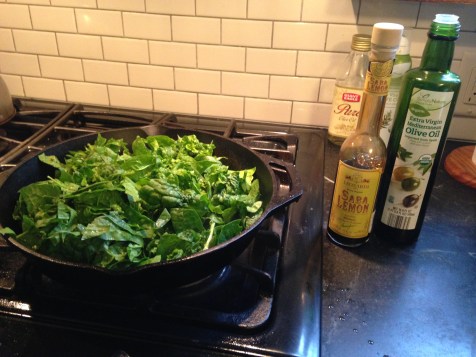
But since you already know how to sauté spinach, I will give you one of my favorite easy recipes to take along somewhere. A potluck, a mom who just had a baby, or an easy meal for everyday — company or not. The next time I make it I’ll be sure to come back and post some pictures; in the meantime you’ll just have to take my word for it: it’s one of the best most hassle-free dinners you can make. Here’s what you need:

  • Spinach
  • Chicken, boneless (I cut boneless breasts in half, thighs I leave whole)
  • some tomatoes (The real recipe calls for sliced Romas, but I have halved cherry tomatoes, sliced regular tomatoes, and even reconstituted and chopped dried tomatoes)
  • your favorite kind of vinaigrette or Italian dressing — not Ranch!
  • parmesan cheese

Fill a 9×13 baking dish with spinach (one bag usually works).

Place chicken pieces on top of spinach. Place tomato slices on top of chicken. Pour some vinaigrette over the whole thing. (The original recipe called for a bottle of dressing, but I never use that much. Just make sure the chicken is nicely slathered  with the vinaigrette.) Sprinkle grated fresh parmesan cheese over all. Cover with aluminum foil and bake at 375 until the chicken is done. Uncover it for the last 5 minutes to brown up the cheese a bit. Depending on the size of the chicken cooking times vary — smaller pieces take less time to cook. (Mine usually takes 30-40 minutes, but I always use a meat thermometer to be sure.)

While the chicken is baking, make some rice or cook some pasta or egg noodles because it makes its own lovely sauce that is yummy over rice.

And just in case you get the wrong opinion from this post, I am not a master gardener. I have done Absolutely Nothing in the garden yet this spring, except pick some kale and pick some spinach, and throw in some radish seeds on an 80 degree day in February… Potatoes? Not planted. Onions? Still in bags. Greens? Still in the seed packets. Partly I can blame the rainy weather: we still have a small pond where the onions are supposed to grow. But I got my bales of mulch today, and I’m ready. As soon as it stops raining…
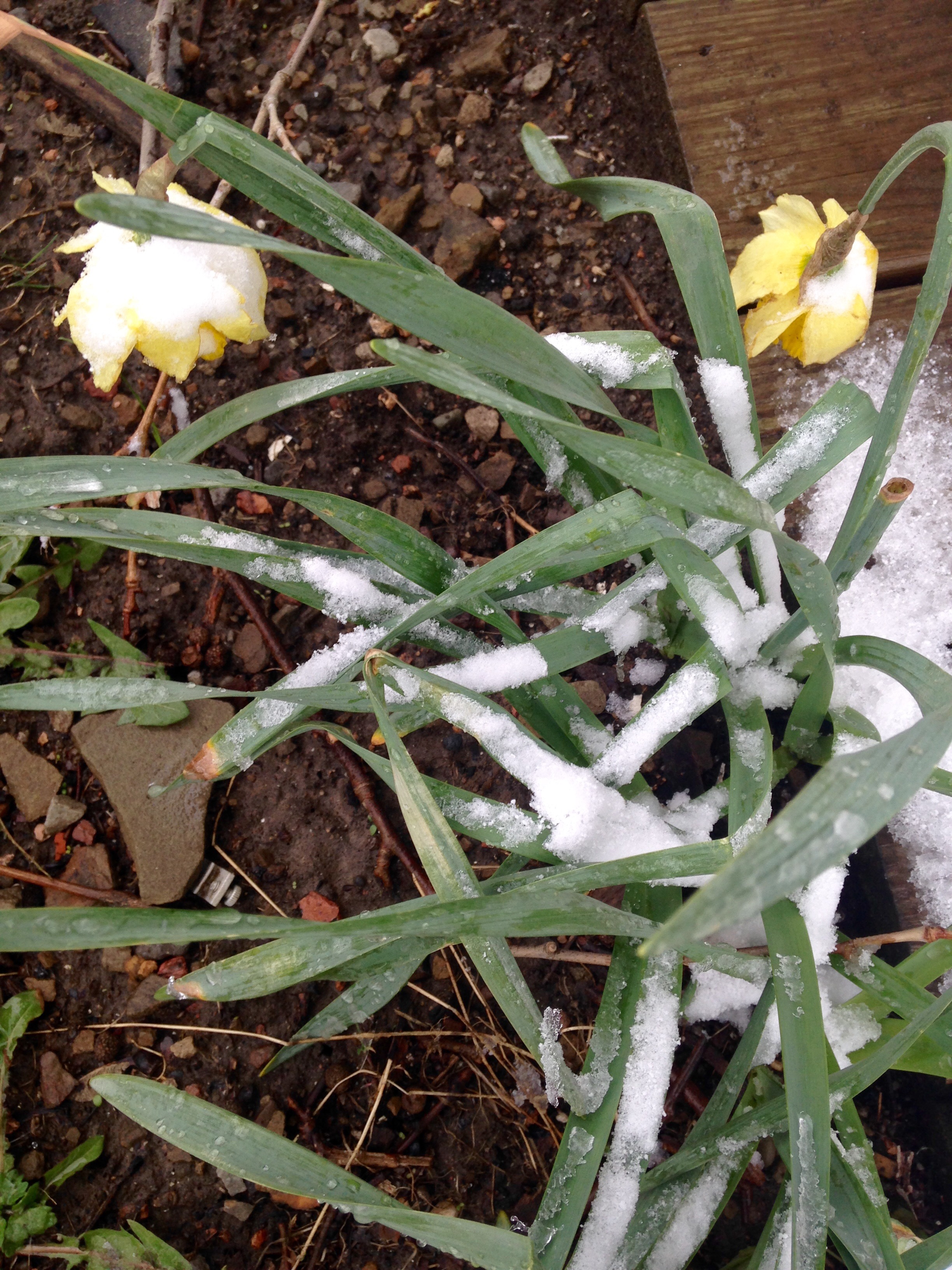
 

The last snow of spring

Our bird feeder sat on the porch table all winter long, filled with sunflower seeds, untouched by any flying, hopping, or scurrying creatures.

It isn’t that we don’t have flying, hopping, or scurrying creatures: we’ve had flocks of Bluebirds in January, and a mischief of mice invaded our kitchen; herds of deer decimate our gardens; a labor of moles have invaded our lush lawn (that’s a joke, folks); last year a chorus of cicadas denuded our trees;  a loveliness of ladybugs live on the west side of the house all autumn; and right now we’re battling a colony of ants. Yes, I’ve written about critters before.

So where were the birds this winter? My best guess is that since we had very little snow, they weren’t starving and didn’t visit out feeder.

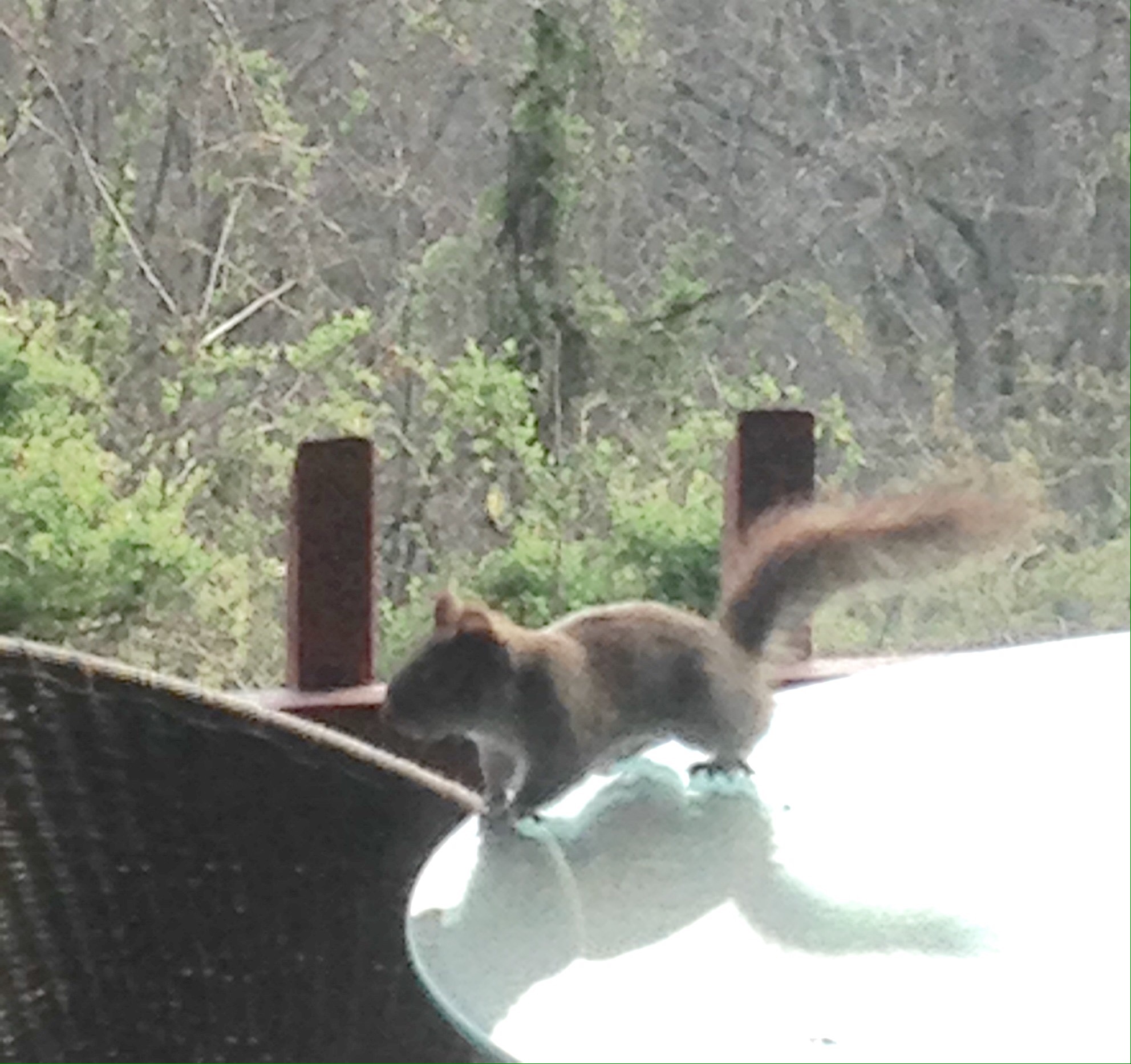
But a week ago we had (what we hope was) the last snow of spring. Snow dusted the ground, the daffodils, and tree branches. And a little visitor found our bird feeder. I didn’t get a picture of him that day; he was skitter-ish, but he discovered that the attack cat is fat and lazy, and his true bravery emerged. Plus he likes sunflower seeds.

Haiku for Squirrel

Red squirrel skitters
Sliding in the slick spring snow
His winter stash spent.

I’m not concerned about a solitary squirrel, but I certainly don’t want a drey of squirrels nesting on the porch this spring or a scurry of squirrels stealing our walnuts this fall.

The Road Winds Around

The Road Winds Around

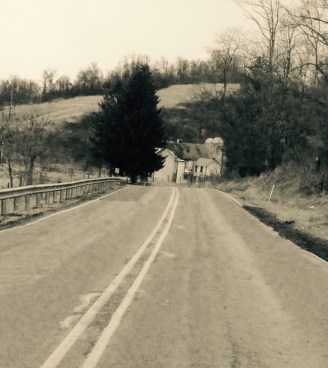
The road winds around through time —
a gray concrete ribbon now,
edged with yellow and white lines.
But before now, then,
then there was a land between two rivers —
inhospitable high forested hills–
stopped the glacier eons ago.
The narrow lands in the valleys curve around the next hill;
the banks of the meandering stream
that connects the two rivers
are the only flat lands
until Ohio.

Deer and bear and Native Iroquois carved out the first path —
the leaves and dirt compacted and hardened by the feet of
animals, wild and domestic; people, wild and domestic.
The route was never chosen, never drawn on paper;
it just became.
Horses picked the easiest way up the high hill;
moccasins chose the slowest curve for walking downhill;
wagons took the flattest way along the stream’s flood plain.
And year after year, as the trees grew and changed colors and dropped their leaves,
the path grew and changed
into a road.

As the road grew wider and harder,
an inn appeared on a long slow curve, where water was plentiful.
The land was flat and spacious for carriages and wagons and horses.
At thirty miles between the towns,
it was a pleasant stopping point between two arduous rides.
Farms dotted the road in between the ridges and woodlands;
sheep proliferated on the hilltops,
cows lived in the narrow valleys
where barns were wedged
between the hills.

Even the industrial era —
coal mines and the discovery of oil —
did not bring more traffic to the hills and curves of the road.
Rather, the oil barons and the coal companies used barges
to float the precious cargo
up and down the rivers to Pittsburgh.
When barges no longer sufficed,
railroads were built on the flat river banks
for the transport
of black rock and black gold.

The surroundings were home
to coal, oil, and gravel,
and the road was macadam,
until Mr. Ford’s Folly was assured.
In 1935, workless men were put to work
laying asphalt over the macadam;
the steam engines and rollers puffing and belching
to get to the top of the hills with picturesque names:
Tin Can Hill, Clearcut Ridge, McFeeter’s Knob,
String Bean Bluff…

The inn, vacant for years, burned to the ground in the thirties,
and a small filling station took its place.
The flood plain by the creek held picnic tables
for families traveling in their new cars.
Family farms were handed down to the next generation of farmers,
never wealthy, but never hungry;
self-reliant but good neighbors;
taciturn, but full of life;
independent, but willing to serve.

And then the era of speed flashed
upon the road–
a lightning bolt in a summer storm.
The Pennsylvania Turnpike,
the first high-speed road of its kind,
opened for business in 1940,
and moved those cars and trucks
across the Blue Ridge Mountains,
linking Philadelphia, Harrisburg, and Pittsburgh.
Seven abandoned railroad tunnels were used for going, not over,
but through those mountains.
Cars and trucks traveling ever faster,
left hills and curves behind in favor of straight, wide, and flat.

There was no straight, wide, or flat
on the road between two rivers.
No.
The road winds around
between hills, valleys, trees and farms,
and is left in the dust of the modern world of speed,
instant indulgence, and time saved.
Those who have chosen that mostly peaceful life
are mostly happy with their choice.
The restless have moved on;
the educated children have moved away
to bigger cities, better jobs, faster lives.
The straight, wide, flat roads bring them home to visit,
only to leave again and again.
Those who stay have chosen place over pace,
paucity over plenty,
peace over prosperity,
people over public.

But some stay who haven’t chosen. Poverty limits them, lack of education limits them, the hills limit them.

Just as the hills keep away hurry,
the hills isolate and divide
those who stay on purpose
and those who are left
in the dust.

The road winds around through time,
telling its story to those
who will take the time
to listen.

IMG_1559


This is actually taken from a novel I’m writing. I’d be glad for comments.