 long ago and far away, I was a children’s librarian. But you know, old librarians never retire, they just get reshelved, checked out, or renewed…
Does that mean I’m qualified to make a list of my favorite picture books of all time?
All librarians, retired or not, love book lists and this February I’m listing the children’s picture books I love. Here are my qualifications: a librarian for thirty-five years; a children’s librarian for twenty-five of those years; a word addict, editor, storyteller, and writer on and off throughout my life; and a book lover since before I even learned to read…
So if any of that makes my list more credible, here are my favorite twenty-nine picture books of all time — old favorites as well as new — one book per day in February divided into weekly groups, so you can go to the library on Saturday for the whole week.
I must confess — I like stories that tell us about how to live. Not heavy-handed, but stories that can be talked about over and over; stories that can be read on more than one level; stories that stick. And because they are picture books, the illustrations have to be outstanding, too. Please notice that this is a list of MY FAVORITES! It is not a list of the Best Picture Books of All Time — you can find those lists here and here.
In no particular order they are:
 Down the Road by Alice Schertle; illustrated by E.B. Lewis. Mama needs eggs, but no one in the family has time to go to the store, so Hetty begs and pleads to be able to “go down the road all by herself.” Mama hedges, but Papa stands up for her and says, “Hetty is absolutely old enough to go by herself.”
Careful and proud to have money in her pocket and finally knowing how it feels to be grown up, Hetty does everything just the way Mama and Papa would do; well, almost…
This might top the list of favorites. It is a wonderful story of family love and messing up and forgiveness. And E.B. Lewis’ soft watercolor illustrations fit the words perfectly!
(Spoiler Alert: Hetty does indeed drop the eggs. Every school age child from kindergarten to 5th grade identifies with this. They are hushed when they see Hetty hiding in the tree and Papa striding down the road to look for her. 6th through 8th graders probably like it too, but they are too cool to let on… So, I’m going out on a limb here and say All Ages…)
 The Lion and the Little Red Bird by Elise Kleven.
Elise Kleven’s artwork sings out joyously; the art in her other books is spectacular too, but this particular book stands out because of the story as well. It’s about art — creating it and sharing it — and the happiness that brings.
The Lion’s tail is a different color every day and the little bird wonders why. When she asks him, all he can hear is her cheerful song. They accompany each other throughout the day, enjoying one another’s company, but not really communicating. (Inter-species difficulties, you know!)
 A nighttime rainstorm and rescue brings the little bird into the lion’s cave where she discovers that he paints all night what he has seen that day. (There is a slight guessing game here that your young one will be so proud to figure out.) And this amazing book is perfect for getting on your own creativity — get out the paints and go wild with color with your child. Ages 3-8

Blueberries for Sal by Robert McCloskey
If there is a McCloskey book on most people’s lists, it is usually Make Way for Ducklings. And although I love that book too, this one stole my heart when I read it (over and over) to my own children. Little Sal and her mother and Little Bear and his mother go to Blueberry Hill one pleasant summer afternoon to stock up on blueberries. They get all mixed up, and the word play, and the illustrations could not possibly be any better.  If you ask me, this one should have won the Caldecott Award. One of McCloskey’s best drawings is the picture of Mother Bear looking at Little Sal in horror as they realize they are with the wrong parent/wrong child. Have some blueberry muffins handy to eat while reading this gem. Ages 4-8

Every time I read this, kids begged to check it out. I think they wanted to pore over the clever illustrations, but honestly, they could never outgrow the lesson here. In fact, if the adult reader doesn’t point it out, they might not even know why they love it so much. (Adults know better than children that we all need unconditional love.)
Blossom and Rocky are two sheep who aren’t known for their wise decisions in the past. In fact, they’ve made some pretty poor choices (very humorously illustrated!). Murphy, the sheep dog who watches over them, knows this and keeps a watchful eye on the pair.
But one day Murphy is busy helping a lamb and the two black sheep make a run for it. They really haven’t even gotten close to their destination of the high clover field on the mountain when they stop for a rest and meet THE WOLF.
There is not a word about Jesus or God in this picture book — but it’s not a stretch to move from this story into the Biblical story of Jesus as the shepherd who watches over us and cares for us all, no matter how we behave… And the kids hardly know they’ve gotten a lesson! Ages 5-9
 Extra Yarn by Mac Barnett; illustrations by Jon Klassen.
This is an understated book and I confess that I had to read it twice before I fell in love. And now, each time I read it, I find more to love about it. It’s another one of those “lesson” books that kids won’t get until you start a discussion about it.
The town where Annabelle lives is grey and cold, and so are the people. Until one day she finds a box of multi-colored yarn and begins to knit. She knits colorful sweaters for herself and her dog, then for her friend and his dog. The sweaters cause a stir, and soon everyone wants one. Somehow the box of yarn never empties…
UNTIL the evil archduke comes to town and offers to buy the magical box of yarn for one million, two million, ten million dollars. But Annabelle won’t sell.
No? She won’t sell? Then he will steal it. This is a parable of joy, of kindness, of goodness, of whatever it is that can’t be bought, sold, or stolen, but can only be given away. Look at the illustrations carefully. They are (almost) as good as the story. Ages 5-9

City Dog, Country Frog by Mo Willems; illustrated by Jon J. Muth.
Mo Willems is another perennial favorite author to Best Picture Book Lists, but generally the book listed is Don’t Let the Pigeon Drive the Bus. Okay, so I’ll give you that it’s cute, but best picture book? No. This one is a thousand times better!
Unlikely friends always make for good stories! There are several other books on this list with that theme. But this particular story is so good because there are So Many Big Themes in this one short picture book. Willems is a master at saying much in few words. And the illustrations! Look at this one of Dog and Frog playing together:
 Every season, Dog escapes into the county and runs off to find his friend. But dogs live longer than frogs do, and one winter Frog is gone. It is a moving story of friendship, loss, grief, and recovery — in less than 350 words. (Note: I’ve read several reviews of this book from parents who didn’t like it because it was about death. But I don’t know of a single child who hasn’t lost a pet, a grandparent, or a friend. Death must be part of our conversations with our children.) All ages
 The Three Questions by Jon J. Muth
There are two books by Jon J. Muth on this list, so I might as well put them next to each other. The Three Questions is adapted from a famous short story by Leo Tolstoy, and Tolstoy fans will find nods to his life and culture in the names of the characters in the book. The boy has three questions that he puts to his friends, a monkey, a bird, and a dog. They answer as their kind would answer — the boy knows they are trying to be helpful, but he also knows they aren’t the true answers. So he goes off to find the wise old Turtle (Leo), who helps him discover for himself, the truth.
Muth takes hard thoughts, and puts them together so a child can understand them. There is much to talk about in this book… Ages 6-11
So get to your favorite library and check these out — there’s one to read for every day… Stay tuned for seven more next week…
 It came from
  Richard Foster’s chapter on Simplicity from Celebration of Discipline is not easy. It has stuck with me, and made me consider many of my actions and the way I live as a wealthy American. No, we won’t ever make the Forbes list of billionaires, but we have houses, cars, and too much stuff, plus some money in the bank. If a family of four makes $40,000 a year (after taxes) they are in the richest 15% of the world’s population. To discover just how rich you are on a world wealth scale, you can go to this site
  Also within the last two weeks, I purchased a new pair of jeans at Ann Taylor Loft and the same questions apply: Were they made in one of those clothing factories that caught fire or collapsed? Or if not those, another sweatshop in another poor country? We live in a world of instant information, but how do we find this out?
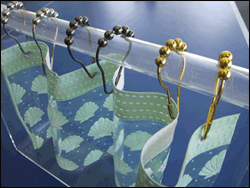 When I googled Made in America Shower Curtain Rings I found these metal


