The absolute, very last ever post on the mudroom…maybe

Why?

Because it is finally finished. And I have to say this final bit was all Mr. H.C. The only share I had in this last wall was painting one coat of paint on the door.

There won’t be too many words about this, because words cannot describe how completely and utterly finished it looks.

Unfortunately photos can’t do it justice either. Because it is all painted in Sherwin Williams’ lovely creamy white color — Steamed Milk. The same color as the kitchen walls. The same color as the dining room walls. The same color as the living room walls. The same color as the ceiling in all those rooms as well. Yes, we like creamy white walls. And ceilings.

In my humble non-decorator-just-average-person opinion, creamy white walls make a humble cottage look bigger, lighter and brighter, and just all-around more cheerful. And anyone who saw the cottage before, with its orange walls and wallpaper and 70s dark paneling would agree.

So without further ado, here are some befores, durings, and afters of our finally-finished-after-five-years mudroom entry to Apple Hill Cottage. (Trumpet sounds here…)

One can see that it is so new, there isn’t even any art on the walls.

This gallery below shows the progression of the outside wall of the mudroom — from the initial window, cedar shake walls, and plastic ceiling — to what it looks like now:

The next gallery of photos shows the progression of the second wall:

The floor has been done for a couple of years, but it still merits a before and after photo shoot:

The finishing of this room took so long because an exterior roof was necessary before the interior ceiling could be installed. Since the roof was finished this past summer, this winter we were able to proceed with the ceiling:

The last wall to be finished (February/March, 2017) was the wall with the most issues. There is an electric panel two feet from the wood stove; there were wires traveling the whole length of the wall that hooked into the electric panel; and this wall was also the orginal entry into the kitchen before the mudroom was enclosed and was just a porch. When we took off the cedar shakes, the wall was down to its original siding and it wasn’t pretty:

These photos below show the electric panel side of the doorway:

The sliding door that covers the electric panel is made from concrete board and trimmed with wood grain concrete board so it mimics the other interior doors in the cottage, but it is safe for being next to the wood stove. It hangs from the ceiling with pocket door hardware.

One of the best things about having the mudroom finished is that now the doorway into the kitchen is finished as well. In the last post on the mudroom,  I showed you the photo on the left. Now the far right is the finished picture.

Five rooms down, two to go. Three if you count the back porch; four if you count the laundry room.

But who’s counting?

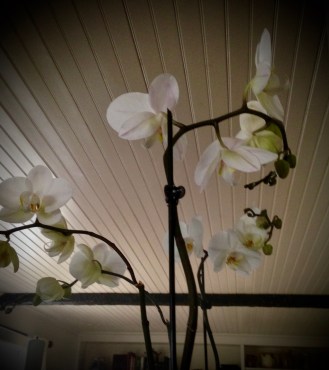
The Accidental Orchid

Last summer my son-in-law brought me out two of his house plants to tend while he went home to Spain for a month. I was glad to tend the hydrangea; it was in a big pot and it could live outside on the porch next to mine. Mine was pink; his was blue. They would look lovely together, and I’m not afraid of hydrangeas.

The other was an orchid. I shook my head at that one. “Oh, I’ll kill that one for sure,” I said. “I’m not good with any plants that are tender or need a lot of care.”

“It’s okay,” he said. “Just give it three ice cubes a week. Or 1/4 cup of water. No direct sun, and if it doesn’t work, I’m not attached to it. Don’t worry.” Even though he said all that, I still didn’t want him come back to a dead orchid.

fullsizeoutput_18f9

That was in July. It had one icy white bloom atop a long thin stem; it looked very fragile. The bloom dropped off within a couple of weeks and left the long green stem. It wasn’t very attractive, but I dutifully gave it a quarter cup of water every Sunday. I didn’t think ice cubes would be good for a tropical flower.

After he came back from Spain, he was in the process of moving and told me to just keep the plants. The orchid didn’t do much for two or three months, and I was starting to think it was silly to keep watering such an ugly plant. (There’s a lesson there in that sentence….) But it didn’t look unhealthy, so I kept watering it.

One morning I was moving all the plants and dusting the window sill when I saw odd looking growths coming from the base of the plant. They were silvery. I had no idea, but since something was happening, I did some basic research on Phalaenopsis Orchid.

fullsizeoutput_18fa These were air roots. Of course. Every plant has air roots, right?

I did more research. There are about a hundred million web sites for novice orchid growers, and they don’t all agree. But the first web site I checked suggested cutting back the old flower spike. It may send out a new shoot, or it may not. Depends if it’s happy or not…

It didn’t seem unhappy, so I cut it back by half. Within days a little sprout appeared just above where it had been cut back. And within days of that little sprout, another shoot appeared, and this time it was growing out of the dirt. Er… it isn’t really dirt. It is magic orchid-growing chunks of pixie dust ‘media’.

Excitement mounted, and I went back to researching. It turns out that the 3-ice cubes per week is a Thing. More correctly, a company — Just Add Ice Orchids. Most of the spectacular flowering orchids that the big box stores are selling right now are orchids from this company. I have always just passed them right by, because I’m not really a fan of delicate hothouse flowers. Did I say that already?
fullsizeoutput_18ef

With air roots and two flower spikes, I actually started to get excited and attached to it. I texted my son-in-law with a photo. He corrected me on its gender and called the orchid a she. Yes, it is plain from the photos, she is a lovely March bride.

img_7837I began to use the ice cube method, since it has obviously been approved — not only approved, encouraged. Her flower spikes grew tall, and soon there were little bumps all along both of the spikes. Dare I think they would be flower buds? I counted them. There were seventeen!

Before you think that I am an absolute genius with tender hothouse orchids, I have a confession.

I struggle with lack of light in the months of November through February. (Does this mean that I myself might be similar to a tender hothouse plant?) So this winter I bought four JOYOUS lightbulbs — full spectrum light that mimics natural daylight. As I was choosing where to put them, I noticed in big print on the packaging (that’s the only kind I can read these days…) that these light bulbs can also be used as grow lights. So I put one of them in the schoolhouse light over the kitchen sink, so the houseplants on the window ledge could benefit from joyful light too.
fullsizeoutput_18f0

I cannot say with full certainty this is why the orchid is so magnificent. Several of the websites I visited said that light does not affect the blooming of orchids. Can I say I don’t believe them? I must also say that this is the first year that my tender Rosemary plant still looks this healthy in early March. Usually it dies by mid-January.

I sent a text to Pedro the other day with a photo of how spectacular she is. I offered to give her back. He generously declined, saying, “She must love your window.”

And the hydrangea? The deer ate it to nubs one night last fall. I brought the container of small sticks inside and shoved it in a corner of the kitchen. Since spring is around the corner (What corner, Where?) it is starting to come back too. I’m hoping its lovely lavender bloom will take over when the last orchid blossom falls off.

So go for that spectacular orchid. If I can do it, you can too.

Relics of Time and Memory

Indian Rock

There are big rocks thirty miles to the south
in Slippery Rock Creek.
There are big rocks thirty miles to the east
in the National Forest.
There are big rocks thirty miles to the north
on the shores of Lake Erie.
But here in the rolling farm lands of Black Ash
there is just one big rock.

Walk with us just down the hill
past the edges of the berry bramble
and the fallow field
to where the
North Fork of the West Branch of Little Sugar Creek
winds its way through the beeches and hemlocks,
rippling and glinting
murmuring and echoing
the breeze of the leaves.

witch_hazel_03_fullTurn here at the witch hazel tree.
The path narrows, but just a stone’s throw
into the little glen
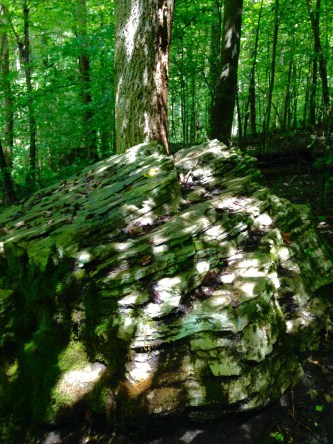
Indian Rock is there,
dominating.
A ten-foot maple tree grows from its moss;
Eons and roots have split the smooth stone.
There is a foot ledge
to enable scrambling,
but no grand view from the top,
for this granite boulder guards a small ravine
and a bubbling spring
that feeds the
North Fork of the West Branch of
Little Sugar Creek.

a giant granite anomaly amidst
a sea of sandstone,
thrown here in ancient days by melting glaciers
and God.

The granite is carpeted with moss
and baby blue forget-me-nots
Pale green lichens and fiddlehead ferns–
Miniature perfection.

delicate rock garden Forget-me-not flowers in moss and stones

Image courtesy of freeimages.co.uk

Relics were found here.
Mortars, pestles, arrowheads
from the people called Seneca.
Picture the mother, baby strapped to her back
pounding the leather, the corn,
kneeling to collect clear cool water from the spring.
i carry my child in a bright green back pack and we
collect the water
in our plastic Mr. Donut buckets,
but i feel a kinship with her just the same.

i lift him from the backpack and sit him on the soft moss;
i step up on the ledge from behind
and we rest in the shimmering green sunlight
on an ancient moraine.

my pale hand reaches to stroke this red haired child
crawling on the mossy rock
as her brown hand tousles the dark hair of her child
crawling on the mossy rock
and in that second
our fingers
touch
through
time.

sunlight on rocks