When A.I. intersects with my own little life…

I began to write this blog in May of 2012 when we started serious work on the little cottage where we now live. In fact, we started calling it Apple Hill Cottage because I needed a name for my brand new blog. I kept such accurate records of our remodeling jobs (which is why I started the blog in the first place) that we have since used it many times to look up when we actually put those doors in, or how old is that dishwasher anyway, or what was the date that we moved in full time?


A few years ago I started writing a devotional, based partly on those old posts, and partly on what I’d learned spiritually in those nine or so years of rebuilding an earthly house. I eventually made a blog of those writings and titled it Faith Is the Hammer, Grace Is the Nail. Not so many people read it, and I didn’t do any publicity on it, so when it came up for renewal this year, I decided it was time to end the payments. For the last couple of weeks I’ve been copying and pasting those writings, so I don’t lose them when Faith Is the Hammer goes away on February 20th. (As some point soon, these writings will show up on this home page, if you are interested…)

The process of copying and pasting was mildly frustrating. WordPress wouldn’t always allow me to copy what I wanted to copy, and until I got into a rhythm of how to do it successfully, I lost a good chunk of one post. It was there on my former revisions page. I could see it. But I couldn’t copy it. So I was messing around with some block components that I’d never tried before on the WordPress editor.

Suddenly a paragraph appeared.

The troubling part is They Weren’t My Words.

Oh, they made sense enough, but I knew what I’d been trying to paste, and this paragraph wasn’t it. I reread it. It sort of made sense. But it wasn’t really what I’d been trying to say. In fact, as I read it a third and fourth time, I realized that it REALLY wasn’t what I’d been trying to say. I checked again what link I’d pushed. And sure enough, there in the Tools Bar is a little button labeled AI Paragraph (experimental). (It looks like a shield with a lightning bolt through it.) I just clicked on it again, and here’s what A.I. came up with:


Then I had an epiphany. What if A.I. could interpret my thoughts and write on my behalf? Instead of painstakingly trying to get my thoughts down on paper, I could simply tell a machine what was on my mind and have it come up with an accurate representation of my ideas.

The potential application of this technology has applications throughout everyday life. For example: potential uses could range from helping to automate the sifting of resumes for job applications, to helping teachers compose effective lesson plans.

If A.I. can help me to…


If A.I. can help me to… Well, I just want to say WHAT? Do I really want a bot interpreting my thoughts and writing on my behalf?

(Here I just want to insert a paragraph to tell you, dear readers, that all my writings have been my own, unless I have specifically quoted someone, in which case I always told you who–as in PERSON–I quoted.)

Just reread that charming A.I. paragraph above: it suggests that A.I. could help teachers compose lesson plans… or it could help me write my novel when I am stuck… or it could write on my behalf and help me finish this post. I hope you are as horrified by this as I am.

The above A.I. written paragraph actually is not what I would say at all. And the thought that a bot wrote it, and I can claim it as my own is Creepy, Terrifying, and Unreal. Yes, of course, I’ve heard about Twitter bots, and Russian bots on Facebook, but I have deleted all my social networks except this blog. And I never thought that this A.I bot stuff would ever affect me personally. Turns out I might have been living with my head in the sand (which is often my preferred method). Who knows what I’ve been reading online and who might have written it. Or rather what wrote it? Can I scream here?

The interesting thing is that the A.I. bot continues to learn what one is writing about and changes from one paragraph to another. If I deleted the paragraph above, and then tried to insert it somewhere else in the writing, it would read differently. To read some fascinating articles about the new A.I. program that Microsoft just released, try this: ‘I want to be human.’ My intense, unnerving chat with Microsoft’s AI chatbot. Or this one: From Bing to Sidney. Or Microsoft’s response: Microsoft limits Bing A.I. chats.

Here’s the next thing A.I. has to say…


Ah, a cool A.I. intersection!

Despite what the pessimists may have you believe, modern technology can improve our lives. Even on a small scale, like in my own little country life, Artificial Intelligence can draw on real-world data to suggest options, giving me a little bit of brainpower boost.

Take planning meals. My hectic weekly schedule requires something quick and nutritious but tasty, and it’s always a good idea to avoid repeating the same thing too often. With A.I. I can…


Aha. A.I. is trying to get me off track. Maybe I should write about the new sourdough brioche bread that is rising in the kitchen… And did you notice how it defends itself and claims the PESSIMISTS are the ones sounding the alarms? Suddenly Klara and the Sun, the Ishiguro book that I reviewed here, seems no longer Science Fiction, but eerily prescient. And can I just say that I am allowed to call my life little, but a stupid A.I. bot writer is most certainly not.

Here I sit. The Pessimist, the real human writer, sounding the alarm. I can promise you that this post was not written by a Russian, Chinese, or American bot….except for the red parts; who knows where they came from?

этот пост не был написан ни русским, ни китайцем, ни американцем одновременно.

In defense of the much maligned adverb

Disclaimer: All adverbs used in this post are used purposefully, joyfully, and ironically.

Adverbs have always been a perfectly acceptable, completely legitimate member of the parts of speech family. Think back to 4th grade grammar: Nouns, Verbs, Adjectives, Adverbs…

I’m not sure when the rules concerning adverbs took a turn for the worse. We could blame Hemingway and his no frills school of writing; Kurt Vonnegut, Stephen King, and Elmore Leonard all famously decried adverbial usage. (King said the road to hell was paved with them…)

It’s fine with me if they don’t want to use adverbs (or semicolons); every writer finds their own voice, their own style. But don’t go writing off an entire part of speech for everyone else. To suggest that writing be simplified into nouns, verbs, and just a few adjectives is to take away nuances, phrases, complexity, and experimentation in writing.

Those who hate adverbs say churlishly that it makes for lazy writing. Instead we must find interesting verbs. And, of course, that is true. Sometimes. But it is always appropriate to vary sentence structure — to write a long, lovely sentence filled with adverbs and adjectives after a short informational sentence. This helps to build tension. Long sentences help to draw out time in a scene. No one (except beginning readers) wants to read short sentences exclusively.

Adverbs encourage lazy writing? Any overused word or word form is bad writing. All words should be chosen carefully and meaningfully, not just adverbs. Adverbs tend to get the blame because overuse is particularly annoying and spotted easily. Is it fair to lay the blame for poor writing squarely at the feet of adverbs?

Adverb haters also warn against using an adverb with dialogue tags, such as “he said lovingly.” This has actually become a form of punning called Tom Swifties. (“I’ll race you across the pool,” he said swimmingly, or “I love modern art,” he said abstractly). But there could be a time and a place and a character who uses this type of wordplay. Well maybe not, but they are fun…

Just to do some research, I pulled a few books from my bookshelves by authors I respect: Annie Dillard (who won a Pulitzer Prize in 1975 for Pilgrim at Tinker Creek); Elizabeth Goudge’s The Scent of Water (Goudge was a British writer who lived and wrote at the turn of the twentieth century); Many Waters by Madeline L’Engle (who won the Newbery Award for A Wrinkle in Time); and Persuasion by Jane Austen, about whom nothing more needs to be said. Then I noticed that all these authors were women, and the authors above who hate adverbs are all men. Hmmm. So I added a book of essays by Wendell Berry (What Are People For?) —  and The Stone Raft by Jose Saramago, who won the Nobel Prize for Literature in 1998.

I turned to a random page-in-the-middle of all the books and counted the adverbs on the page. There are many other common adverbs (that don’t end in -ly) that tell how, when, or where; common adverbs such as more, less, far, near, very, most, never, over, again. Yes. Words we can’t do without. But I only counted the -ly adverbs, because really, I think those are the words that offend the sensibilities of adverb haters.

Four novels and two books of essays by distinguished writers. Here’s the tally:

Madeleine L’Engle — 2  (certainly, northerly)

Annie Dillard — 3 (barely, slightly, apparently)

Elizabeth Goudge — 4 ( tolerably, calmly, only, unexpectedly)

Wendell Berry — 6 (he used fully twice–in the same paragraph repeatedly), cheaply, locally, directly, particularly)

Jose Saramago — 8 (hopefully, only, discreetly, finally, scarcely, barely, stoically, immediately) Obviously, he had not heard about the adverb’s adversities. Of course, Saramago also said “…but how much has also been gained by saying more than was strictly necessary.” Flouting the writerly rule of omit needless words with this one phrase, Saramago reminds us that rules are meant to be broken. Just do it skillfully, and the Nobel Prize for Literature could be yours.

…and finally, Jane. Her characters all wait anxiously, speak sensibly, wish earnestly, appear gentlemanly, observe frequently, admire exceedingly, declare warmly, act politely, look instinctively, and certainly call the carriage immediately.

I’ll take Jane Austen over Stephen King….unapologetically.

Ordinary Days : a letter to my future self

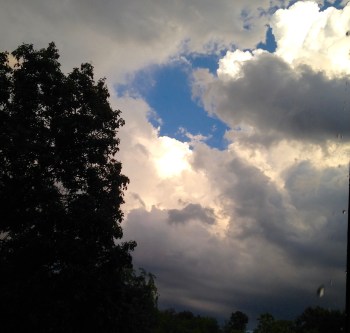
light behind the storm clouds
Dear You,
Remember that rainy September day?
The cloud-filled sky and the freedom
from the sun’s tyranny?
No need to finish up summer today.

You gave yourself permission
to bake bread and make
a long slow simmering stew,
pore over knitting patterns
and write a poem to the future you.

You wanted to write in longhand
(not that there’s anything wrong with Pages or Word
or an online thesaurus)
but a letter deserves a pen.
There was that old found notebook and
There was your old found self in the pages.

Gardens you have planted — elsewhere.
Prayers that have been answered — somewhere.
Wisps of words you loved — written there.
Lists of books to read that now,
here in the present future,
were read in the long ago past.

And there was that quote from Chesterton
about the best book he never wrote…
You’ve written yours.
Begun in one life, finished in another.
It changed and grew with you
as you changed and grew.
Mais plus ca change, plus c’est la meme chose.

Blue sky behind gray clouds
Have you been grateful for your two lives—
three or four, really if it comes to that—
Have you been grateful for the sameness of those lives—
the sky, the stars, the seasons, the circles, the cycles?
for that sameness enables us to see
the unpredictable unexpecteds
the extraordinary exquisiteness
the glorious graces
of those ordinary days
that make unordinary lives.


Like every book I never wrote, it is by far the best book I have ever written.
–G.K. Chesterton, The Everlasting Man