14. The Writing on the Wall

The best thing about living in a space where walls are crumbling and severely in need of repair is Writing On Them! For instance, at our advanced ages we seem to have memory short-outs quite frequently. This wall writing is very handy!

Just so we won’t forget to make it a 3-way switch…

The other day Mr. H.C. asked me if we had a chalkboard (I actually did find an old one of Clara’s) but I don’t know why I didn’t just tell him to write it on the wall. It isn’t like we haven’t already made mistakes. The stove was originally going to go in the far corner of the kitchen where the pantry wall was taken out. We measured, drew lines, and very carefully marked where the stove would be (in heavy carpenter pencil). Then we changed our minds. So now the writing on that wall is wrong. What do you do with that?

Erase? No, it won’t erase.

X-out? What, and draw attention to the fact that we can’t decide?

This just proves that reading the writing on the wall isn’t always accurate…

So the wrong writing is still there; I hope we don’t forget and put the stove there anyway…

It’s also very handy for keeping measurements–just so we don’t have to measure the same doorway or window more than 4 times:

But the best writing on the wall so far is actually on the ceiling — red chalk lines that will help us lay out the new bead-board ceiling,
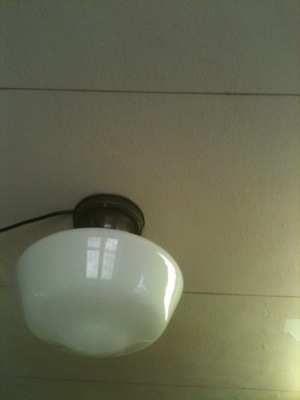
20120714-101002.jpg
This means we are actually getting close! (Mr. H.C. is installing an attic fan and the light brackets in the attic as I’m writing this.)

I have a history of wall-writing. One of my first memories is happily writing on the wall with crayons while I was supposedly taking a nap. I have blocked out what happened when I was found out, but the fact that I remember it at all makes me think it was traumatic. Maybe the first time I got in trouble and remembered about it?

20120713-214625.jpgMuch later, middle sister and I were getting ready to put wallpaper in our bedroom. It was bright orange and yellow and red flowers — must have been around 1966 or 67– and it looked eerily like the wallpaper on our bedroom now, here at the cottage.
We were painting the wall before we wallpapered it; I surely don’t remember why. Mom gave us permission to do graffiti on the wall before she papered over it. I painted several Nazi swastikas on it. I was just a kid and had no idea of the import of this symbol. When Mom came in and saw what I had done, she was horrified — her only brother had been killed in France during the war. She made us paint over them. “But we’re wallpapering over it,” I pointed out. She was shouting now. “I will not have someone finding these symbols fifty years from now on my house!” Of course, now I understand her rage perfectly. (Diane, am I remembering this right? I’m claiming full responsibility here because I can’t remember the extent of your involvement…)

A few years later, my boyfriend — he was called Mike back then — and I wrote our initials on the inside of a covered bridge on the Lippencott Road not far from where the cottage is now. We went back after we were married –30 or so years later — to see if they were still there.

20120715-132619.jpg
The inside of the bridge had been painted and we couldn’t find any initials, but then, we weren’t even sure if it was the right bridge…(There are 7 covered bridges in Greene County–you can find information about them here.) And from reading this website, I’ve discovered its real name–The Lippencott-Cox Farm bridge.
So there must be a place on these three acres where we can paint or carve our initials inside a heart on our 10th anniversary (coming up in August). I’m thinking maybe The Gazebo, or one of our very tall trees. Might have to go get some spray paint…

6. Tearing Down Walls

We were a bit hesitant to tear out walls.
Dusty, everyone said.
Old Plaster, Mr. H.C. said.
What will we do with it? I said.

I was a bit hesitant to write on this topic of walls. So metaphorical, walls are. Especially tearing them down.

I could wax poetic, except I’m an unexceptional poet.

I could philosophize, except I’m an unexceptional philosopher.

I could spout theology, except I’m an unexceptional theologian.

I’m even an unexceptional photographer–it’s especially difficult to take pictures of walls that aren’t there any longer.

Wikipedia tells me that the word wall is from the Old English word weall and it is a vertical structure, usually solid, that defines and sometimes protects an area. In fact, if walls divide and separate us, I could discuss the new trend in houses that opens up kitchens to the living areas of a house. So do we want an undefined and unprotected kitchen? Yes.

I have read Jane Powell’s books extensively. I love them. I love her humor, I love her authenticity, I love her strict ideas against “remodeling.” Don’t do damage to your old house, she says. If you keep to its period, no one will hate you down the line in 50 years. No one will have to rip out the trendy 4×8 sheets of fake paneling that you have carefully installed in the family room. I especially liked Bungalow Kitchens, and yes, I read The Bungalow Bathroom too. I renewed them both until the library wouldn’t let me keep them any longer. She says, Never under any circumstances should one listen to an architect who suggests changing your bungalow to an “open plan.” (Not a direct quote, but pretty close…)

Two points are especially important here: 1. We don’t, technically, live in a bungalow. 2. We didn’t hire an architect.

1. We don’t technically live in a bungalow. Although it was built around the time of many bungalows, and it might fit the definition, as in being one story and a modest, affordable dwelling, it has no architectural presence. There’s nothing that makes it stand out except maybe the clipped gables (also called jerkinhead gables–I don’t know where to start with that one, so I think I’ll leave it alone…) No beautiful woodwork, no congruency–as Dad said, “Well, that house grew like Topsy…” (from Uncle Tom’s Cabin by Harriet Beecher Stowe). The closest the cottage gets to architectural charm is a couple of built-in cupboards and a big brick chimney, all of which we are taking great pains to keep.

The outside of the houses look similar, but the floor plans don’t match.

I did find a lovely rendering of an Aladdin kit house that was sold between 1949 and 1951 called the Potomac. It was an Economy house and sold for around $1500-$2000, depending on whether you bought the pergola porch. The houses look remarkably similar. I’d like to use this as inspiration for what the house should look like on the outside when we are finished.

2. We didn’t hire an architect. No, we didn’t. Brother-in-law Jim is the closest to an architect we could find for free and he said, “Oh, take out this wall. Yes, take it down.”

Yahoo notes that, “The most important thing to do before tearing down a wall is to determine if the wall is structurally necessary.”   Mr. H.C. is an expert on whether walls are structurally necessary or not. Daughter Maggie can attest to that! She hired a contractor who took out a structural wall. We happened to be visiting a week or so later. Mr.H.C. took a couple of looks and then they sped to Home Depot to buy studs to support the spot where the wall had been taken out. Then they had to hire a structural engineer  to figure out what to do next. THAT contractor was sorry!

So Mr. H.C. climbed up into the crawl space above our bathroom, dodging cobwebs and spiders and checked out which way the joists and rafters run. Turns out to be safe to tear ’em down.  Full Speed Ahead:  Open up the room; Let in the light;  Make the kitchen bigger; Cook with your friends!

Walls are human made things. There is nothing (that I can think of) in the natural world–in God’s creation–that was the prototype for a wall. They were made to define, to protect, to separate, to divide…. That’s not to say I’m totally against walls — walls around a bathroom are a fine idea :-) — but mostly God wants the walls around us gone.

It’s scary taking down walls. What if you take a support wall down and the structure starts to crumble? What if you expose what’s underneath? Let me tell you, it’s guaranteed to be ugly and it’s also guaranteed to be hard work, and there will be surprises. So why even try?

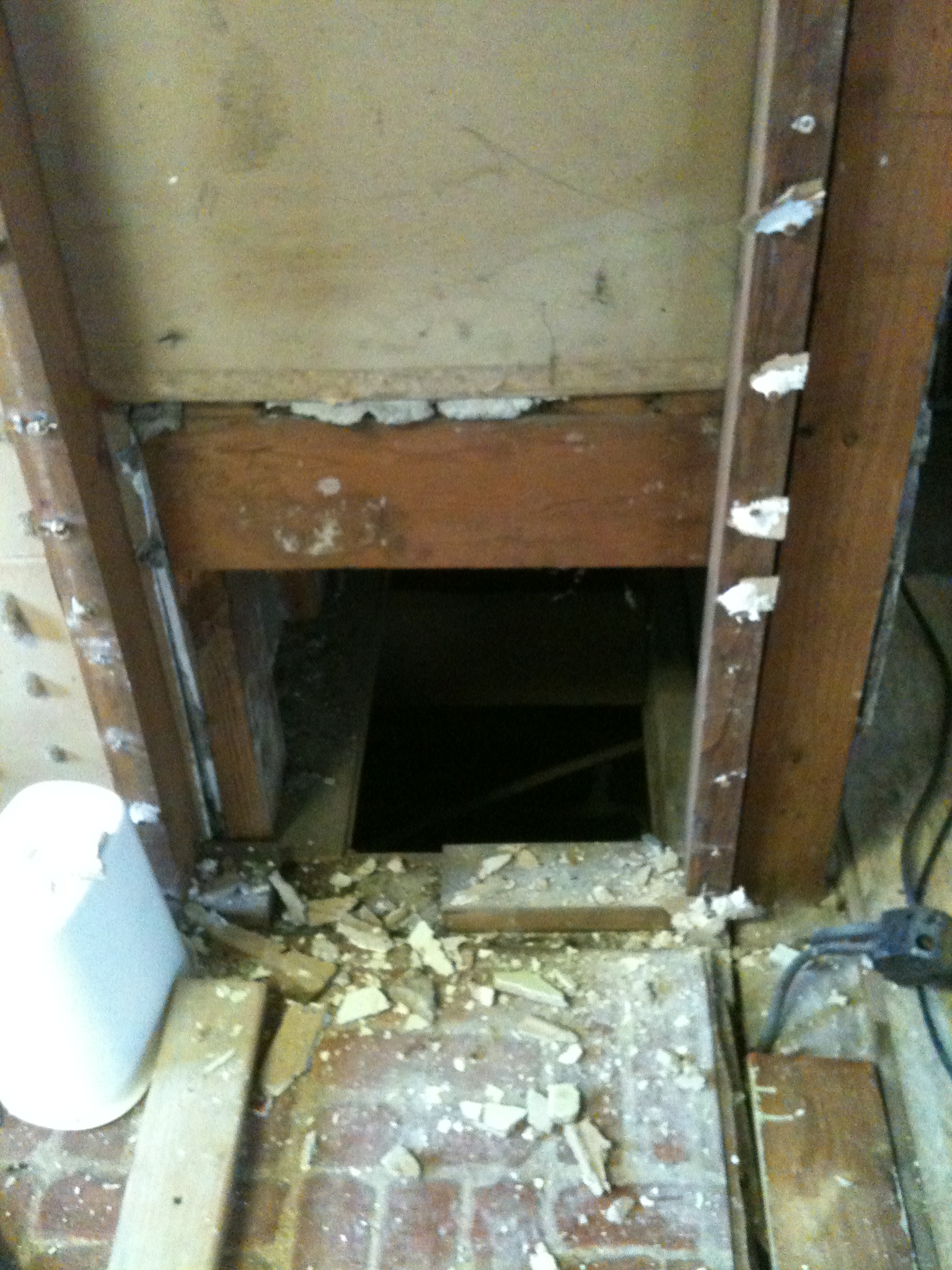
This is a picture of the floor where the wall was–yep, it’s ugly!

And this was the surprise. A real hole that was never finished. Now we know where all those bugs come from…

Why try? Because when that wall is down, it opens up the room that is your heart; it makes the room bigger; it lets light into your life;  it allows for true relationships, both with people and with God. So Full Speed Ahead, let the walls come crashing down!

Let in the light!

The walls we took out are still being supported by studs until the beam goes up, so any pictures posted here, will not look as if the walls are cleanly gone. But I can’t resist–Something there is that doesn’t love a wall / That wants it down. / I could say “Elves” to him, / But it’s not elves exactly… (The Mending Wall by Robert Frost.)

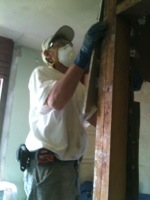
No it isn’t exactly elves. Here is Mr. H.C. taking out a piece of the wall. (We actually took out pieces of three walls.) 20120622-231320.jpgIt wasn’t wood lath and plaster, which is what most people think of as old, dusty plaster. This was plaster board coated with plaster. Mostly it came down in chunks. We researched it (it’s organic); tested the paint (no lead); and then wheelbarrowed it down to the hillside and tossed it over. We’ve since covered most of it with dirt and weeds, although I must admit, it was hard to throw those first few pieces. It just didn’t seem ‘green’. (But neither is Wasp Killer or Mole-Away…) Just think of it as fill.

Jim the architect said, “That is SO West Virginia.”

EEEYup. It is.

AWYSG (Always Wear Your Safety Glasses)