35. The attitude of gratitude : Hannah Coulter and I

Hannah Coulter by Wendell Berry has just shot up to the top of my Best Books I’ve Ever Read List. As a librarian, I’m asked a lot (mostly by kids) what my favorite book is. I always hedge. How can one pick a favorite book, when there are so many great reads, so many books, so little time…

But I hadn’t yet read Hannah Coulter.

Yes, yes, I know. This is supposed to be a blog about the cottage, but the subtitle is the circle of life; if anyone knows how to write about the circle of life, Wendell Berry does. His writing is lyrical, a pleasure to read and savor, yet so truthful as to bring pain… My fingertips ached with the beauty of his thoughts, transferred with such clarity into the thoughts of a woman, Hannah Coulter.

Hannah is in her seventies, a widow who has lost two husbands; she has lived her life on a farm in rural Kentucky, her children have grown up, gone to University, and gone from the farm. This is her memoir, but it is more. It is a mourning of the rural life, lost to modernity; it is a mourning of the loss of community that modernity brings; yet, it is also a celebration of love, faith, trust, and the hopes of the human heart.

I’ve been scraping the paint off the cottage this weekend, and that has given me time to ponder the circle of life. The paint was peeling terribly on this weather-beaten, sun-scorched side of the house, yet the warmth of the autumn sun made it lovely weather for scraping — scraping old paint from siding that was probably put on and painted originally by my grandfather. And then re-sided and rearranged by Michael’s dad, Joe. Yet they never knew that this place made by their hands would someday be also lovingly touched by their children’s and grandchildren’s hands… Here is what Hannah says about that…

“As I went about my work then as a young woman, and still now when I am old, Grandmam has been often close to me in my thoughts. And again I come to the difficulty of finding words. It is hard to say what it means to be at work and thinking of a person you loved and love still who did that same work before you and who taught you to do it. It is a comfort, ever and always, like hearing the rhyme come when you are singing a song.” Chapter 14, The Room of Love

I remember making applesauce with Nanny, my grandmother, in her kitchen. She was peeling the apples with a perfect stroke so that the peel dangled in one long piece from the apple. I was awkwardly scraping the apple and only getting little bits of peel to fall into the sink. “It’s all in learning how,” she told me gently. “I couldn’t do it when I was young either. You’ll be able to do it with practice.” I think about that every time I peel an apple in one piece.

Education was important in our family. My grandfather and his brother both left the family farm together to go college and become teachers. But Pa was always a farmer; even while working as a principal, and later, as the superintendent, he farmed. Cows first, then apples, then peaches. Here is what Hannah has to say about education…

“The big idea of education, from first to last, is the idea of a better place. Not a better place where you are, because you want it to be better and have been to school and learned to make it better, but a better place somewhere else. In order to move up, you have got to move on. I didn’t see this at first. And for awhile after I knew it, I pretended I didn’t. I didn’t want it to be true.” Chapter 15, A Better Chance


Yet most of us have gone from our home places to the Great Away, and we are inclined to think (or be taught) that it is just the nature of growing up and moving on. Life ever changes and if we are to get on in this world, that’s just the way of it. I know very few who stayed. And now that I am back in my home place, I envy the rootedness of those who stayed. I envy them their place in the community — not their standing or their accomplishments — but their place. Their membership. Here is what Hannah has to say about that…

This was our membership. Burley called it that. He loved to call it that… The work was freely given in exchange for work freely given. There was no bookkeeping, no accounting, no settling up. What you owed was considered paid when you had done what needed doing. Every account was paid in full by the understanding that when we were needed we would go, and when we had need the others, or enough of them, would come…The membership includes the dead… The members, I guess you could say, are born into it, they stay in it by choosing to stay, and they die in it. Or they leave it, as my children have done… And so an old woman, sitting by the fire, waiting for sleep, makes her reckoning, naming over the names of the dead and the living, which also are the names of her gratitude.” Chapter 11, The Membership

I have given up my membership once, twice, three times maybe, and now I am about to give it up again and move back where I started. A circle. A wandering circle. And though I will miss friendships and those left behind, there is also an excitement. And herein, I think, is part of the problem. We are always searching for the new, the exciting, the next big thing. Eve probably picked that first apple and gave it to Adam because she was bored with the same old grapes every day for breakfast. What we know, we know, and it has become the routine, the boring. What has become of steadfastness, neighborliness, rootedness to a place, community? Here is what Hannah has to say about that…

“The old neighborliness has about gone from it now. The old harvest crews and their talk and laughter at kitchen tables loaded with food have been replaced by machines, and by migrant laborers who eat at the store. The old thrift has been replaced by extravagance and waste. People are living as if they think they are in a movie. They are all looking in one direction, toward ‘a better place’ and what they see is no thicker than a screen. The houses in Port William and even on some of the farms are more and more being used as temporary lodgings by people who temporarily, as they think, can do no better.” Chapter 22, Next?

20121121-220306.jpg
When I was finished scraping the paint from one small section, I found an old brush and began to paint primer over the bare wood. As I was covering over the ugly, patchy, half-scraped wood, I wondered what are the differences between those of us who leave and those of us who stay?
Mr. Berry believes that to our detriment, and perhaps our demise, rural life has never been seen as desirable in society, in education, in culture. Indeed, when one of my good city friends discovered I was originally from Greene County, she shouted, “You’re a Hoopie!” Indeed, when I was in high school, the ultimate insult was to call someone a Farmer. Indeed, when my kids were in high school they shook their heads (as did I) over the kids who were choosing to stay. Here is what Hannah has to say about that…

Oftentimes after it no longer matters whether things are clear or not, they become clear. After not liking school at all, Caleb had got to liking it too much… He liked knowing the things he was learning… He was, maybe you could say, tempted by it. And I know, I can almost hear, the voices that were speaking to him, voices of people he had learned to respect, and they were saying, ‘Caleb, you’re too bright to be a farmer.’ They were saying, ‘Caleb, there’s no future for you in farming.’ They were saying, ‘Caleb, why should you be a farmer yourself when you can do so much for farmers?’… These were the voices of farm-raised people who were saying, ‘Caleb, why go home and work your ass off for what you’ll earn? Things are going to get worse for farmers.’ And they were true prophets.” Chapter 17, Caleb.

We leave for so many reasons — a new chance, new friends, a better job, a better place, marriage, escape — for good reasons and for bad ones. But sometimes we expect that someplace else will be better or different, when we really just need to see in a new way. Expectations, Hannah says, are most often a bucket of smoke…

Life may surprise us, it may not turn out how we expect, but always we are asked to see what is and call it good. And until we stop breathing, there will always be surprises. Here is what Hannah says about that…

“Life without expectations was still life, and life was still good…The world that so often had disappointed us and made us sorrowful sometimes made us happy by surprise. You think winter will never end, and then, when you don’t expect it, when you have almost forgotten it, warmth comes and a different light. Under the bare trees the wildflowers bloom so thick you can’t walk without stepping on them. The pastures turn green and the leaves come.” Chapter 19, The Branches.

And as I was scraping away years of dried paint, I was thinking how can I write these things without those who know me thinking that I am being regretful, or feeling guilty, or making them feel guilty? But there is no guilt — just thankful thoughts about what was and what is. And here is what Hannah says about that:

“The chance you had is the life you’ve got. You can make complaints about what people, including you, make of their lives after they have got them, and about what people make of other people’s lives, even about your children being gone, but you mustn’t wish for another life. You mustn’t want to be somebody else. What you must do is this: ‘Rejoice evermore. Pray without ceasing. In every thing give thanks.’ I am not all the way capable of so much, but those are the right instructions.” Chapter 15, A Better Chance.

Yes, indeed, those are the right instructions…

___________________

10. Clara’s Kitsch

July 12 is the first anniversary of when we buried Clara and cancelled the auction of Apple Hill Cottage. So Clara, this one’s for you…)

Hello Readers,

Today we are trying something new. Reader interaction! Most of Clara’s Treasures that she sold in the Gazebo Tree House (you should read the first post–Apple Hill Cottage : the Story here) were taken away by the auctioneer when the house was being cleaned out and readied for auction. But not all! I’m undecided about what to keep and what to toss, so you get to vote! Below are pictures of some of her Kitschy Treasures. (I am decidedly NOT a seventies fan, so this is especially difficult for me.) So with your help, we can figure this out. Look at the items, read the captions, then get busy and vote. You can leave comments, too!

Clara was from Colton, a small town in California outside of San Bernardino. She met Joe, a soldier from Pine Bank, and when they married, he brought her to Greene County. Talk about culture shock! This is on the wall outside by the door.

Clara had all sorts of plaques, signs, and wooden shelves. This one was hanging above the pantry door, where else?

I think I saw something very similar to this switch plate at Anthropologie… Well, not quite…

The color don't go with our day-core… We saw a red one for sale in a shoppe for $60.

The color don’t go with our day-core… We saw a red one for sale in a shoppe for $60.

There are two of these wooden butterflies on the chicken coop–one on each corner. I don’t know, could they be painted up?

This is on the outside of the house by the front door.

This is also on the outside by the front door. I took down the high one above the door–I was afraid it might fall on someone’s head. That would really be bad luck!

This is a cast iron shelf with a metal towel bar underneath, about 15″ long. The colors are bad in this photo, but it’s orange, of course. Her favorite color. Paint it? Ditch it?

Okay, ladies and gentlemen, Go to it! The Poll is below. You may vote for as many as you like, and the poll stays open until Sept. 30, 2012. Have fun!

4. Owed to Dad

This is a special Father’s Day post. The regular Apple Hill Cottage posts will resume next week.

Dad died in March. He was 90 and until he was about 88, he was healthy, happy, and still playing golf. The last year wasn’t so good and the last few months were bad. He had always been a handsome-looking man and never looked his age. He spent his life outdoors–owning a small natural gas company and working outside and playing golf and mowing most of the 3 acres where we lived. It’s surprising he didn’t get skin cancer earlier.

Dad had dark hair, but his skin was fair and freckly and his eyes were blue. All summer long he had either a sunburn or a farmer’s tan.

This is the first time in over 50 years that I haven’t struggled with what to get Dad for Father’s Day. It was really hard when we were kids. As we got older, it didn’t get much easier. After he retired, he started reading, so a good new novel was always appreciated. He liked those yellow golf balls–he said he could see them better–although he always shot so straight he just had to walk down the fairway to find his ball. He had lots of golf shirts and lots of sweaters and handkerchiefs in his drawer that were still in the box. If he wanted something, he just went out and bought it. Usually right before his birthday…

He was a kind and generous man. I didn’t always get the kindness part when I was younger; that came later. He was stern with his daughters, and he had a deep, scary voice. But I always knew he was generous. Every Christmas there were an amazing amount of presents, and I remember Mom saying, “It’s your Dad who buys all these presents!”

I remember Mom laughing once, saying to a friend, that as soon as she had that third daughter, she knew she would have to learn to sew. Mom made almost all our clothes, and they didn’t look homemade, either; she was good–pantsuits (they were In then), prom gowns, skirts, dresses–the only clothes we bought were sweaters, blouses, and coats. So we didn’t go shopping very often, and Dad almost never went shopping with us. But once he did. We went to South Hills Village (that was when malls were new and going was special) to get winter coats. I don’t know why Dad went along, except it was evening; it must have been Friday or Saturday night. Diane and I were in high school and maxi-coats were the big fashion rage. I found one I loved and looked at the price tag. My heart sank. Dad said, “Try it on.” It was black tweed with a black fur collar (back before PETA…) and then he said, “You can get it.” Then he looked at Diane and told her she could get one too. Hers was bright red. (Nancy, you must have gotten something; he was always careful to treat us all equally.) It might not seem like much now, but I remember being overwhelmed that he let us get these expensive, beautiful coats.

He would always pay for dinner. You couldn’t get around it, and you couldn’t ever try to treat him. Once on his birthday–Sept. 14th–Michael asked the waitress for the bill before we even sat down at the table. Dad was furious at Michael; and I think it was only a month or so after we had gotten married. Michael stood his ground; he said, “Sam, I will let you buy every meal you want, except on your birthday. I will not let you buy your own birthday dinner.” Dad was mad at him for a couple of days, but he never fought us about that again.

This picture makes me smile every time, so I just had to put it in. Look at Daniel’s expression in the background…

I won’t say we always got along. He was hard to live with sometimes, but aren’t we all? Isn’t it awful that we act the worst to those people whom we love the best? We had some rip-roaring fights back in the late sixties, early seventies when I was a hippie with radical politics (who me?) and Dad was a conservative business owner. People who knew him well, knew never to bring up the PUC (Pennsylvania Utility Commission) who made his work life miserable by regulating the little guy out of the gas business. Oh my goodness, he would rant…

Once we had an argument about vegetarianism–I was considering it and supporting it–he threw down his fork and shouted “Cows were made to be eaten. They wouldn’t be here if we hadn’t bred them for it.” His argument did make sense, and I never again brought up how much grain they ate and how we would all be better off if we ate lower on the food chain. And son Casey–a lefty–is probably permanently scarred from Grandaddy trying to teach him how to hold a fork correctly…

He mellowed as he got older. When we were kids, I only saw him cry once–at his own dad’s funeral–but as he got older, he cried all the time. At first it was disconcerting. And it might have started after Mom died; I can’t remember. Maybe he just hid it well from his kids. I DO remember that he would never watch sad movies with us. We would all be sitting down in the basement sobbing over some tear-jerker movie (Imitation of Life with Lana Turner) and he would come down for five minutes, laugh at us, tease us, and then go back upstairs. Mom said once that he just didn’t want to cry along with us. At the time I thought she was way wrong, but she knew him better than we did…

When we were growing up, Dad wasn’t around much. Mom was the glue. After I left home, when I would call, if Dad answered the phone he would say, “Hi. How are you. Here’s your Mom…” He was of that “Greatest Generation.” Quiet, stern with your children (and your nephews), the disciplinarian. I don’t remember Mom saying “Wait until your Father gets home,” but we just instinctively knew it… But we also never doubted that we were his cherished, loved daughters.

When I got older and could think about such things, I always felt bad that he had only daughters. Here he was, a man’s man, stuck with girls. I think probably he was disappointed at first, but he got over it and taught us all to play golf. He was also the one who helped us with arithmetic homework (many tears) and gave us driving lessons. (That’s another story…)

Dad liked to be in control–of his family, of his money, of his work, of his life. He certainly didn’t want to have any of his daughters taking care of him. It was an issue as he got older, and especially those last months. It was a doctor who convinced him, and I will always be grateful to Dr. Martin for that conversation. Right before he was admitted to the hospital with a broken hip, Dr. Martin asked him what his plans were. Dad shrugged, and I said, “I wish you would convince him to come to my house.” Dad did his She Has Her Own Life and I Don’t Want to Be a Bother routine. The doctor listened and then spoke passionately about family. The ties we have to each other. The love and care we give to each other. He looked right at Dad and said, “If she needed your help, wouldn’t you want her to come to you?” Dad nodded. And it wasn’t an issue again. He came and lived with us for the last three months. And now we get all his junk mail. Thanks, Dad!

When you’re sitting at your father’s bedside, and you know he’s dying, it’s important to remember those things you want to say. About three weeks before he died, his pastor visited on Wednesday, and the hospice chaplain visited on Friday. Those were important days because we reminisced with one who knew him when he had been younger, and with the other who didn’t. And suddenly in conversation it came to me what I knew–what all of us sisters knew–but I, at least, had never shared with Dad. “You know, Dad, ” I said. “When Mom died we were all angry. But I look back and now I know that God’s purpose in that was so your daughters would have a closer, better relationship with you.” He looked at me for a long time. His sight was failing pretty rapidly, but I know he was seeing me. Thoughtfully, he said, “You just might be right.” I hugged him and we cried. It was really one of the last good conversations we had. I’m thankful for it.

I spent one day, after he died, by myself at his apartment going through the little stuff–his drawers, his books, and I found a card I had made him one Father’s Day sometime in the early nineties. I had just read an Ann Landers column in the newspaper where she had encouraged everyone to write a letter to their mother and/or father and just tell them why you love them. ‘Don’t worry about fancy wording and don’t buy a card. Just write it in plain language,’ she wrote, ‘and I guarantee you’ll find it in their drawer after they are gone.’ She was right. There it was. I remembered struggling over the words. But when I read it again, so many years later (through my tears) they were true.

So thank you Dad, for the kindness and generosity and compassion and love and honesty and good values and work ethic that you always modeled for us. See ya later, alligator…

Here are some favorite pictures:

Dad helping Casey work on his swing.

Wedding photo, 1949.

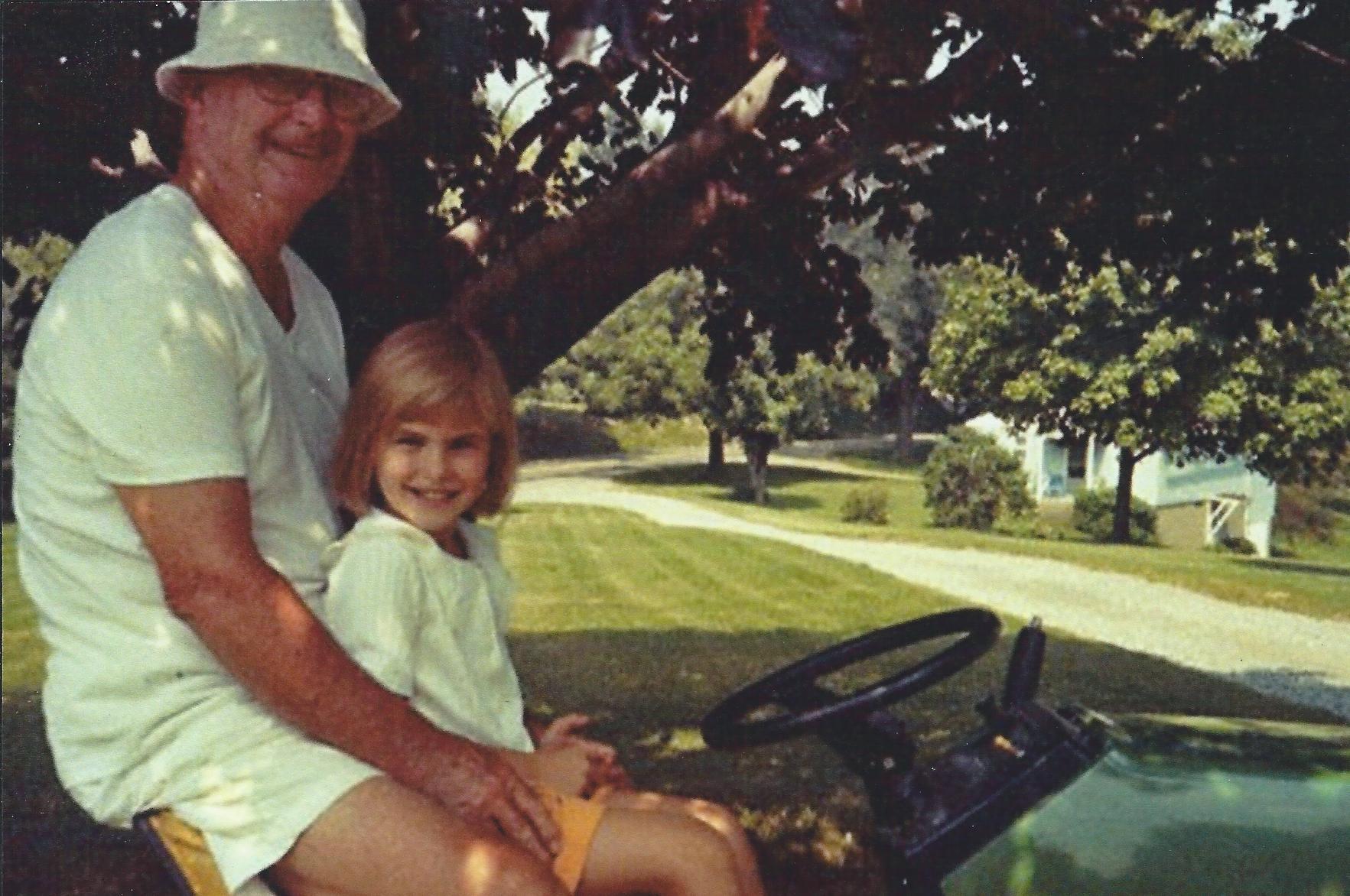
Grandads are great for tractor rides!

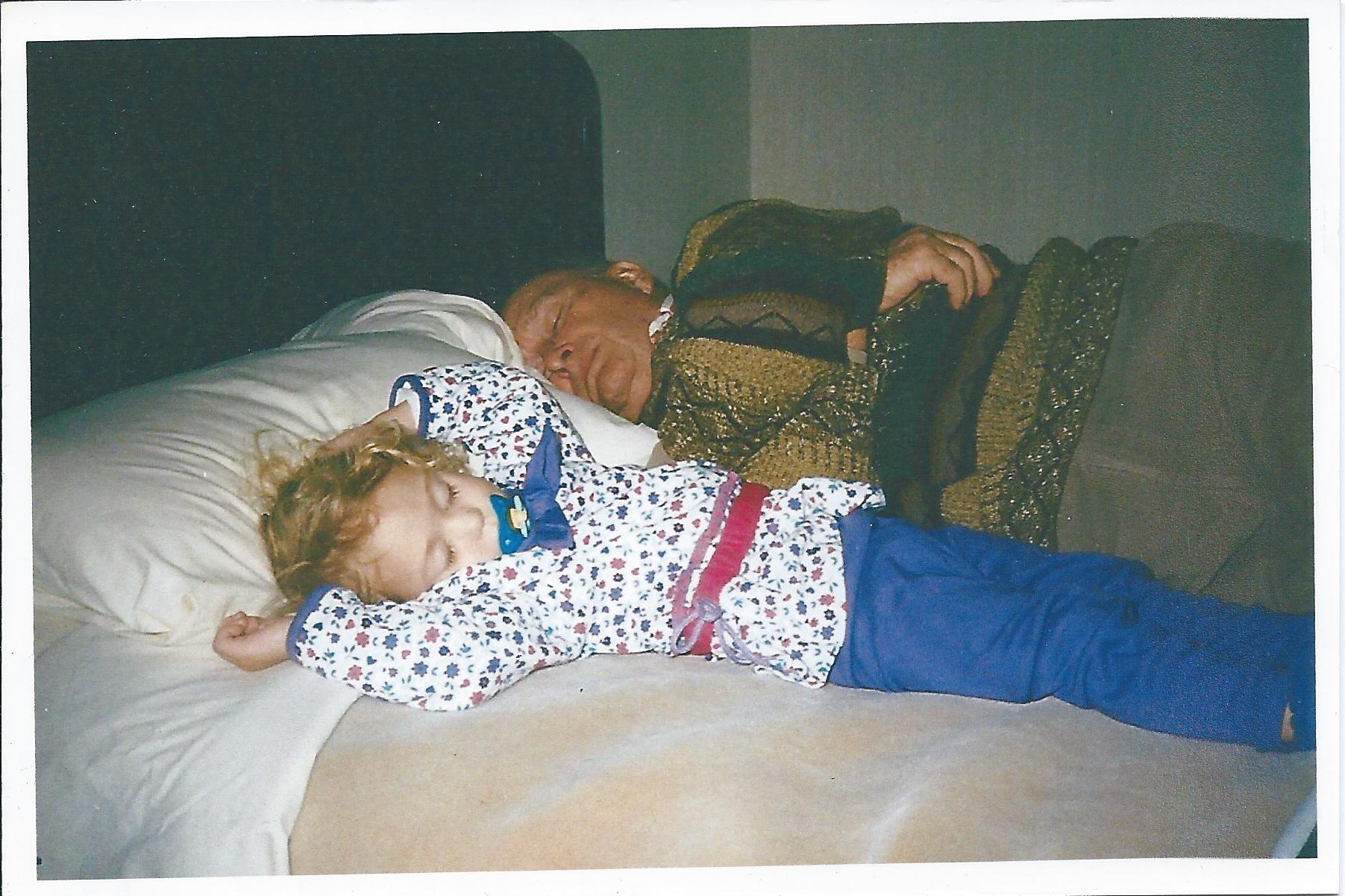
Dad and Amanda napping

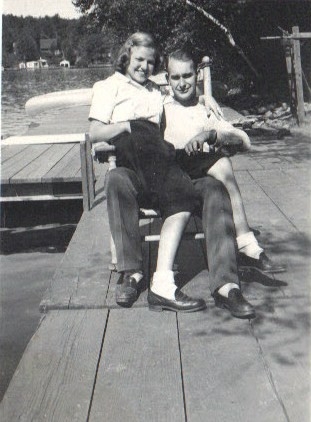
Mom and Dad on a dock. This might be on their honeymoon.

Dad and Aunt Ruth on their back porch on High Street ca. 1925.

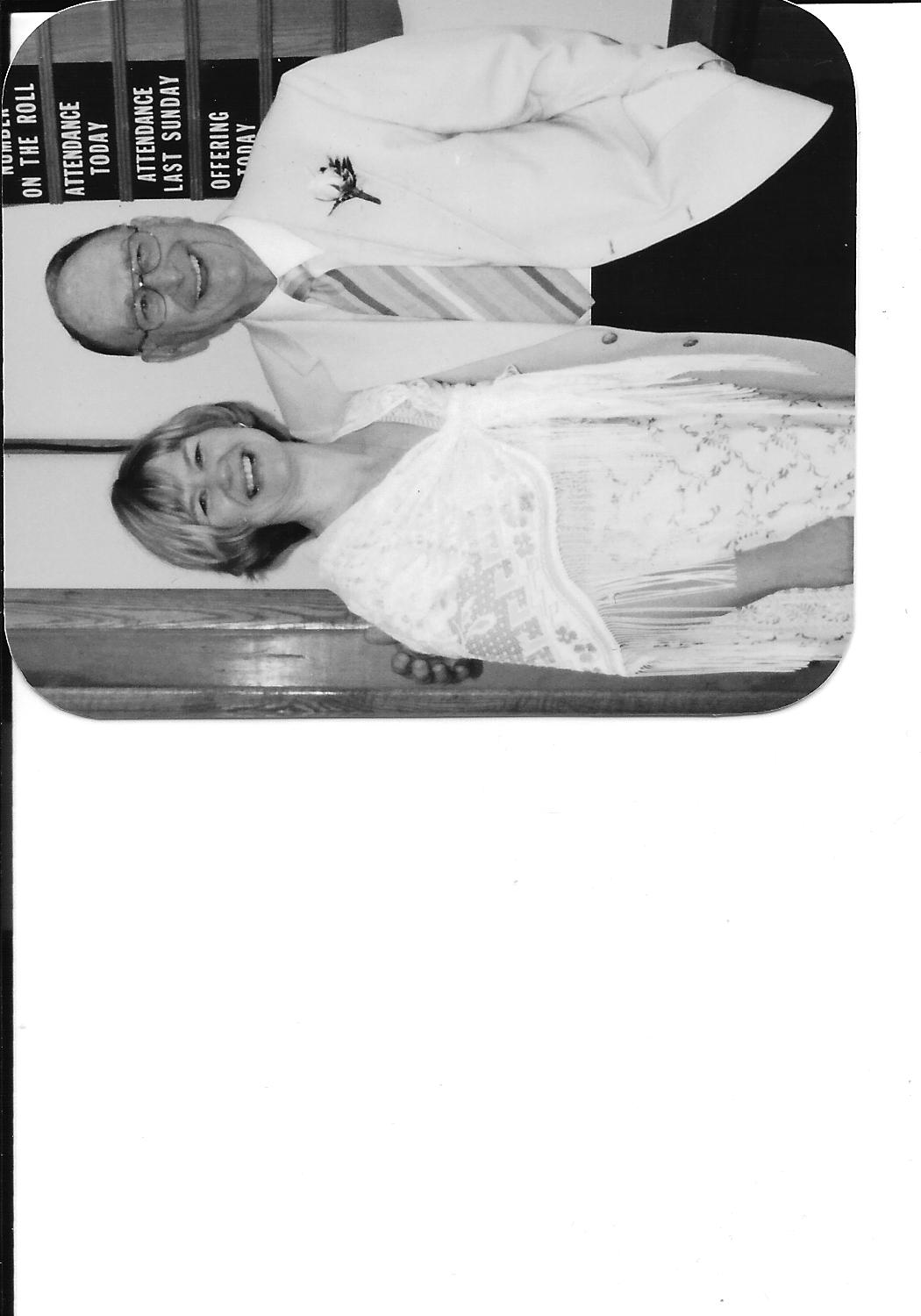
Dad and Aunt Ruth at Lauren’s wedding. This was the last time they saw each other.

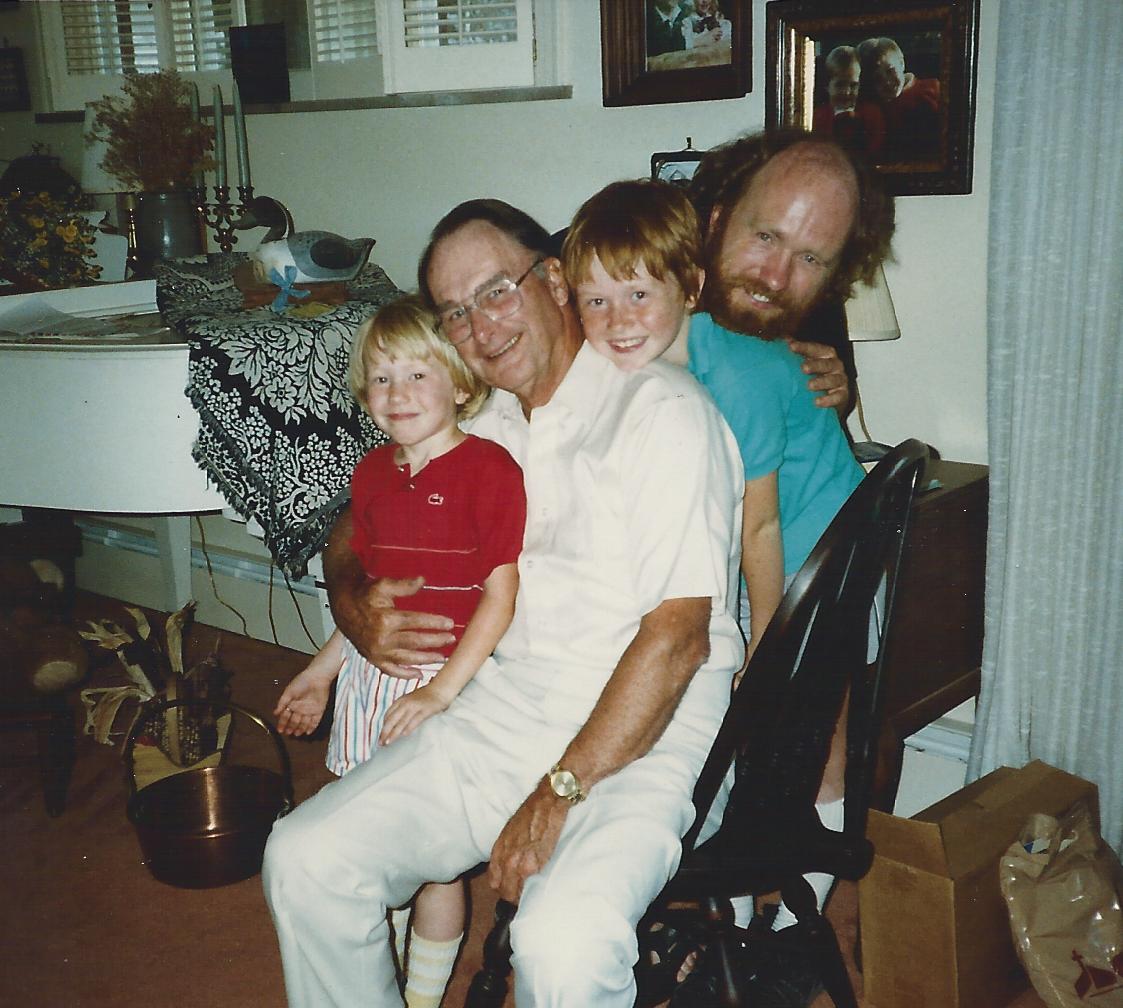
The kids and grandad