We knew we would have a huge apple harvest when the tree limbs started bending under the weight of the apples.
I picked off many, many, many little green apples, but I didn’t get the ladder out and cull the high branches. I should have!
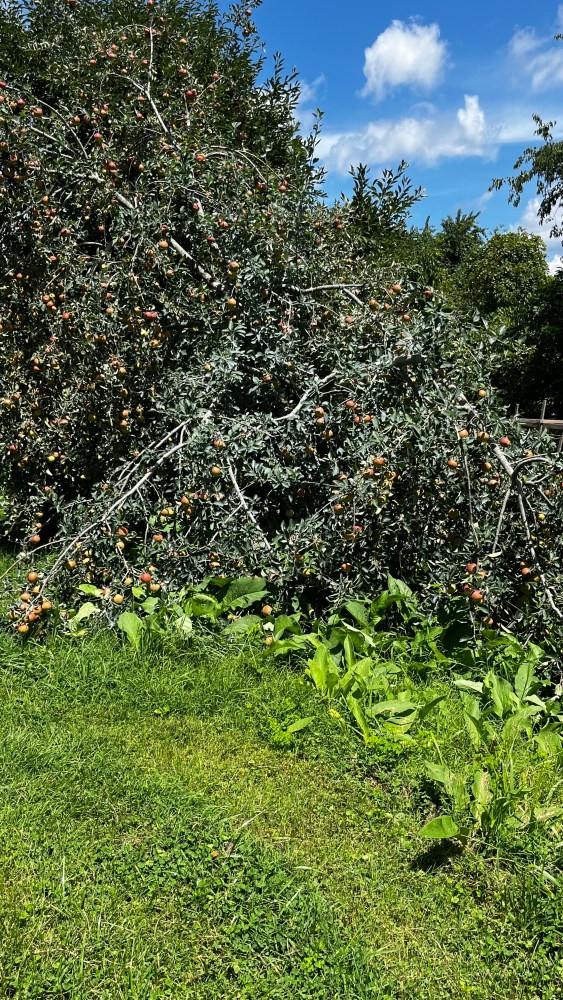
This poor Winesap tree used to stand tall and reach for the sky. Now it may be bent and weeping forever…
In mid-August the main Winesap branch broke right off, and we had to emergency-pick seven five-gallon buckets of half-ripe apples. We had to prop up several other branches on other trees and pick others before they were quite ready. By late August I had 10 bags of pie filling in the freezer, yet I had not enough time to even think about making a fresh pie. All I managed were a couple of crisps.

We knew we had too many apples and that the answer was cider.
We had a vintage press that we’d never even thought of using. In fact, a couple of years ago Mr. H.C. varnished a tree round and added it to the top of the press. Suddenly it became a high table with benches out on the porch instead of dust catcher.
One evening as we were staring at it, Mr. H.C. said, “I think there’s another piece to this up in the attic.” Sure enough, within 15 minutes, we were staring at the other vintage piece–a hopper. Both were made by Red Cross Manufacturing Co. in Bluffton Indiana, probably around 1920-40. We spent the better part of the next week cleaning the cobwebs and crud with a garden hose, a power washer, and an air hose. We did a final rinse with vinegar and water; bought some cheesecloth sacks; some sanitizing tablets; and couple of new buckets. We were ready for the grand experiment…


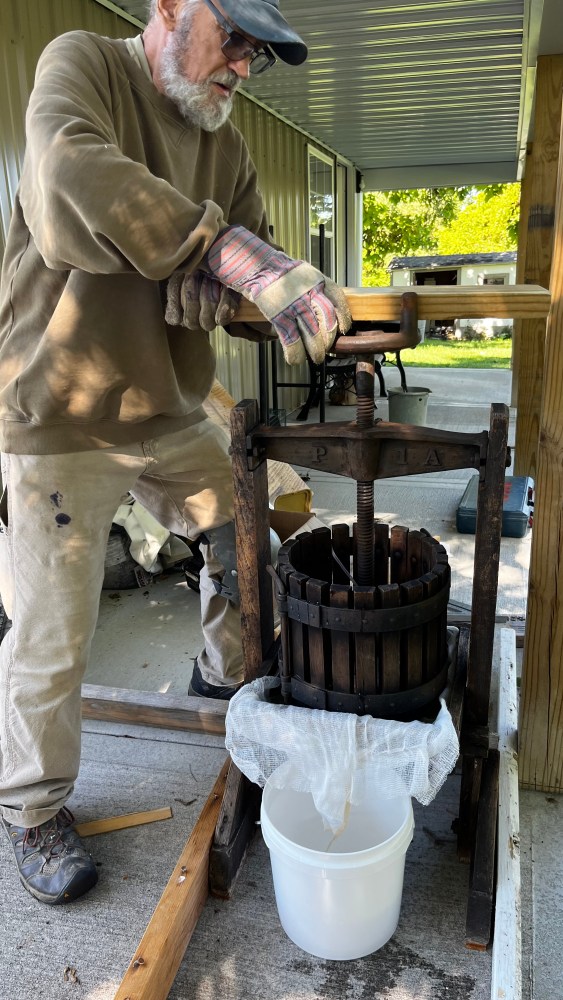
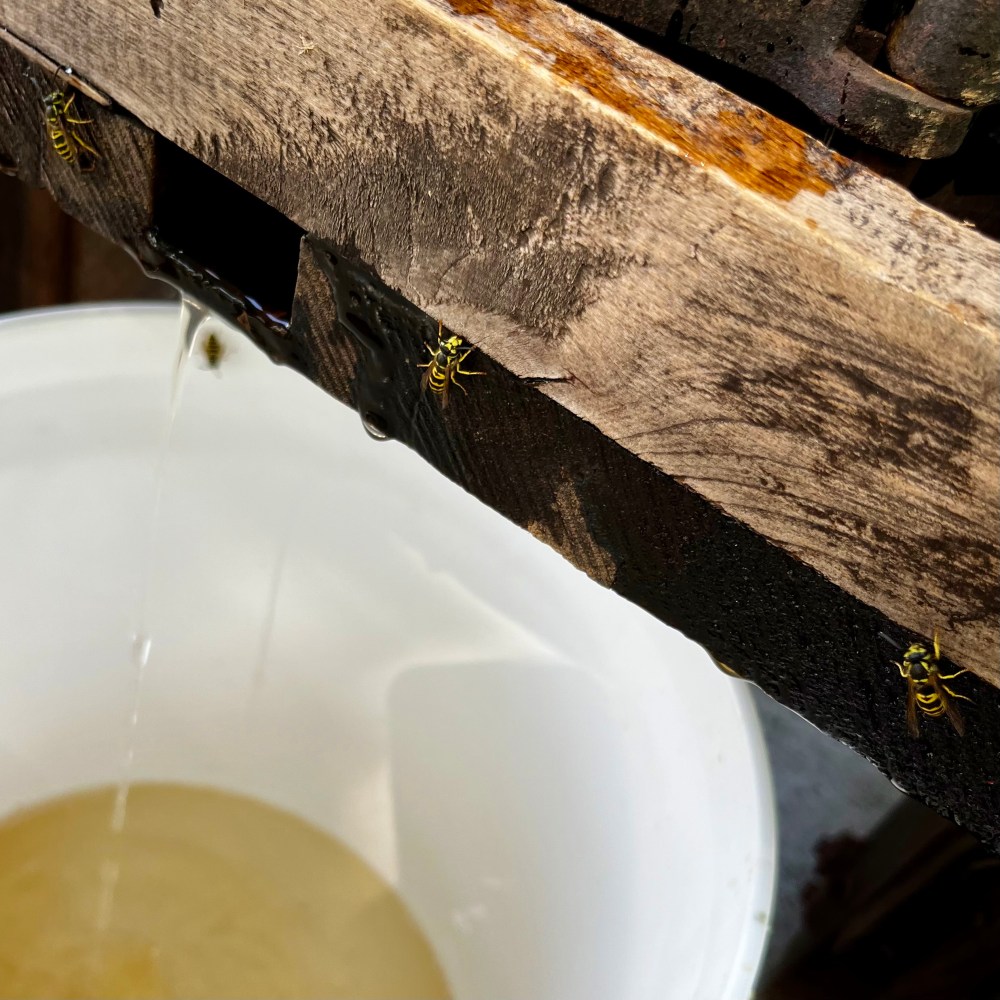
What we didn’t know was that the chopper/hopper was made for grapes. It really didn’t like to chop up the apples as they should be. So we had to chop the apples by hand–the smaller the better–before the hopper would grind them at all. And it really didn’t like the hard, green semi-ripe apples. So we used pears, and the other ripe apples that had bad spots and we just cut out the bad spots. We cut, and chopped, and pounded, and pressed for about 10 hours over two days. And no one got stung.


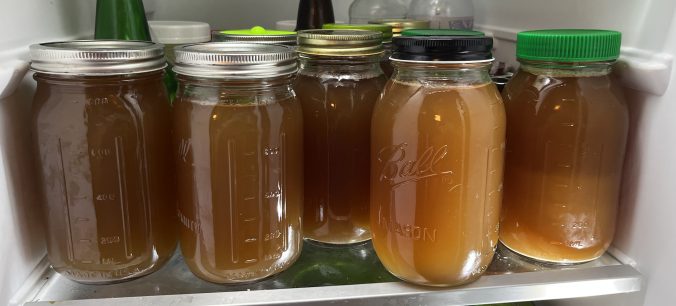
We ended up with about 2 gallons of pear cider, and about 4 gallons of an apple-pear mix. I canned ten quarts, and pasteurized the rest for half-gallon containers. (To pasteurize cider, heat it to 160 degrees for 30 minutes.)
But we still had so many more apples, and honestly? We were exhausted.
Yes. We did this to ourselves. What were we thinking? But truthfully, this is the first year it’s ever been like this. We think it is a combination of a very good year for Pennsylvania apples (Every wild tree is loaded with apples!) and that our trees are just now coming into a very fruitful maturity–5 to 7 years.
So we started an internet search to find a local cider press… Stay tuned for Cider Days, Part Two

 This is the cleaned up version. For the last three years it has been relegated to the floor of my upstairs sewing room where it’s been catching dust rather than putting out fires. And let me tell you, this baby catches a lot of dust.


 I don’t know much about him. My grandma, Nanny, always started to cry when his name was mentioned, so we never talked about him much. Mom only said that she was the kid sister, and just as she was getting old enough for them to be friends again, he joined the army and went off to war. He was a smart kid, an intellectual-type, who graduated from high school in 1943, went to college for one semester, and then went to war. A young boy who probably never wanted to be a soldier… and yet, he went, he served, and he died. At age 20.


 the circle of life