88. Stories from Apple Hill

It is the season of giving thanks and remembering our blessings.

And while I have much to be thankful for at the cottage (new windows, new insulation, and lower gas bills) today I’m going to be thankful for those who built and took care of this little cottage before us.

cropped-applehillrdclose.jpg

Joe and Clara named the road and made the signs. Now it is officially called Apple Hill Rd. and it’s even on Google Maps…

My grandfather, Pa, built the cottage sometime in the thirties after he bought the orchard. It was just a little two-room house at the time; it was what is now the kitchen and the living room. My mother told stories about her brother’s friends spending the nights out there on an occasional weekend and scaring themselves with ghost stories. My dad told the story of Pa shooting his shotgun in the air to scare off teenagers who were stealing apples in the dark. (I’m not sure how he knew that one…)

Mom and Dad at Apple Hill, ca.1949

This is the first photograph I have of the cottage. It was taken either right before or right after my mom and dad were married. There are several things I love about this picture:

  • My mom is skinny. (She would love that!)
  • Their smiles.
  • My dad’s tie.
  • My mom’s hair style.
  • My dad holding a cigarette. (Oh the forties, when everyone smoked…)
  • The delphiniums (or foxgloves) blooming behind them.
  • They are so young…

Mom also told the story of The Accident. (Some details are sketchy because I heard this story when I was young and never thought to ask for specifics; now there’s no one to ask. There is a lesson here…)

She was a teenager, dressed up to go out on a date. Pa was working late out at the orchard — it was his second job, being a farmer. I don’t know why Mom was out on the farm in her “going out on a date” clothes, but that was the way she told it. Pa asked her to drive the tractor into the big barn while he rode on the back in the wagon. I imagine she wasn’t happy about driving the tractor in her good black and white plaid skirt. As she was driving, Pa reached down to do something with the connection between the two vehicles and his hand got caught. He screamed, but she couldn’t hear him in the noise of the tractor. Bleeding, they raced the four miles to the hospital in the truck–Mom driving– but Pa lost the top knuckle of his ring finger. Whenever we asked him about it, he would just shrug and say it was an accident. Mom was the one who told us how it happened.

IMG_3220Pa was a teacher, a principal, and he retired as the county superintendent of schools, but I remember him always dressed in his farming clothes. Dark green or gray matching shirt and pants — he wore the suit of manual labor as proudly as he wore his business suits. He let us kids ride in the back of the truck as he bounced around the orchard. And he built bleachers for the bushel baskets of apples around the large oak tree in the front yard. As kids, we used to run around the bleachers, jumping from level to level, listening to the zing of the boards as we landed.

Painting of Apple Hill Cottage, ca.1973

This is the way the cottage looked as I remember it as a kid.

Aunt Mary and Uncle Leslie lived in the cottage from sometime in the fifties until around 1973. Aunt Mary sold the apples from the bleachers in the front yard. Water problems always haunted the cottage — there was a well in the side yard with a hand pump where Aunt Mary got water for cooking and drinking, and there was a cistern in the other side yard for non-potable water. Aunt Mary was an Italian farm girl married to a Welsh miner. When my dad died I found her naturalization papers in his desk drawer.

Later, probably after their son Bob was born, they made a small kid’s room in the living room and added a split level basement with a large back bedroom over the foundation. It has hardwood floors and early sixties type trim around the doors. Neighbor Betty has told us the story of a young Bob who was playing with matches in his bedroom (or maybe smoking?) and set part of his room on fire. He was so afraid of getting in trouble, he ran away — all the way to the big apple barn down the road.  He was found later that day in the hay loft, where we were never allowed to go as kids. As we took off walls and plaster in the cottage living room, we thought we could see scorch marks on some of the ceiling joists. (Bob, if you’re out there reading this, please let us know your version.)

Cider barn and shed

The little barn has a refrigerated basement and that’s where the cider was stored.
Joe and Clara built the little garden shed. This spring it will get a facelift with a window box and new paint.

Mr. H.C.’s mom and dad, Joe and Clara bought the orchard in 1973 from my grandfather who wanted to retire–at the age of 81. Clara told the story of Joe coming home and announcing that he was thinking of buying the orchard, and how would she like to move? When they went to see the cottage, Aunt Mary was there and not particularly welcoming to the people who would be buying her house. She had lived there for thirty plus years and was now going to have to move to an apartment in town. Clara was moving from the house where she had lived for almost twenty years –the house they had built, the house where she had raised her family — to a humble cottage in the country that needed repairing. Two women, two stories; if these walls could talk….

Joe and Clara took out the little bedroom and made a larger living/dining room. They also made the garage into the garage bedroom and enclosed the apple stand to make what they called The Gazebo. They took up the bleachers and made shelves along the walls for Clara’s treasures. It was called the Treehouse Yard Sale.treehouseyardsale2
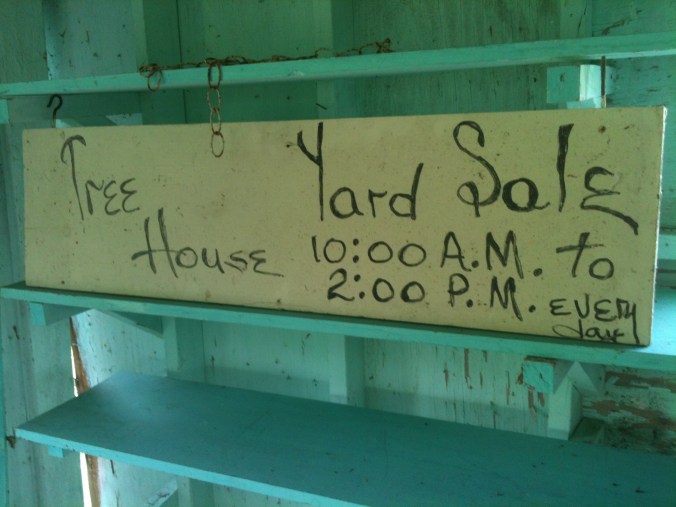
We found this sign inside the Gazebo hanging on the old door.office hours

It is totally Joe’s corny humor and we smile every time we read it.

And we found this on the back side of the step that goes down into the garage bedroom:IMG_3209We added our names next to theirs — with the date of Aug. 12, 2011.

Telling a story is like reaching into a granary full of wheat and drawing out a handful. There is always more to tell than can be told… —Wendell Berry in Jayber Crow.
86. Demolishing the strongholds

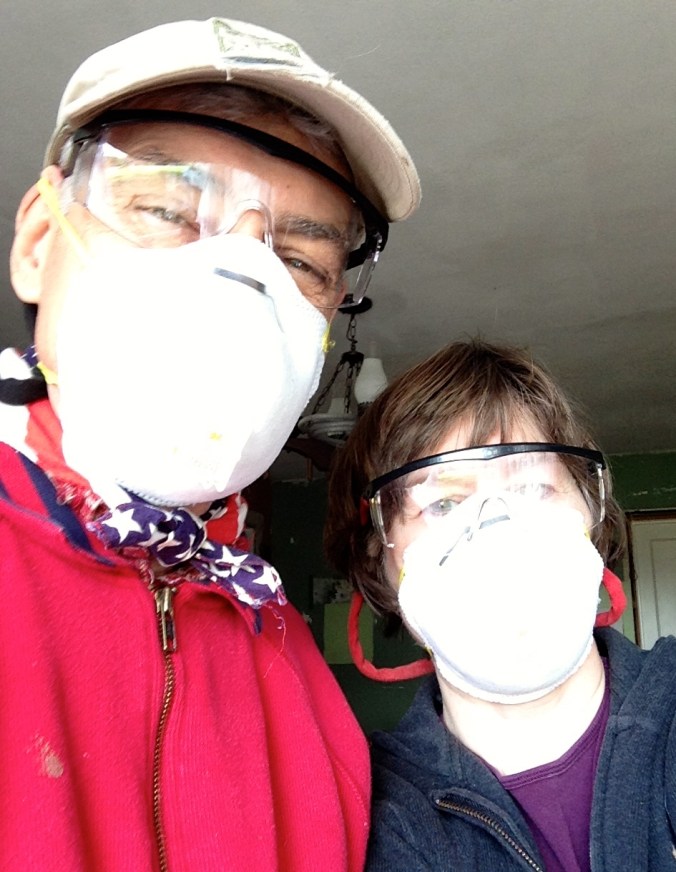
We strapped on our armor this past week. We were doing battle.

safety glasses and masks

Against the creatures who have lived and died in our walls.

What is living in the walls of your house? The better question might be phrased What is dead in the walls of your house?

IMG_3012
It isn’t pretty, and it isn’t picture-worthy. What? You say, you don’t really want to see pictures of Dead mice, Old nests, Dead ladybugs, Old hickory nut shells, Scat, and Spiders? Throw in dirty insulation, rusty nails, and forty-year old newspapers that have been stapled to the walls? And dust, lots and lots of plaster dust…

Lesson learned: If your house is neglected, unwanted creatures will move in to dwell with you.

I actually wished that the newspapers were in better shape — I love looking at old newspaper ads and reading articles from the seventies would be fun. But the newspapers were of the sort that couldn’t be touched without gloves — heavy duty work gloves, that is.

This newspaper is dated March 14, 1974.

This newspaper is dated March 14, 1974.

I have stopped dithering about what is to be done next and decided to just go with what is. Or what will be? Everything we do to this old cottage is an improvement; so does it matter if one project isn’t quite finished before we start the next? Or, more accurately, does it matter how many rooms are torn up in the effort to finish them all?

Lesson learned: Demolition of walls is only fun once it is done.

IMG_3009

The view from the living room through the holes. The mudroom has already been gutted; the living room is on its way….

The holes in the mudroom lead into the living room. An air conditioner was once there; a log box for storage and easy access for fireplace logs was once there too. Now they are just gaping holes that have to be repaired. Wiring is another issue. The wiring in the living room is just hodge-podged up there and has to be fixed. The electric panel is in the mudroom, and right now with those holes between the two rooms, it is a perfect time to rewire the living room too.

When we bought the window for the mudroom a few weeks ago, we also ordered a new series of windows for the living room. (Can’t pass up a sale on Anderson windows!) In order to take out the large window in the living room to replace it, we had to take off the current trim and a bit of the old paneling. Once we had some of the paneling off, there was a terrible stench. We have had bad smells at this place pretty often; we have torn up carpet, peeled off wallpaper, and scrubbed walls to get rid of smells. This one was very bad, so we had to keep tearing out to find the root of the evil, er…the smell.
Living room wall demolition

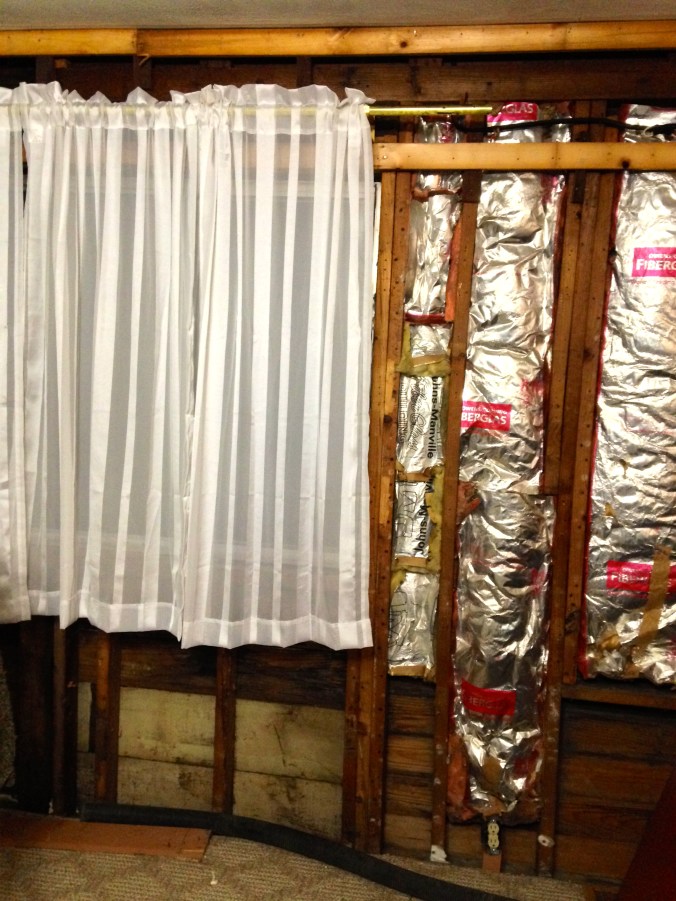
We are now down to bare studs on the living room wall. (We were hoping this wasn’t the plan…) But three dead mice later, the smell is gone. So now insulation is a necessity too.

Lesson learned: Every part of a house is interconnected.

We thought we would be doing this cottage one room at a time. It’s easier to manage that way; it’s easier to think about one room at a time. But the inter-connectedness of the wiring, walls, roofline, ceilings — all makes that impossible to do. And I’m okay with that — finally.

My post on the finishing of the kitchen that is ready to be published? It will just have to wait. And that’s okay too. After all, the whole house has to be finished for us to get featured on This Old House anyway. 😀

Lovely expensive sheers (K-mart special) hanging next to bare stud walls and insulation. Is this like leather and lace?

Lovely expensive sheers (K-mart special) hanging next to bare stud walls and insulation. Is this like leather and lace?

There are many lessons in this post, but these three should be repeated:

  • If you neglect your house, unwanted creatures will move in to dwell with you.
  • Your house is interconnected; it can’t be dealt with one room at a time.  
  • Demolish the strongholds of ugly stuff today; the longer you wait, the bigger the job.

IMG_3028

85. Dithering

We spend a lot of time dithering…

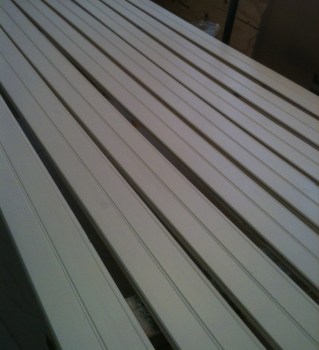
siding boards

Trying to figure out every angle before we start, so we won’t be surprised.

It never works, and we just end up with a work stoppage.

Yesterday, after a morning of spectacular dithering, I wondered to myself why we don’t discuss these problems on the way back and forth from house to house. We’ve got plenty of time; the drive is at least an hour, and that’s if all the cars and drivers are behaving. (And the cat; when the cat misbehaves we end up with a conversation stoppage…).

But then I realized that we don’t discuss these problems because they are Unforeseen. Unexpected. Unknowns.

While we were dithering
about the project
before we started,
we never thought THAT
would happen,
even though
we thought
that we had thought
of Everything
causes dithering again.

Painting of Apple Hill Cottage, ca.1973

When the cottage first became ours, it was rather like a new romance. Oh, we wandered around thinking of possibilities — how grand it would be if we could put in hardwood floors here; and maybe we could raise the roof there; and perhaps if we enclosed this part of the back porch it would make a lovely guest bedroom…
The basic plan was to bring the cottage back to the way it looked originally (as close as we could get it, at least…) That wasn’t dithering; it was dreaming, and wondering, and expanding possibilities.

But the honeymoon is over now because we have spent almost every spare moment working on this cottage. Nothing can surprise us now, and some of the charm has been lost in the reality of sweat, blood, finances, time, arguments discussions, and just plain exhaustion. It’s an old house; suddenly we have to move to plan B because the furnace blew up. Or suddenly we have to leave Plan A to fix the roof because it is leaking. Or suddenly we have to change Plan A because the new siding isn’t quite the same as the old siding… Can we just be done already and get on with life?

No? Then, let’s at least stop dithering and get on with the plan. (Uh, was that Plan A or Plan B?)

The troubles come when glitches occur in the actual plan. Sort of like life? Glitches abound. And are we going to dither; or are we ready to accept the problem, embrace the setback, and make the delay part of the plan?
peeling paint
And here is where Jesus can help. If we are trying to live life according to His plan, well then, it’s His plan — it’s not our plan. We just like to think it’s our plan and that we are in charge. And when we get too uppity about it, God will remind us. Most of the time He reminds us gently, and that’s when we are to say, “Oh, yes. God, it is yours, not mine. Forgive me for trying to take over.”

Lawn chairs in fall

Sometimes it’s a big thing; sometimes we just see through the glass darkly and we fight and kick and struggle for weeks, months, years… until the glass clears and we finally get it — the fight belongs to Him, not us. He made us and we are his. We are his people, the sheep of his pasture. (Psalm 100:3) 

We dither because we are sheep. I know, it’s not a pleasant comparison, but there it is. Picture sheep running around the gated pasture bleating in confusion. Going nowhere and running in those circles cause befuddlement, bewilderment, agitation, and demoralization. Don’t ask me how I know this… (Read Luke 15 to be reminded. I need to be reminded of this often…)

But we have a good shepherd to lead us — one who never gives up on us no matter how far we wander;

mist in the hills

one who loves each one of us not because we are good, bad, black, or white, but simply because we are his;

one who constantly cares for us if we would just allow it.
the heavens

Note to self: Dithering is believing that your own plans might be better than God’s amazing plans! Embrace the delays and know that you are being taught something important.

Note to God: “Yes, God, it is truly yours, not mine. Forgive me for trying to take over.”

IMG_2959

Amen.