11. Lights, Hardware, Action?

The kitchen cabinets are looking creamy and shiny — the luscious color of steamed milk. They are ‘curing’ in the garage bedroom, and before we leave them for awhile, I have a confession to make : I spent as much on the new hardware for them as we spent on the cabinets themselves.

20120706-224308.jpg
The bottom two handles are from an antique cupboard that we bought from the E.N. Miller Antique Mall (***** 5 stars) in Verona last year. It is the bottom to an old schoolhouse cupboard that held art supplies. We will be using it as the island in the kitchen. It has great charm, but could be considered by some to be in rough shape. More on its transformation later…

The handles are wonderful — old, heavy, off-set pulls — and I wanted those exact handles for the other cabinets. I found them online at VanDyke Restorers. I’ve blanked out how much they were individually, but the final total was about $280. (I missed out on the sale price by “thinking” about whether I really wanted to spend that much. When I made the decision to buy — a day later –they were two dollars more!)

I confess to having measured the holes on the cabinets. And I ordered 3″ handles. They don’t fit. The holes are actually 2 7/8″ apart. Stupid me, I assumed that handles were uniform on the half inch. I guess that is modern cabinetry. Carpenter husband assures me it’s only a minor glitch, but the cabinets are painted, and I’m ready to dress them up with their finery, but now we have to drill new holes. Patience is being taught here…

20120707-214220.jpg

Painted cabinets awaiting their handles.

The next step is the lighting and that means rewiring (not MY job) before the ceiling can be installed. This is what Michael reads before bed:
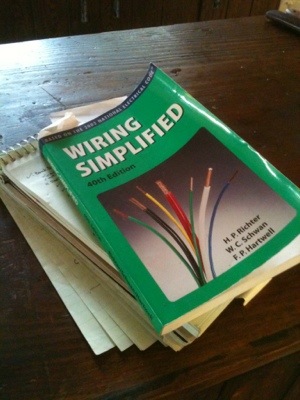
20120707-214942.jpg

Bedtime reading — It puts him right to sleep!

On to the fun stuff — the lights. Michael hung them temporarily so we could visualize and also see if the kitchen was bright enough. (Yes, at our age we like lots of light — no squiggly bulbs here!)

These are just up temporarily, so ignore extensions cords hanging from them! (We are visual learners…)

The light in the center is over the island; the ones that are pendants are on either side–over the sink and over the pass-through. (I think we will lower them a couple of inches.) I realize that’s backwards and most people have hanging lights over the island, but we tried it and like this better. It’s more symmetrical, and I like symmetry! A LOT! When I see the asymmetrical, I want to go fix it.

And now, back to the island cabinet…Michael spent many hours on these beautiful doors:
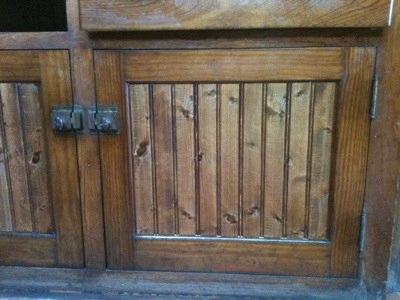
20120707-222303.jpg
The center of the doors was originally veneer. It was warping and buckling so I scraped it off, and we decided to put thin wainscot on because that’s what is on the inside of the cupboard. They looked like this:

Before…

He painstakingly beveled all the edges and then had to get just the right stain mix to match hundred year old wood.

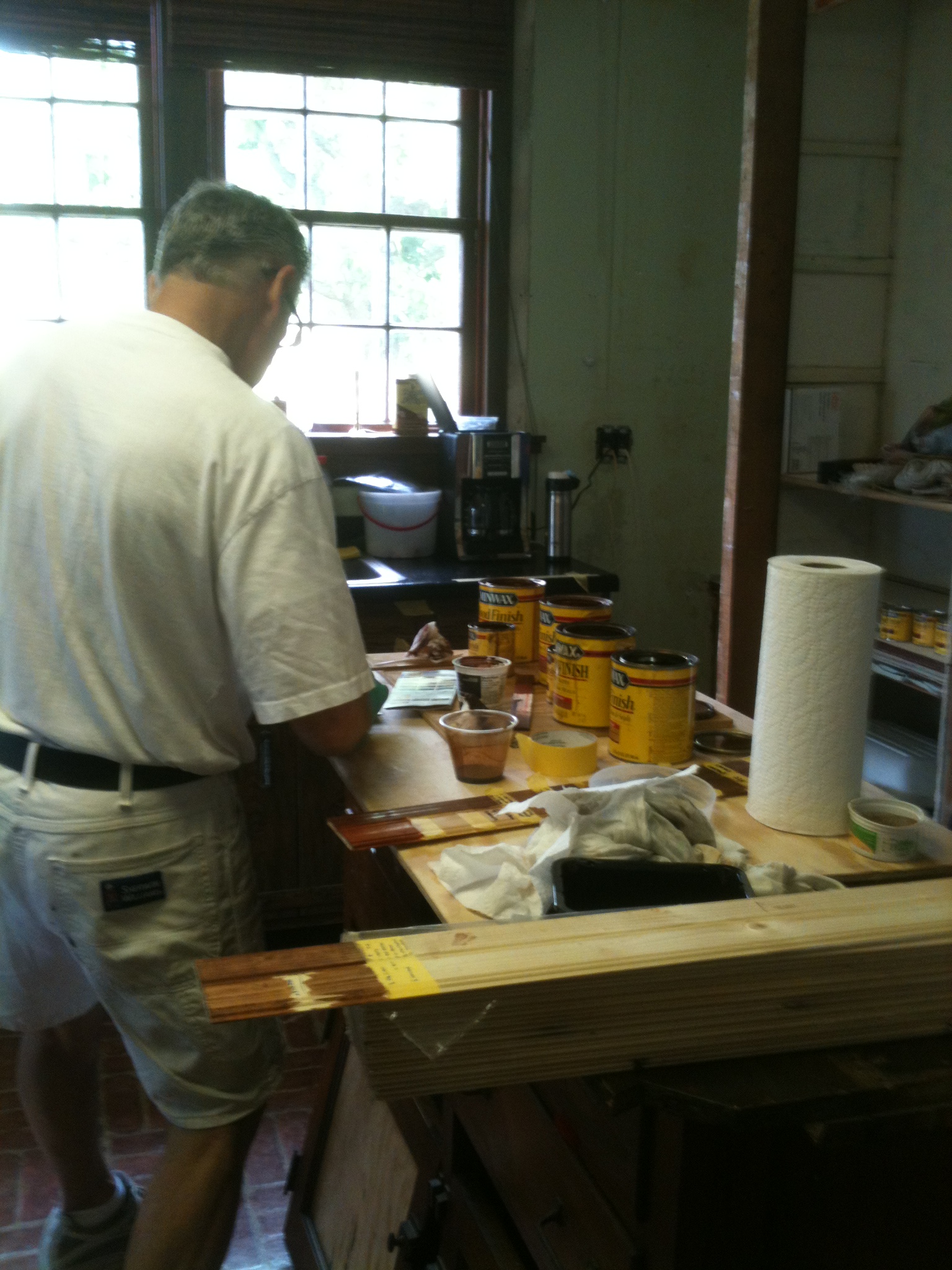
20120707-223026.jpg

The mixologist at work…

We also spent time researching what kind of finish was on the cabinet and how to clean it. The librarian did the research, the woodworker did the experimenting. (What a team!) We determined it was lacquer and cleaned it with a mixture of linseed oil and turpentine. They were detailed instructions and if you want the full article on cleaning and restoring shellac, lacquer, or varnish you can find it here. http://www.ca.uky.edu/hes/fcs/FACTSHTS/HF-LRA.053.PDF We still aren’t finished with the cupboard, but it looks lots better already, and the doors look like they were original.
20120707-224516.jpg

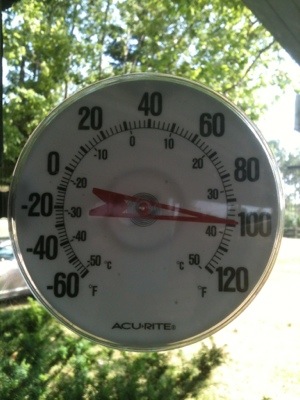
With the temperature hitting 100 degrees, we were glad to work inside in air conditioned comfort.

How amazing that we have air conditioning in our humble cottage when our walls look like this:

20120707-225038.jpg

and this:

It looks like someone took a shotgun to it, but it was really just Clara’s picture wall. It was covered with photographs. She must have moved them around a lot…

(Sigh…)

Patience is being taught here…

7. Imperfectly Sanded, Imperfectly Primed

Kitchen Cabinet Redux:

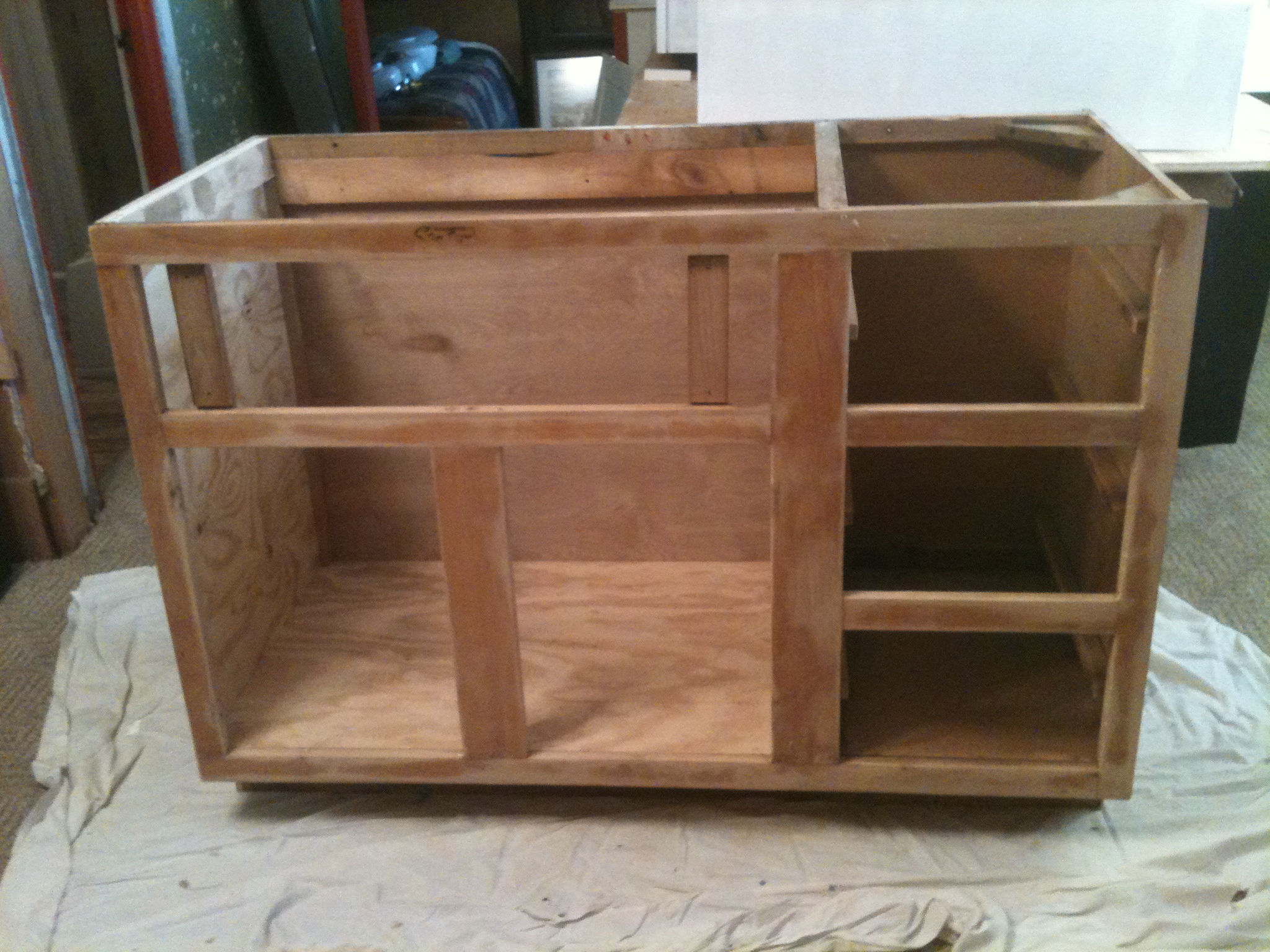
We bought the imperfectly sanded, imperfectly primed kitchen cabinets in two different places at two different times. The first (and main) batch was purchased at Construction Junction for $225. They include 3 base cabinets and 4 wall cabinets in almost exactly the sizes we needed. The sink base was seriously injured–it was in such bad shape that it was almost a deal breaker. We tried to get them to come down in price because of it, but they were firm. We left the cabinets there the first time, thought about it overnight, and went back the next day. They were still there. (Surprise, surprise–everyone else thought they were supremely ugly as well!)

It took Michael an entire day to rebuild the sink base. Here are before/after shots:

On the dolly headed for the workshop…

What a difference!

While sanding the sink base, I found a clue as to its origins: on the top was stamped William Schenck & Co., Inc. and underneath were the words Step Saver. When I googled these words I found a fragment of a newspaper article from the Pittsburgh Post Gazette, May 31, 1952. Apparently the cabinet company was going to have a display booth at the brand new, state-of-the-art Greater Pittsburgh Airport. The cabinet company was located in Evans City, PA. Judging from the quality of workmanship, I’d say these were not expensive cabinets. The owners didn’t take care of them well either. Four layers of paint scraped off at the same time, which left only the original varnish to sand off.

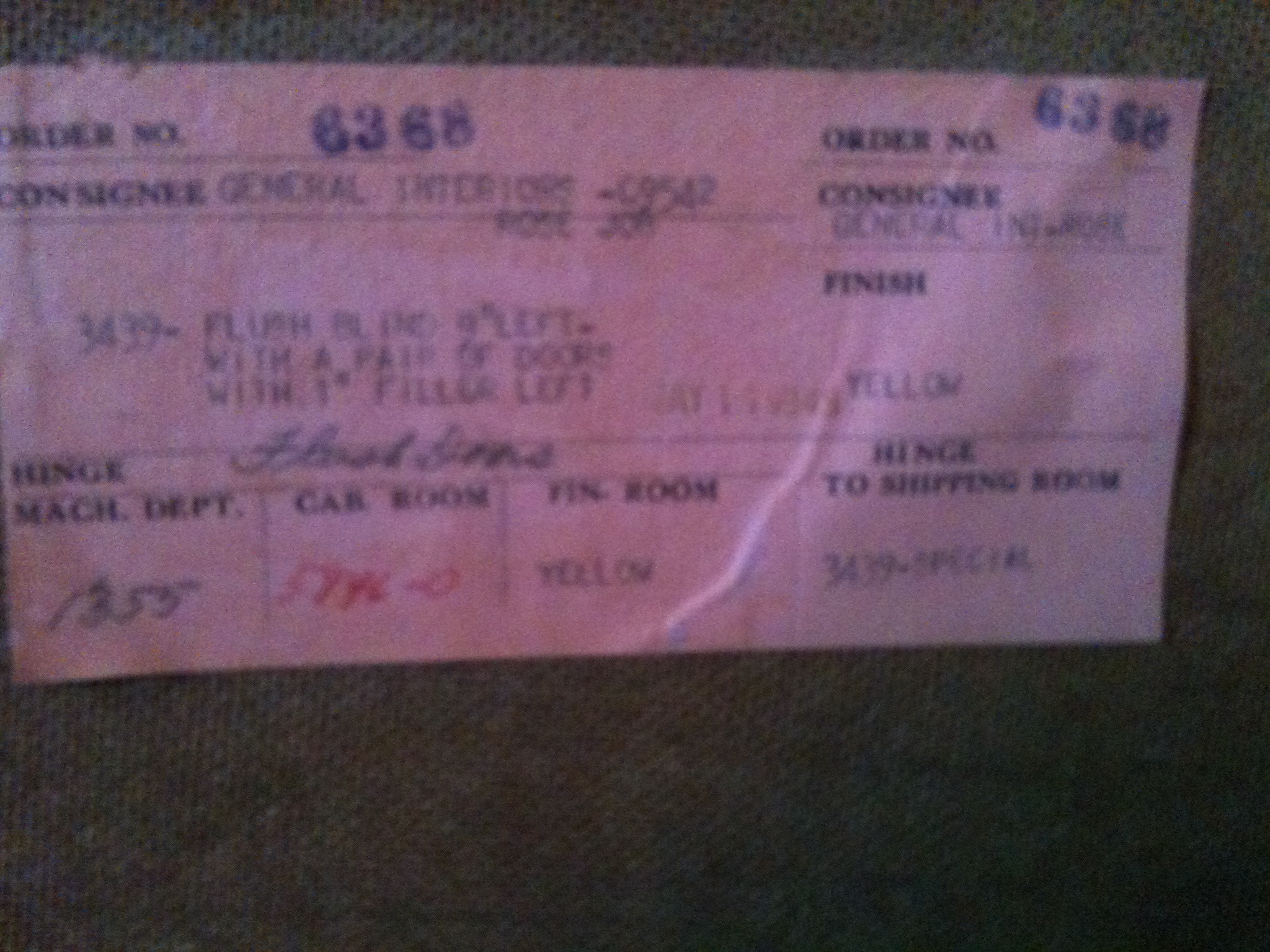
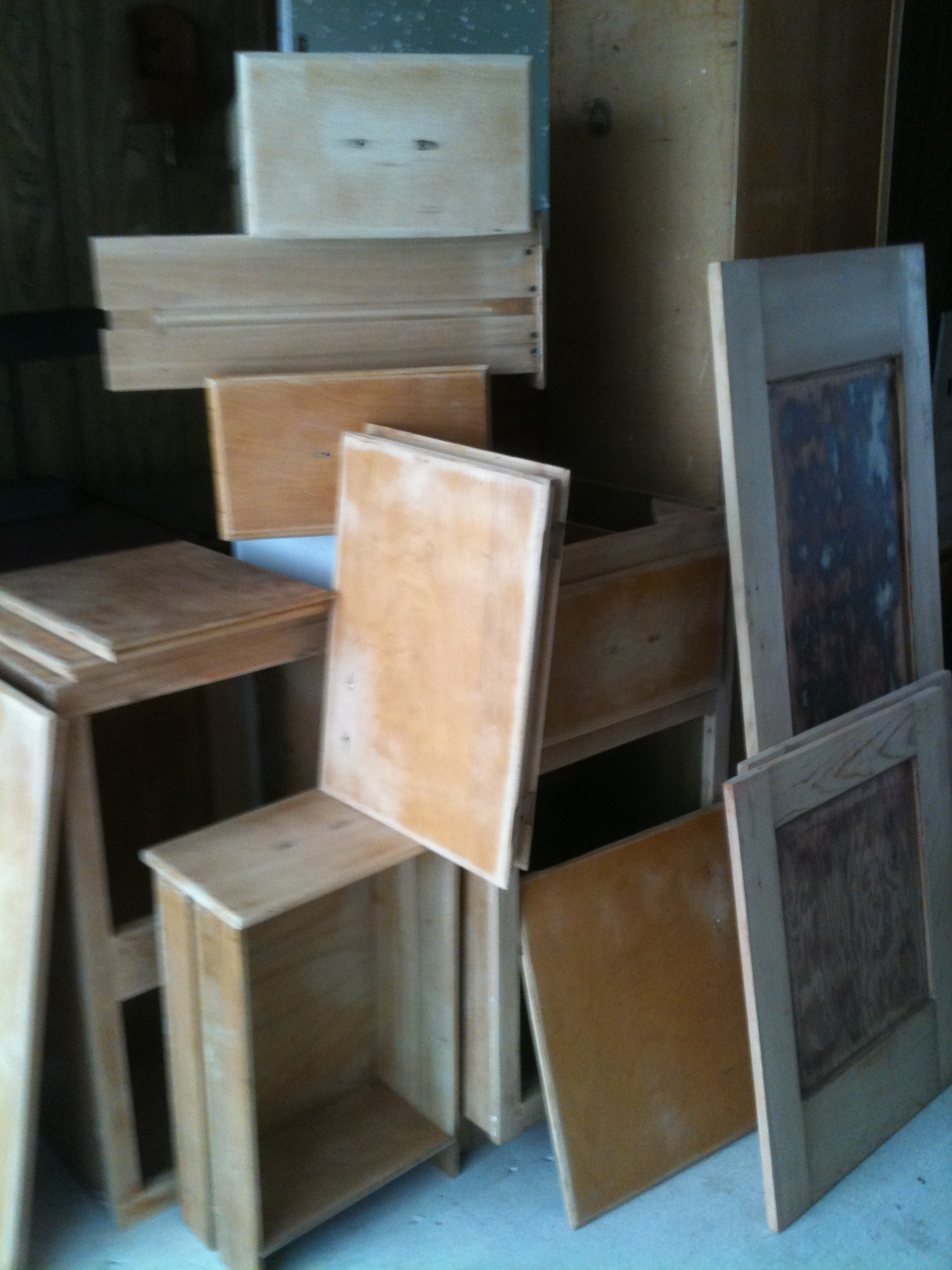
The second batch we found at the Habitat for Humanity ReStore in Edgewood. These were much nicer and higher quality cabinets, both in the way they were manufactured AND in the way the owners had restored them. They were primed; they were painted beautifully in a very nice shade of high-gloss cream. I spent some time wishing the paint wasn’t chipping off in key places. I even asked Michael if they could just be touched up? Of course, the answer was no. We bought 3 wall cabinets–two for $35 and one for $40. Two are exactly the same size; Michael will build a base for them, and they will be re-purposed as a pass-through/peninsula/bar between the kitchen and the dining room. To finish, they will get a butcher block top made from Sapele wood from the Hardwood Lumber Company in Ohio. The third cabinet has lovely glass doors (which is why we bought it) and, as yet, it is place-less. While sanding them, I found a tag on the back dated May 11, 1949.

Tag found on the back of the high end cabinets dating them in May of 1949.

It says they were to be made for General Interiors for the Rose job. These cabinets are made of poplar–no plywood here–and are very heavy and expensively made. Mrs. Rose must have had a yellow kitchen, for underneath the nice cream paint is a sunny shade of BRIGHT yellow. Yes, an early 50’s kitchen color!

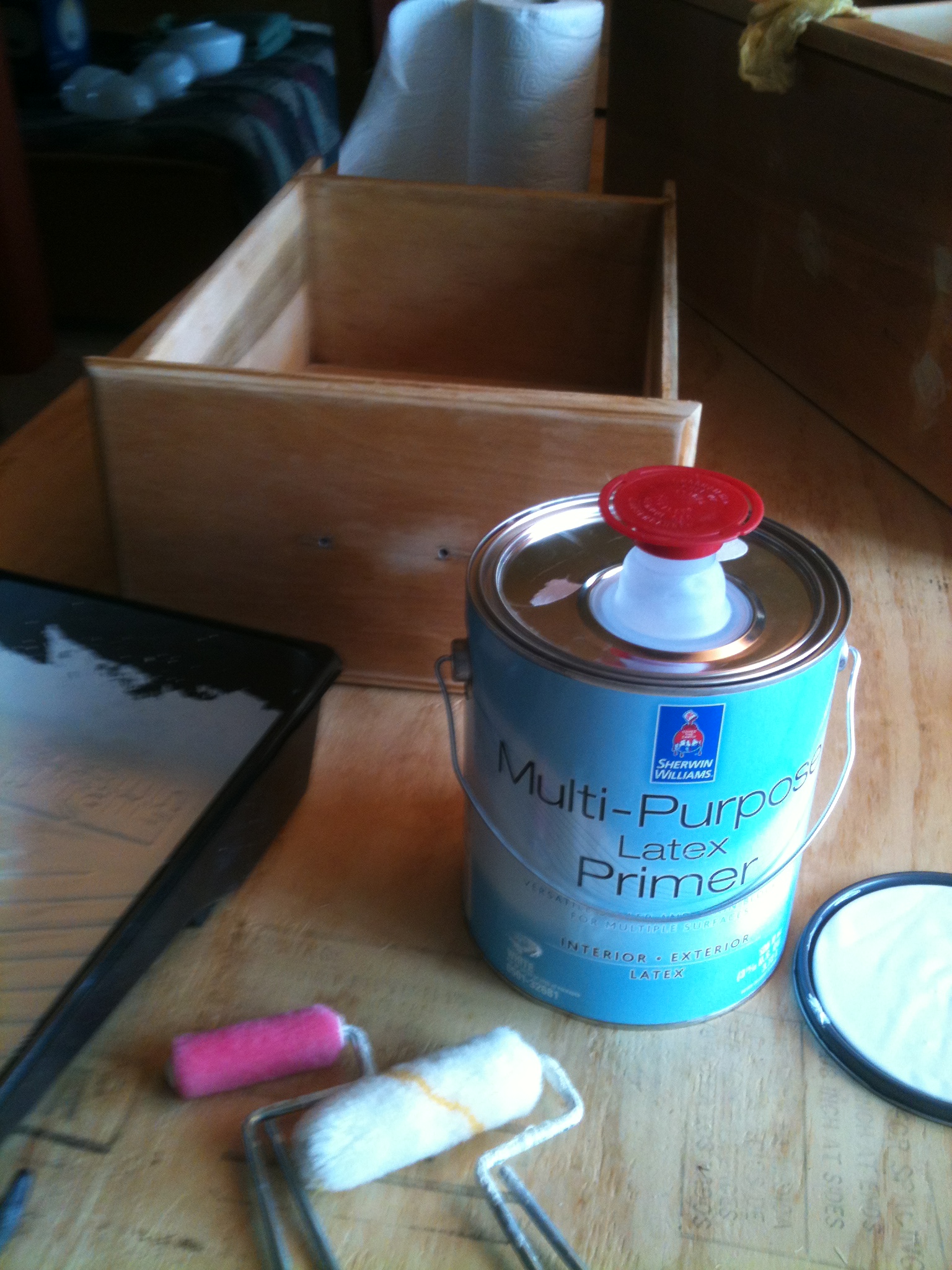
The cabinets are ready,

The tools are set,

Let’s go Prime!

Some tips for priming:

  • Put on some good music or a book on CD. Priming is as boring as sanding, but it’s not as LOUD! One can actually hear the birds singing outside.
  • Have a clean rag and a dish of water near by for goofs. Not that anyone would goof…but if one would happen to get a spot of primer somewhere it doesn’t belong, a wet rag applied immediately will help.
  • We are going to use oil-base paint to finish the cabinets, but Missy at Sherwin-Williams assured us that using a water-based primer will be fine. It sure is easier! If your cabinets aren’t as well sanded as ours are :-) you can buy adhesion primer that is miraculous stuff and will stick to everything. It is $$$.
  • Primer dries quickly, so don’t put much primer in the paint pan. Have both a brush and a roller handy, but keep them moist with primer, so they don’t dry out. And don’t go away and forget to cover them. Clean your brush when finished, but a roller will keep overnight in a plastic baggie if you tape it up tightly.
  • I worked on two drawers/doors at once. By the time the second one is done, the primer has dried on the first one, and it can be turned over and finished on the second side.
  • Prime the spots that need to be brushed first; then go over the brush marks with the roller. (All tips courtesy of Homeworks Contracting, Inc.)

    The corners are brushed on;

and then finished with a roller.

The cabinets are almost ready to be painted. The only step left to do is to sand the primer lightly with a fine grit sanding block to get rid of bumples.

And the next installment is: Painting the imperfectly sanded, imperfectly primed kitchen cabinets. (I’m sure they will be imperfectly painted as well…)

6. Tearing Down Walls

We were a bit hesitant to tear out walls.
Dusty, everyone said.
Old Plaster, Mr. H.C. said.
What will we do with it? I said.

I was a bit hesitant to write on this topic of walls. So metaphorical, walls are. Especially tearing them down.

I could wax poetic, except I’m an unexceptional poet.

I could philosophize, except I’m an unexceptional philosopher.

I could spout theology, except I’m an unexceptional theologian.

I’m even an unexceptional photographer–it’s especially difficult to take pictures of walls that aren’t there any longer.

Wikipedia tells me that the word wall is from the Old English word weall and it is a vertical structure, usually solid, that defines and sometimes protects an area. In fact, if walls divide and separate us, I could discuss the new trend in houses that opens up kitchens to the living areas of a house. So do we want an undefined and unprotected kitchen? Yes.

I have read Jane Powell’s books extensively. I love them. I love her humor, I love her authenticity, I love her strict ideas against “remodeling.” Don’t do damage to your old house, she says. If you keep to its period, no one will hate you down the line in 50 years. No one will have to rip out the trendy 4×8 sheets of fake paneling that you have carefully installed in the family room. I especially liked Bungalow Kitchens, and yes, I read The Bungalow Bathroom too. I renewed them both until the library wouldn’t let me keep them any longer. She says, Never under any circumstances should one listen to an architect who suggests changing your bungalow to an “open plan.” (Not a direct quote, but pretty close…)

Two points are especially important here: 1. We don’t, technically, live in a bungalow. 2. We didn’t hire an architect.

1. We don’t technically live in a bungalow. Although it was built around the time of many bungalows, and it might fit the definition, as in being one story and a modest, affordable dwelling, it has no architectural presence. There’s nothing that makes it stand out except maybe the clipped gables (also called jerkinhead gables–I don’t know where to start with that one, so I think I’ll leave it alone…) No beautiful woodwork, no congruency–as Dad said, “Well, that house grew like Topsy…” (from Uncle Tom’s Cabin by Harriet Beecher Stowe). The closest the cottage gets to architectural charm is a couple of built-in cupboards and a big brick chimney, all of which we are taking great pains to keep.

The outside of the houses look similar, but the floor plans don’t match.

I did find a lovely rendering of an Aladdin kit house that was sold between 1949 and 1951 called the Potomac. It was an Economy house and sold for around $1500-$2000, depending on whether you bought the pergola porch. The houses look remarkably similar. I’d like to use this as inspiration for what the house should look like on the outside when we are finished.

2. We didn’t hire an architect. No, we didn’t. Brother-in-law Jim is the closest to an architect we could find for free and he said, “Oh, take out this wall. Yes, take it down.”

Yahoo notes that, “The most important thing to do before tearing down a wall is to determine if the wall is structurally necessary.”   Mr. H.C. is an expert on whether walls are structurally necessary or not. Daughter Maggie can attest to that! She hired a contractor who took out a structural wall. We happened to be visiting a week or so later. Mr.H.C. took a couple of looks and then they sped to Home Depot to buy studs to support the spot where the wall had been taken out. Then they had to hire a structural engineer  to figure out what to do next. THAT contractor was sorry!

So Mr. H.C. climbed up into the crawl space above our bathroom, dodging cobwebs and spiders and checked out which way the joists and rafters run. Turns out to be safe to tear ’em down.  Full Speed Ahead:  Open up the room; Let in the light;  Make the kitchen bigger; Cook with your friends!

Walls are human made things. There is nothing (that I can think of) in the natural world–in God’s creation–that was the prototype for a wall. They were made to define, to protect, to separate, to divide…. That’s not to say I’m totally against walls — walls around a bathroom are a fine idea :-) — but mostly God wants the walls around us gone.

It’s scary taking down walls. What if you take a support wall down and the structure starts to crumble? What if you expose what’s underneath? Let me tell you, it’s guaranteed to be ugly and it’s also guaranteed to be hard work, and there will be surprises. So why even try?

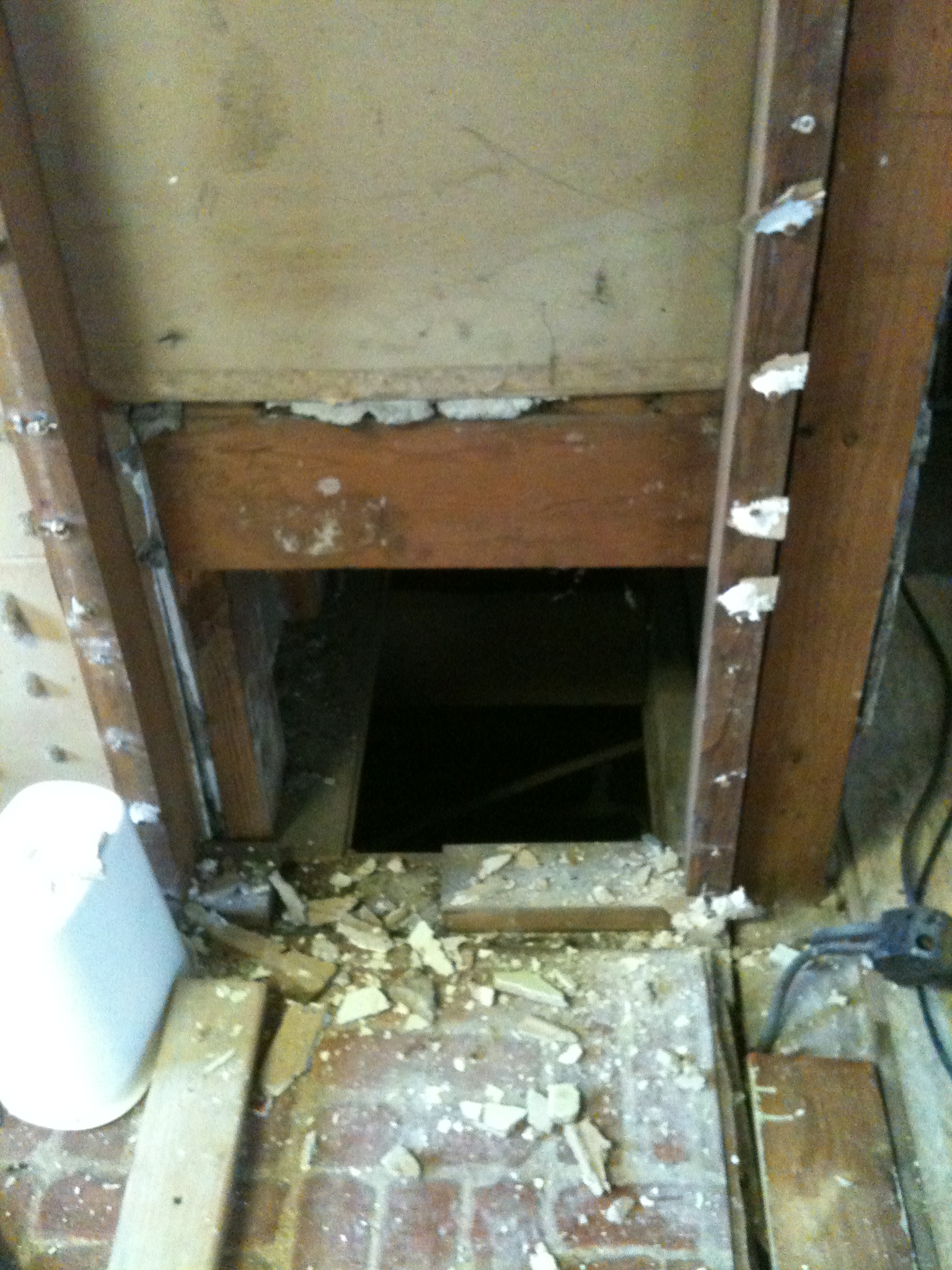
This is a picture of the floor where the wall was–yep, it’s ugly!

And this was the surprise. A real hole that was never finished. Now we know where all those bugs come from…

Why try? Because when that wall is down, it opens up the room that is your heart; it makes the room bigger; it lets light into your life;  it allows for true relationships, both with people and with God. So Full Speed Ahead, let the walls come crashing down!

Let in the light!

The walls we took out are still being supported by studs until the beam goes up, so any pictures posted here, will not look as if the walls are cleanly gone. But I can’t resist–Something there is that doesn’t love a wall / That wants it down. / I could say “Elves” to him, / But it’s not elves exactly… (The Mending Wall by Robert Frost.)

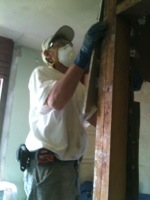
No it isn’t exactly elves. Here is Mr. H.C. taking out a piece of the wall. (We actually took out pieces of three walls.) 20120622-231320.jpgIt wasn’t wood lath and plaster, which is what most people think of as old, dusty plaster. This was plaster board coated with plaster. Mostly it came down in chunks. We researched it (it’s organic); tested the paint (no lead); and then wheelbarrowed it down to the hillside and tossed it over. We’ve since covered most of it with dirt and weeds, although I must admit, it was hard to throw those first few pieces. It just didn’t seem ‘green’. (But neither is Wasp Killer or Mole-Away…) Just think of it as fill.

Jim the architect said, “That is SO West Virginia.”

EEEYup. It is.

AWYSG (Always Wear Your Safety Glasses)