the sorrowful song of the trees

You will go out in joy and be led forth in peace; 
the mountains and the hills will burst into song before you, 
and all the trees of the field will clap their hands. Isaiah 55:12

That’s always been one of my favorite verses — the image of the trees rising up and swaying their branches in joy to the Savior is a powerful one for me. (I always loved Tolkien’s Ents, too.)

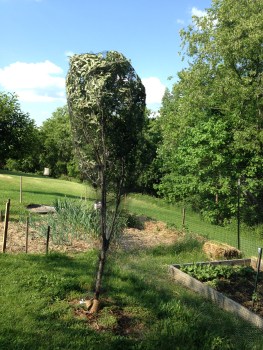
But the year of 2016 paints a grim picture of trees cowering in fear from the plague of giant flying periodical cicadas. (Yes, I’m sorry, another post on cicadas. It’s what’s happening here at Apple Hill Cottage.)

This is the oak tree at the side of our house. The oaks seem to be a favorite and sustain the most damage.

The only websites I can find that tell the truth about these creatures are the Penn State and Ohio State agricultural offices. At the bottom of the Penn State article it says, (I’m paraphrasing) Your trees should be fine, that is, unless you have 4-year-old or less fruit trees. Then you’re in big trouble.

The adult cicadas are gone now. I can go out in the morning and actually hear birds singing. But the damage they have done to the trees is disheartening. Our yard is littered with broken little branches.


The female cicadas lay their eggs in small shoots at the edges of trees. This is a close up of the slits they make.

Each female can lay up to 400 eggs in 40 to 50 different sites. By my unofficial count that’s about a gazillion cicada eggs on our 2.9 acres… So we are gathering up prunings of branches, both fallen and cut from trees, and burning them.

Tonight we undid the netting on the two trees we covered. As of now, it doesn’t seem like our efforts made a difference, but the branches are not done dying… We pruned back the trees by about a third. The apples seem to have been hit the worst; the two pear trees the least; the beautiful little cherry may make it, but will never be as symmetrical as it was this spring before the cicada plague began.

Mr. H. C.’s beloved Honey Crisp tree went from 10 feet tall to 6 feet. We’re just grateful that we were slackers this spring and didn’t do the early spring pruning.

Pruning from a Honey Crisp apple tree after the decimation of periodical cicadasThat pile of branches is from one tree. Note the tree in the far background. No, it isn’t October!

Why did we not know that to plant our fruit trees 3 or 4 years ago was, in effect, dooming them from the 17-year-locusts? Why did we waste money, time, effort, and love on these six beautiful little trees? What? Oh, NEXT YEAR is the year to plant fruit trees because then they will have 17 years to grow and be fruitful before the next horde arrives.

IMG_7053

Most people are just delighted that the awful bugs are gone. Everyone has a story about someone they know who was outside doing chores and opened their mouth at the wrong time. It was bonding, living through this plague — there was always something to talk about with strangers in line at the grocery store…

But from everything I’ve read about the life cycle of Magicicada Septendecim, once they hatch in the twigs (after about six weeks) they are the size of grains of rice and they drop to the ground. Really? Cicada maggots the size of rice dropping from trees? I originally thought the dead branches fell with the eggs in them and that’s how the larvae got to the ground. But this quote below is from the OSU Entomology Dept.:

Cicada eggs remain in the twigs for six to ten weeks before hatching. The newly hatched, ant-like nymphs fall to the ground where they burrow six to 18 inches underground to feed.

It definitely implies that the nymphs fall through the air, doesn’t it? There’s something to look forward to in August!

I need a wide-brimmed hat with a veil more than ever…

A Plague of Cicadas

Once in awhile 

God sends us a reminder

that we are human 

and God is God.

Every seventeen years Magicicada Septendecim (periodical cicadas or seventeen-year locusts) emerge from the deep mysterious underground. It takes seven to ten days for the adults to shed their exoskeleton and mate. Here in the Southwest Corner of Pennsylvania, this is the year.

Yes. They have emerged.

And this seems a fine time for me to emerge from my own writing cocoon. I’ve designed and redesigned the blog; thought and rethought;, written and rewritten; and the best I’ve come to is, yes, i need to write.  And I probably shouldn’t wait seventeen years to restart.

These cicadas just beg to be examined.three stages of periodic cicada

In the week that I have had this post in my draft box, I’ve re-written it twice, and renamed it three times. As the cicada plague worsens, so does my attitude towards it. At first it was fascinating, in an ugly, horrifying way. Now it has just become horrifying.

Some of those who study such things predict 1.5 million cicadas per acre. That’s 4.3 million giant ugly bugs that have just gotten their wings on our property alone…Need I say more? With my trusty smasher I walked our buildings this afternoon and killed 178 253 375. That’s three hundred seventy-five less, right? As the days wear on, I reckon between the two of us, we kill 500 per day. And yes, some people eat them.

The experts say Keep Calm and Carry On: the adult cicadas aren’t hungry and it is the larvae who will damage the precious little branches of your fruit trees. But these flowers sure look damaged to me…

These used to be pretty impatiens...

These used to be pretty impatiens…

The truth is maybe they aren’t hungry. But they are thirsty, and they latch on to one’s beautiful flowers (that one has just bought for $85 at a nursery–including a gorgeous hanging basket for $30) and drink the water out of them, and the plants die.

It is a beautiful Memorial Day Monday and I’m sitting inside writing this post, because I don’t even want to go outside. Can I truly hibernate in the cottage until mid-July?

Our Winesap apple wrapped up in netting…

We’ve wrapped two of our fruit trees with netting, and then it seemed to us we might be wasting our time; plus we ran out of netting. So I guess we can call it a grand experiment. What troubles us the most is that two of our apple trees had many many little precious apples on them… Lovely little green and red swirly marbles that we were counting before they hatched ripened… And the female cicada’s dream house? A fruit tree branch 3/4 inch in diameter where she makes little slits and lays her eggs.

I am reminded of a plague of locusts of biblical proportions. Floods, hurricanes, plagues — yes, we are humans and God is God. I am like Lot’s wife, not trusting that all will be well, and looking back one last time to get a glimpse of beautifully tended flowers, vegetables, and fruit trees — a landscape that only existed in my April dreams.

Seventeen years. It’s a long time to incubate in the ground. My neighbor told me that the ground most infested is undisturbed ground, especially near trees. There’s a metaphor here too, I’m sure. If you don’t turn over that ground of your soul, if you don’t keep it plowed and ready for seed, it gets infested with stuff that you don’t even know is there until seventeen years later…  And then it looks like this:

This is just a sweeping of one corner of the porch. I had three piles this size in the space of two hours.

This is just a sweeping of one corner of the porch. I had three piles this size in the space of a half-hour.

I’ve been reading some odd stuff about these cicadas on the Internet. Our local bakery is roasting them and serving on them on omelettes and making chocolate chip crunch cookies with a roasted, sugared cicada as garnish. I’ll pass, thank you. I don’t think eating insects with red eyes is good for you. Plus, I’ve squished a lot of these things and have seen what’s inside them. Ugh.

There is even a web page called Cicada Mania where you can buy coffee mugs and t-shirts with cicadas emblazoned on them. If any of you want a coffee mug of these bugs, just let me know and I’ll send you some. We have more than our share. I can put some on a t-shirt and sent them to you too, if you’d rather…

And then I read comments like this: Enjoy them… Please don’t kill the cicadas, or let children use them as torture toys. They have waited years and years underground for this brief climax of their lives, when they turn into winged creatures whose joy is sunlight and mating. When the food supply in their bodies runs out, they die. They cannot eat. And by sheer numbers, they provide food for birds, small mammals, reptiles and in death, fertilize the trees…

I’m pretty sure this commenter is a city apartment dweller and her front porch doesn’t look like this:porch covered with periodic cicadas

or her house walls like this:Periodic Cicadas on house wall

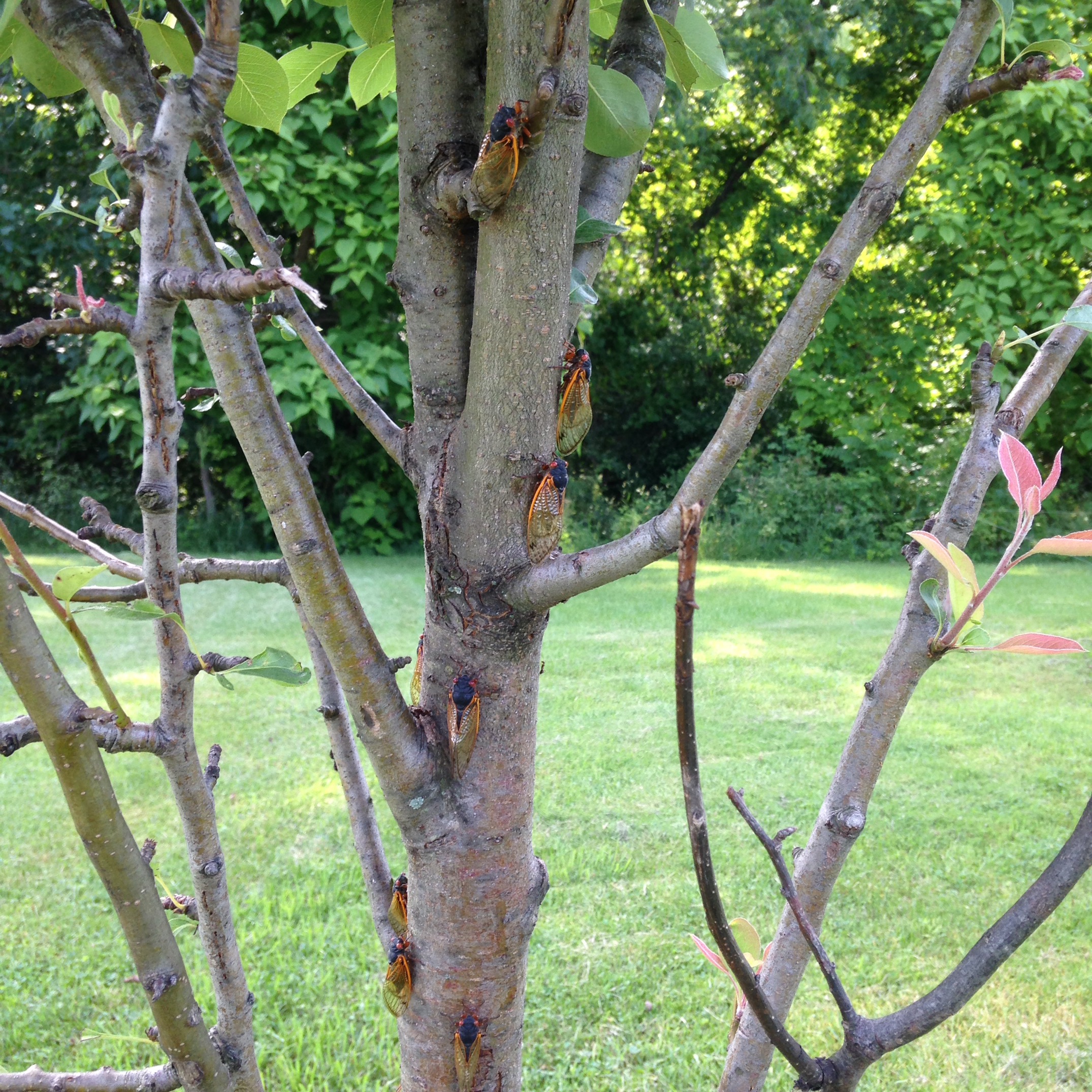
or her fruit trees like this:

Seventeen Year Locusts on apple tree

or her front yard tree like this:

periodic cicadas on sycamore

 Oh, wait — don’t kill the bugs… their joy is singing and mating and sunlight. Tralaa-tralaa….

Bah, Humbug!

And if these photos weren’t ugly and graphic enough, here is a video. It is totally amateurish, but it is taken right outside our front door. When shooting it, I moved about three feet and 360 degrees. The background is the cicadas singing. I’m told the males sing to find a mate. They don’t have to go far…

The plague is supposed to be over by mid-July. By that time, the dead bodies will have rotted, the smell will be gone, and probably the apples too. I’ll keep you posted… In the meantime, no one is invited to the cottage this summer — Not that you’d want to visit after seeing these pictures.  

138. the missing bees

I lied.

In a post a few weeks ago, I waxed poetic about the blooming catalpa tree in the side yard. And I said, “Birds and bees love her”.

This year there were no bees buzzing around the catalpa blossoms.

I know because the hammock is hung on the lowest branch of the giant catalpa tree, and this year, the only hammock hazard was from falling catalpa blossoms. There was no potential problem of a bee sting, because there were no bees.

In a beginning backyard fruit tree orchard, this is not good.

In an effort to see if the bees have really disappeared, we stopped mowing the back yard and let the clover bloom. There actually seems to be more clover in the back yard than grass — perhaps a leftover from when clover was routinely sown between the older apple trees.

And we watched.

Over a period of a week, we saw about ten honey bees in the clover (and five rabbits, ten deer, and a groundhog).

This has become such a worry that Mr. H.C. has actually suggested we buy a hive of bees for next spring.

We’re thinking of buying the hive, the bees, and some supplies, and asking a friend to take care of it the first year, while he is mentoring us. This is quite a step for Mr. H.C. — he actively dislikes bees — though neither of us is allergic to their stings.

It has become a national anxiety about bees. You can read about the issue here and here and here. No one will say exactly what the problem is, but to me, a non-scientific, tree-hugging, crunchy, suspicious-of-all-big-corporations type of person, it is obvious. Pesticides.

Duh. If we spray to get rid of insects, we’re going to get rid of insects, yes?

It’s called Colony Collapse Disorder (CCD for short) and since 2004-2005 beekeepers have reported a loss of bees in their hives from 35 to 90%. What is most mysterious is that rather than finding dead bees around the hive, the bees just disappear. And once I started reading about it, there are several dozen reasons/theories/government plots for the disappearance of the bees. (To be fair, there is a wide range of opinion –some people doubt if the bees are really disappearing and some people think the bees are being abducted by aliens….)

But if you want to be concerned about this issue, consider these points (that are all taken from the above articles.)

  • A full third of the American diet is dependent on pollination, and wild and domestic honeybees are responsible for 80 percent of pollination.
  • About 200,000 species of plants rely on insects and a majority of those rely on bees.
  • Commercial beekeepers are often feeding their bees on high fructose corn syrup, a questionable man-made sugar substance at best; a cancer-and-diabetes-and-obesity causing substance at worst.
  • Not surprisingly perhaps, organic beekeepers have not experienced CCD, leading to speculation that overall greener management practices could be the answer even if direct causes are not determined.
  • If honey bees disappeared, the following crops would be affected: tree fruits — think apples, oranges, pears, lemons; tree nuts — think walnuts, hazelnuts, cashews, almonds;  garden vegetables — tomatoes, beans, squash, cucumbers, onions, pumpkins; alfalfa and clover — think hay for animal feed;  berries of all sorts — straw, blue, cran, black and razz; coffee; cocoa; cotton; flax;  and you can read a much longer list here. (And also to be fair, I must note that we have a bumper crop of raspberries this summer, so something is pollinating the berries.)

So come next spring, we may look like aliens ourselves. But we won’t be abducting bees; we’ll be helping to pollinate catalpa trees.

And apples and peaches,

and cherries and beans,

and pumpkins and peas…