Cider Days, Part One

We knew we would have a huge apple harvest when the tree limbs started bending under the weight of the apples.

I picked off many, many, many little green apples, but I didn’t get the ladder out and cull the high branches. I should have!
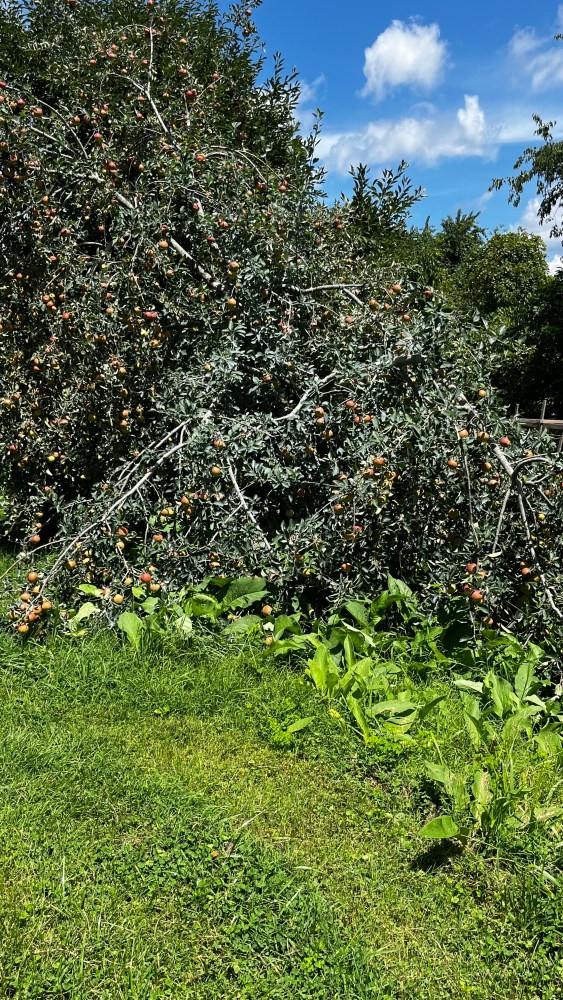
This poor Winesap tree used to stand tall and reach for the sky. Now it may be bent and weeping forever…

In mid-August the main Winesap branch broke right off, and we had to emergency-pick seven five-gallon buckets of half-ripe apples. We had to prop up several other branches on other trees and pick others before they were quite ready. By late August I had 10 bags of pie filling in the freezer, yet I had not enough time to even think about making a fresh pie. All I managed were a couple of crisps.

We knew we had too many apples and that the answer was cider.

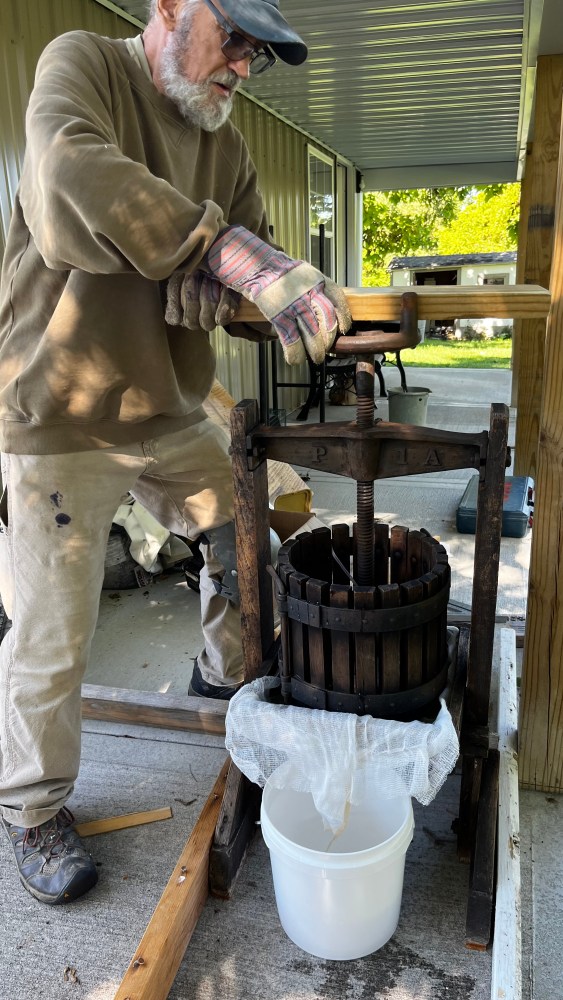
We had a vintage press that we’d never even thought of using. In fact, a couple of years ago Mr. H.C. varnished a tree round and added it to the top of the press. Suddenly it became a high table with benches out on the porch instead of dust catcher.

One evening as we were staring at it, Mr. H.C. said, “I think there’s another piece to this up in the attic.” Sure enough, within 15 minutes, we were staring at the other vintage piece–a hopper. Both were made by Red Cross Manufacturing Co. in Bluffton Indiana, probably around 1920-40. We spent the better part of the next week cleaning the cobwebs and crud with a garden hose, a power washer, and an air hose. We did a final rinse with vinegar and water; bought some cheesecloth sacks; some sanitizing tablets; and couple of new buckets. We were ready for the grand experiment…

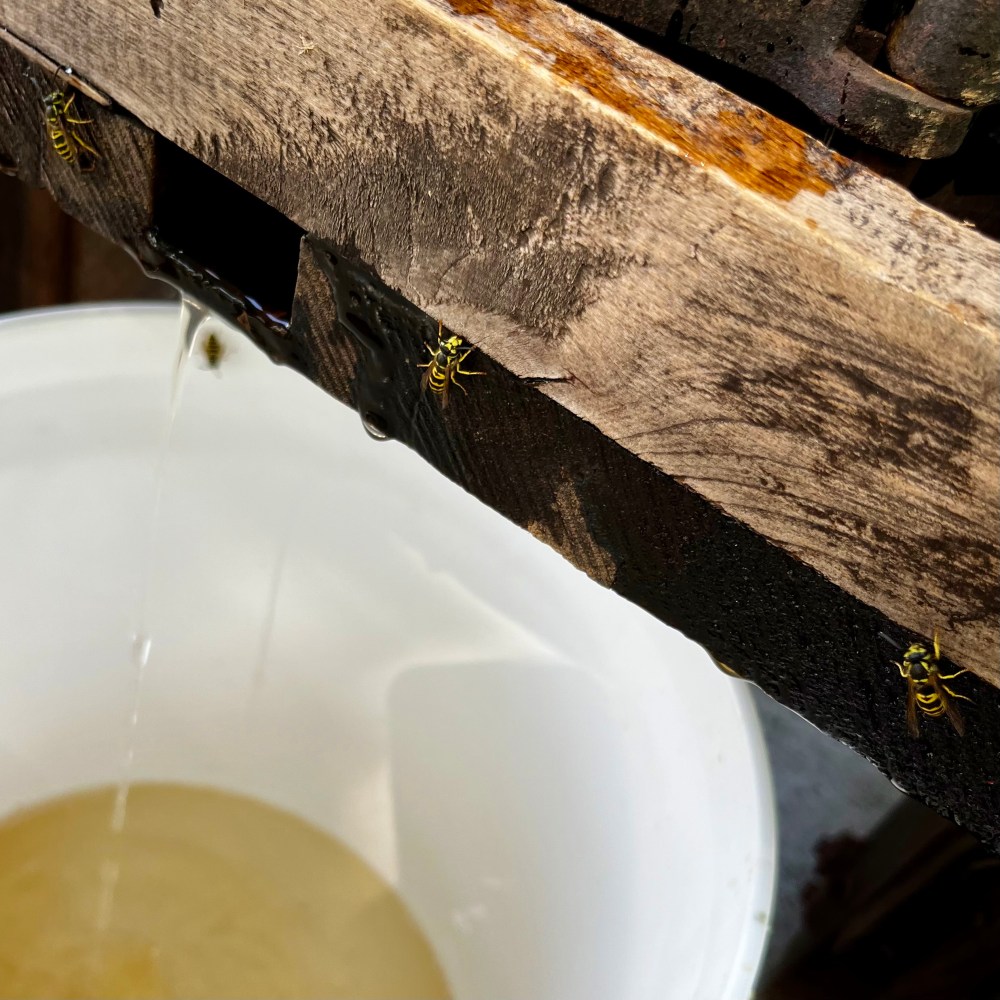
What we didn’t know was that the chopper/hopper was made for grapes. It really didn’t like to chop up the apples as they should be. So we had to chop the apples by hand–the smaller the better–before the hopper would grind them at all. And it really didn’t like the hard, green semi-ripe apples. So we used pears, and the other ripe apples that had bad spots and we just cut out the bad spots. We cut, and chopped, and pounded, and pressed for about 10 hours over two days. And no one got stung.

We ended up with about 2 gallons of pear cider, and about 4 gallons of an apple-pear mix. I canned ten quarts, and pasteurized the rest for half-gallon containers. (To pasteurize cider, heat it to 160 degrees for 30 minutes.)
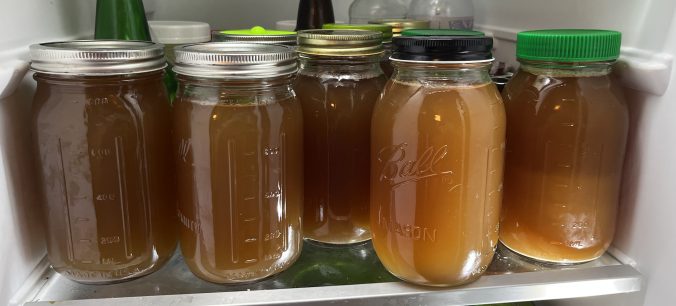
But we still had so many more apples, and honestly? We were exhausted.

Yes. We did this to ourselves. What were we thinking? But truthfully, this is the first year it’s ever been like this. We think it is a combination of a very good year for Pennsylvania apples (Every wild tree is loaded with apples!) and that our trees are just now coming into a very fruitful maturity–5 to 7 years.

So we started an internet search to find a local cider press… Stay tuned for Cider Days, Part Two

Bees and Blossoms and Frosts

The apple trees are in full bloom

After a week of 70 degree temperatures, the cold winds came blowing.

Two nights ago the low was 28 degrees; last night it was 30 degrees. We’ve been glued to our phones, watching as the frost warnings come and go. It’s always interesting when our weather apps forecast different temperatures.

According to several state orcharding sites, blossoms can survive temperatures above 28 degrees. It’s been close. Tonight after sundown we sprayed with kelp and fish fertilizer, hoping it will fight the cold. Although the forecast was just changed to a low of 34 degrees…

One pear tree has tiny little red pears on it, which is a really good sign, and there are tiny cherries on the sour cherry tree–as well as an interesting little spider on a blossom.

Any fruit we get this year will be better than last year, when it snowed in May, and we ended up with about ten scabby apples, no pears, no cherries, and no peaches.

But for now we’re just enjoying the blossoms and hoping…

The Gloriousness of June

I THINK
I will write you a letter, 
June day.
Dear June Fifth,
you're all in green,
so many kinds and all one
green, tree shadows on
grass blades and grass
blade shadows. The air
fills up with motor
mower sound. The cat
walks up the drive
a dead baby rabbit
in her maw. The sun
is hot, the breeze
is cool. And suddenly
in all the green
the lilacs bloom,
massive and exquisite
in color and shape
and scent. The roses
are more full of
buds than ever. No
flowers. But soon.
June day, you have
your own perfection:
so green to say
goodbye to. Green,
stick around
a while.
         -- James Schuyler

James Schuyler has written the perfect poem: a love letter to a day in June. Not just any day. Today.

June green is unlike any other, vibrant and alive, still nourished by the spring rains, not yet ruined by hot sun, nor eaten by insects. Next to the June green, the peonies are more vibrant, the sundrops more sunny, the daisies more pure. Yes, June green is more.

The gardens are planted, red pears and green apples are growing, cherries are ripening, birds are nesting, perching, and singing.

The wild primrose opened in Sunday’s sun and surprised the surrounding motley plants. Her dazzling yellow perks up the shabby shed and makes the neighboring weeds look more stately. 

The new gate opens wide and the new fence keeps the fruit trees in and the riffraff critters out (so far).


If I stand by the garden gate I can watch the grape vines growing, their tendrils curling around and around. The grapes are too small still to be more than a vague hope. Will they be sweet? Will they be juicy? Will they be jam or wine?

The cherries are yellow, blushing pink. I ate one today, still sour, still small. Bluebirds are nesting in the eaves of the porch; wrens are nesting by the door. They can have some cherries as long as they share the deep blue June sky.

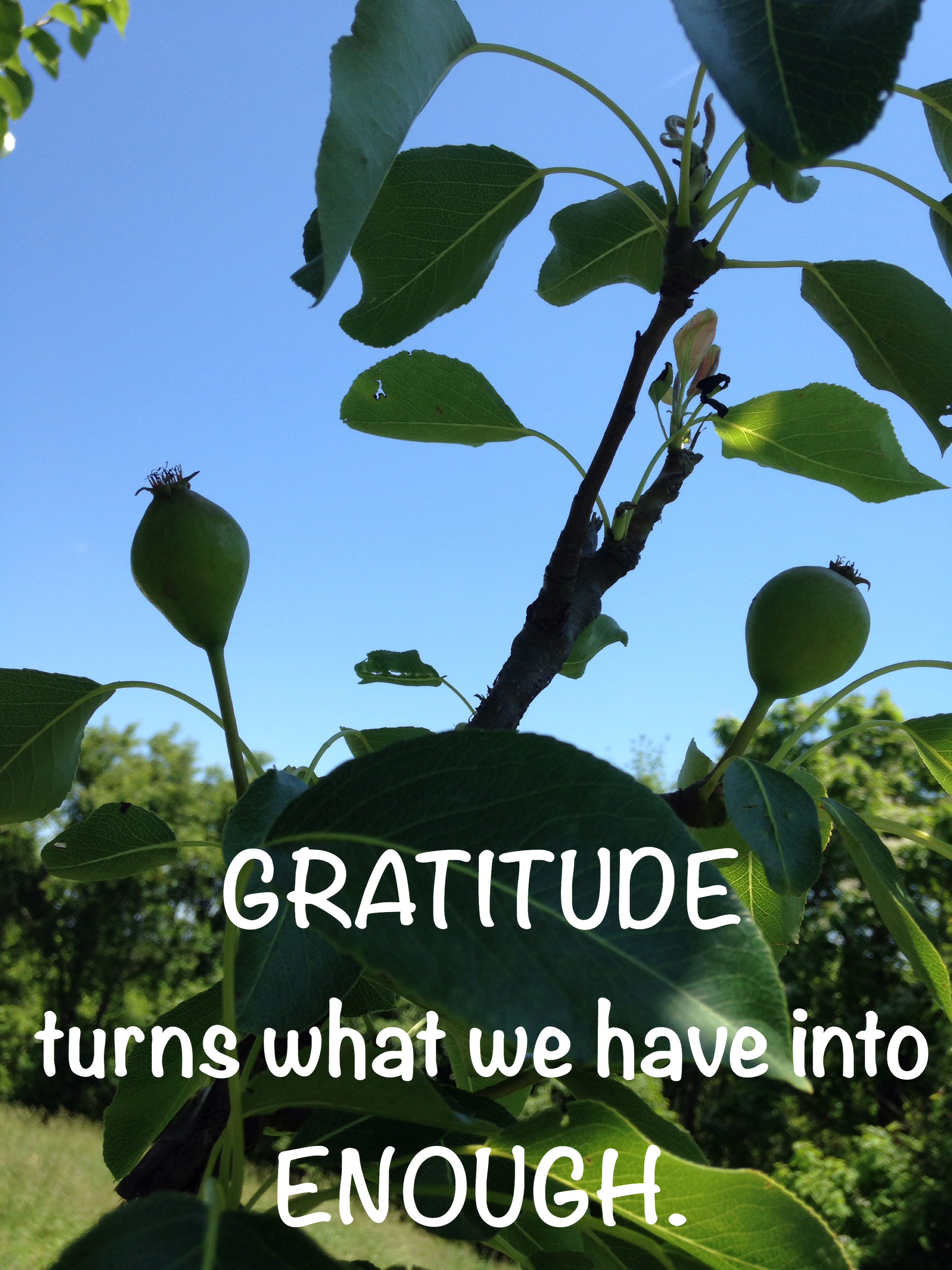
Dear June fifth, you are glorious. You are enough.