DIY Cleaners, Cleansers, and Creams: Simple recipes that really work

When I wrote that post Every Day Is Earth Day I thought maybe later I’ll post some DIY recipes that I use all the time. So almost a year and a half has gone by… But today, I actually made a new batch of deodorant. I usually have to make it about 2 or 3 times a year. It’s pretty easy, after you gather the ingredients, and it only takes about 20 minutes. So I took photos. And here’s the recipe.

Homemade Deodorant
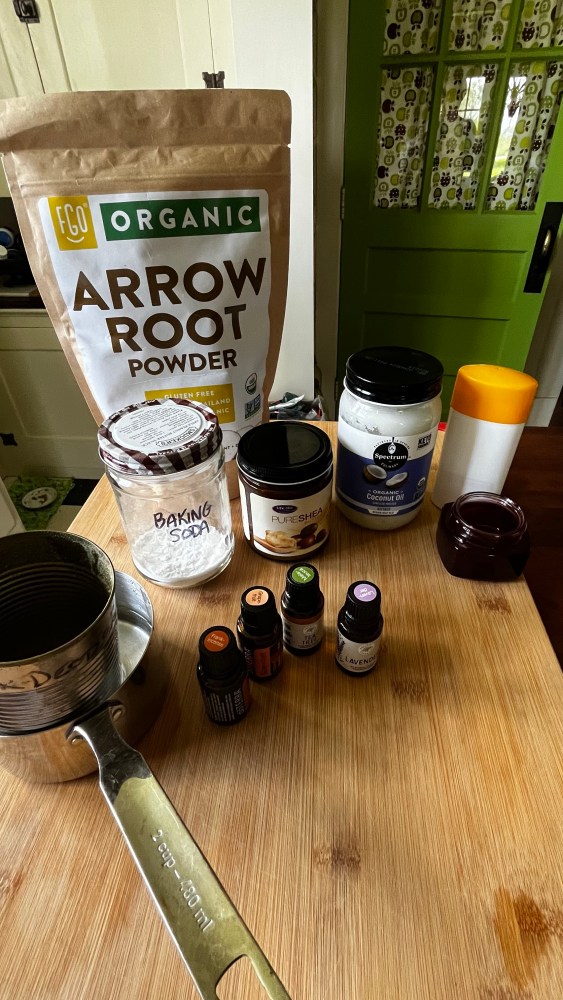
 (This recipe is adapted from wellnessmama.com and almost the exact recipe is also here on Revive)

Ingredients:

3 Tbsp Coconut Oil

3 Tbsp Baking Soda

2 Tbsp Shea Butter

1-2 Tbsp grated Bees Wax

2 Tbsp Arrowroot or Cornstarch

Essential Oils (optional, but unless you are allergic to scents, please use them…)

Directions:

1.  Melt Shea Butter, Coconut Oil, and Beeswax in a double boiler over medium heat until barely melted; OR use a can instead and place this in a small saucepan of water until melted. I save my can for every time I make deodorant–I store the bees wax chunk in it, and I don’t have to wash it out. When melted together, stir well. You want all the beeswax stirred into the other oils because the beeswax is what will keep it from melting in the heat of summer, or a hot bathroom. (I use a chopstick).

2.  Remove from heat and add baking soda and arrowroot.

3.  Mix well

4.  Add a few drops of essential oil and pour into a glass container for storage. I use an old deodorant container, but be careful. The first time I tried this, I had two old deodorant containers–the first one worked fine and the second leaked out all over the counter. Old face cream jars or half-pint jelly jars work great too.

5. Some good essential oils to use for skin and deodorant purposes include: Tea Tree Oil (sometimes called Melaleuca); Grapefruit; Bergamot; Lavender; and Clary Sage. Some lists also include Rosemary, YlangYlang, and Cypress.

If you refrigerate the deodorant, it will firm up faster. After it is firm, it doesn’t have to be refrigerated.

Laundry Soap

Yep, I make my laundry soap too. I do have to add a caveat here: This laundry soap is not for extra dirty, or hard stained clothing. It works very well for regular wash, and old work clothes that already have paint stains and grease blotches. But on your nice clothes, bad stains have to be pre-treated with something else. Also, I have a top-loader with an agitator, so I can’t address how much soap to use if you have a front-loader.

Here is what you need:

Ingredients:

1/2 cup borax

1/2 cup washing soda

3/4 cup Castile soap

20 drops essential oils (lemon or other citrus, tea tree oil, lavender, and peppermint are all good)

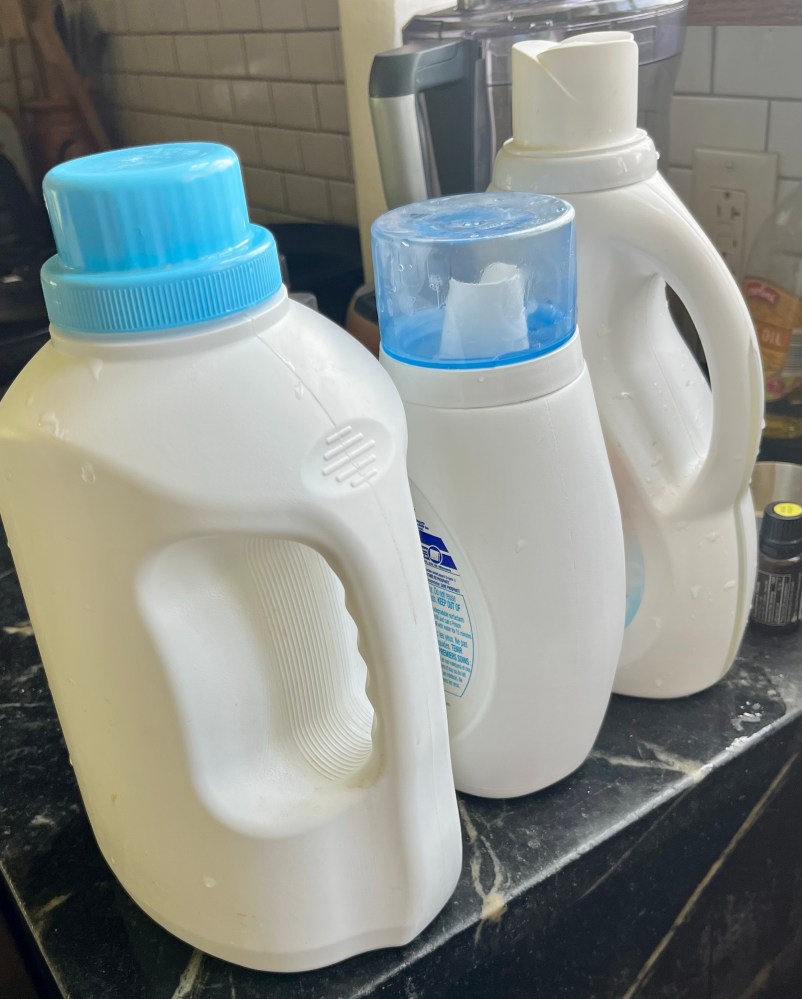
2-gallon bucket, and cleaned out laundry soap containers or clean gallon jugs

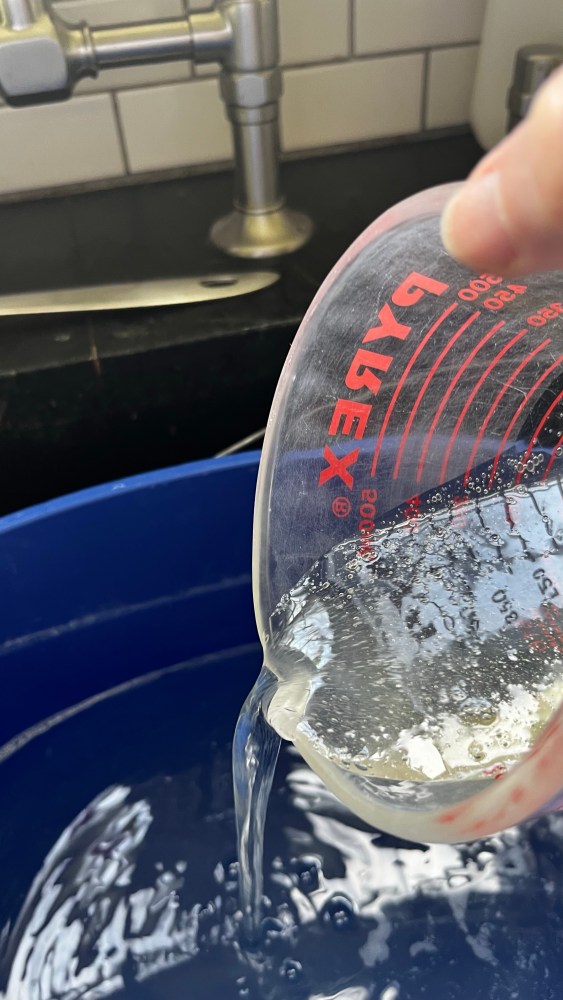
  1. Put the borax and washing soda in the gallon bucket and pour in up to a gallon of hot water to dissolve the powders. Stir around until it is all dissolved. The hotter the water, the faster the powders will dissolve.
  2. It’s handy if your bucket has hash marks for how may quarts or gallons, but if not, add another half gallon of water and stir around.
  3. Add the Castile soap at the end, otherwise it will foam too much. Stir gently to mix the soap in with the other liquid.
  4. Add about 20 drops of your choice of essential oils and stir gently.
  5. Use a measuring cup to carefully pour into your waiting laundry jugs.
  6. (My original recipe called for using 2 gallons of water, but I’ve found that I prefer using less water. I usually end up with about a gallon and a half of liquid soap.) Be sure to shake well before adding to the washer. I usually use the cap of the container for a medium load. This is not a wild, soapy recipe–Castile soap is not known for its sudsiness.
All-purpose Spray Cleanser 1

If you’ve got the stuff for laundry soap, you can use this similar recipe for a spray cleaner…

Ingredients:

1 t. washing soda

2 t. Borax

1 T. Castile soap

2 cups very hot water

10 drops essential oil–Lemon, Orange, or Tea Tree, or a combination

Dissolve the powders in the hot water. Add the Castile soap and the essential oils and pour into a 16 ounce spray bottle.

Spray Cleanser and Degreaser 2

1 cup white vinegar

1 t. Castile soap

1 T. baking soda

3 cups warm water

15-20 drops essential oil–Lemon, Orange, or Tea Tree, or a combination

Mix together and pour into spray bottle. Do not use vinegar on marble. This is good for stovetops, range hoods, tile, sinks, and general cleaning. I have not had success on my oven door though. Nothing seems to clean my oven door….

Right now we are working on the laundry room, so I’m cleaning and reorganizing and throwing stuff out. It might be the last room in the house. Maybe it will be finished enough for photos in a couple of weeks…
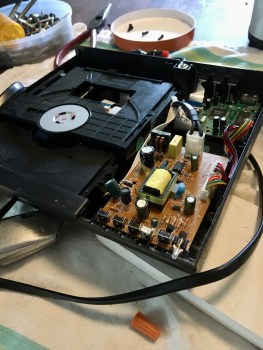
Retrieved from the trash bin

We were fifty minutes into the hour-long Outlander episode “The Deep Heart’s Core” when the DVD player stopped. Didn’t even give us any warning of weird blips or slow motion stoppages–just died. Just as Roger is about to escape from the Indians who are dragging him to New York far away from Brianna. Not only did it stop playing, but the disc wouldn’t eject. Visions of having to pay for a Netflix disc made us disgruntled, as well as the DVD stopping just at the exciting part. It might take us a week to find out what happened to Roger.

Mr. H.C. is handy with pliers and screwdrivers, so he took the thing apart and we physically took the disc out of the player. We retired to the bedroom and watched the last ten minutes on the laptop. Roger escaped.

Now, I can hear you saying, why do you even rent discs from Netflix anyway? Can’t you just stream like the rest of the world?

Well, thanks for asking, but no. We can’t, actually. Because we live in rural Pennsylvania, where there are hills and hollers, and the nearest 5G network is 50 miles north in Pittsburgh. We have three options for internet service: Windstream, whose fastest rate in our neck of the woods is 1 mbps (yes, 1); Dish networks, which everyone knows are worthless when it is cloudy (and let me just say, we have cloudy here); and a hotspot. Which is what we have. It’s serviceable. It works. Sort of. Most of the time. It’s expensive. We don’t have unlimited data. But I digress. This is not a post about our crappy internet service.

The next morning Mr. H.C. took a look inside the player and (unbeknownst to me) tossed it in the garbage.

Let me tell you, this is something that NEVER happens. Mr. H.C. keeps everything so he can fix it someday.

By the next afternoon we had surveyed our options and they were: 1. Buy a cheap one on Amazon for $45; or 2. buy the one they had left at Walmart for $150.  (I would just like to interject here, that when we lived in Pittsburgh, we had a very modern set up with streaming and a decent-sized multi-screen that functioned both as a TV and a media screen, and if we ever got discs we played them through the computer. It all worked smoothly.) DVD players seem so 90s. So I spent some time online the next morning to see if anyone could tell us how to fix it. The best I could come up with was a YouTube video on cleaning your DVD player.

“Maybe it just needs to be cleaned?” I asked him.
“Well, it’s in the garbage, so it really needs to be cleaned now,” he said, as he rooted through the trash and dug it out brushing off some crusted oatmeal. (No, that’s a lie. There was no oatmeal on the DVD player because we are a zero-food-trash- composting family.)

Genius husband then cleaned the DVD player and tried an old disc we didn’t care about, and then ended up watching the whole thing. DVD player is as good as new, which is a great thing, because now we don’t have to spend our Lockdown money on a 90s DVD player. It’s also a great thing, because now we can avoid the news and watch the last few episodes of Outlander. Unfortunately, we’re a season behind, because we live on a country road (almost heaven, but not quite) where there is no streaming (in heaven the light will be all the streaming we need). Oh, I mentioned no streaming already.

The moral of this story is Never throw anything away because you might have to retrieve it from the trash bin. Yes, our recycling place is closed too.

The real moral of the story is Don’t live in rural Pencilbania. Where there’s no recycling and no decent internet. And the yard signs are all for the wrong guy. (I’m debating about whether to put a Biden sign in the front yard, but I don’t want to start a sign war…)

The real, real moral of the story is Can our country be retrieved from the trash bin, cleaned, and fixed so it works once again?


The absolute, very last ever post on the mudroom…maybe

Why?

Because it is finally finished. And I have to say this final bit was all Mr. H.C. The only share I had in this last wall was painting one coat of paint on the door.

There won’t be too many words about this, because words cannot describe how completely and utterly finished it looks.

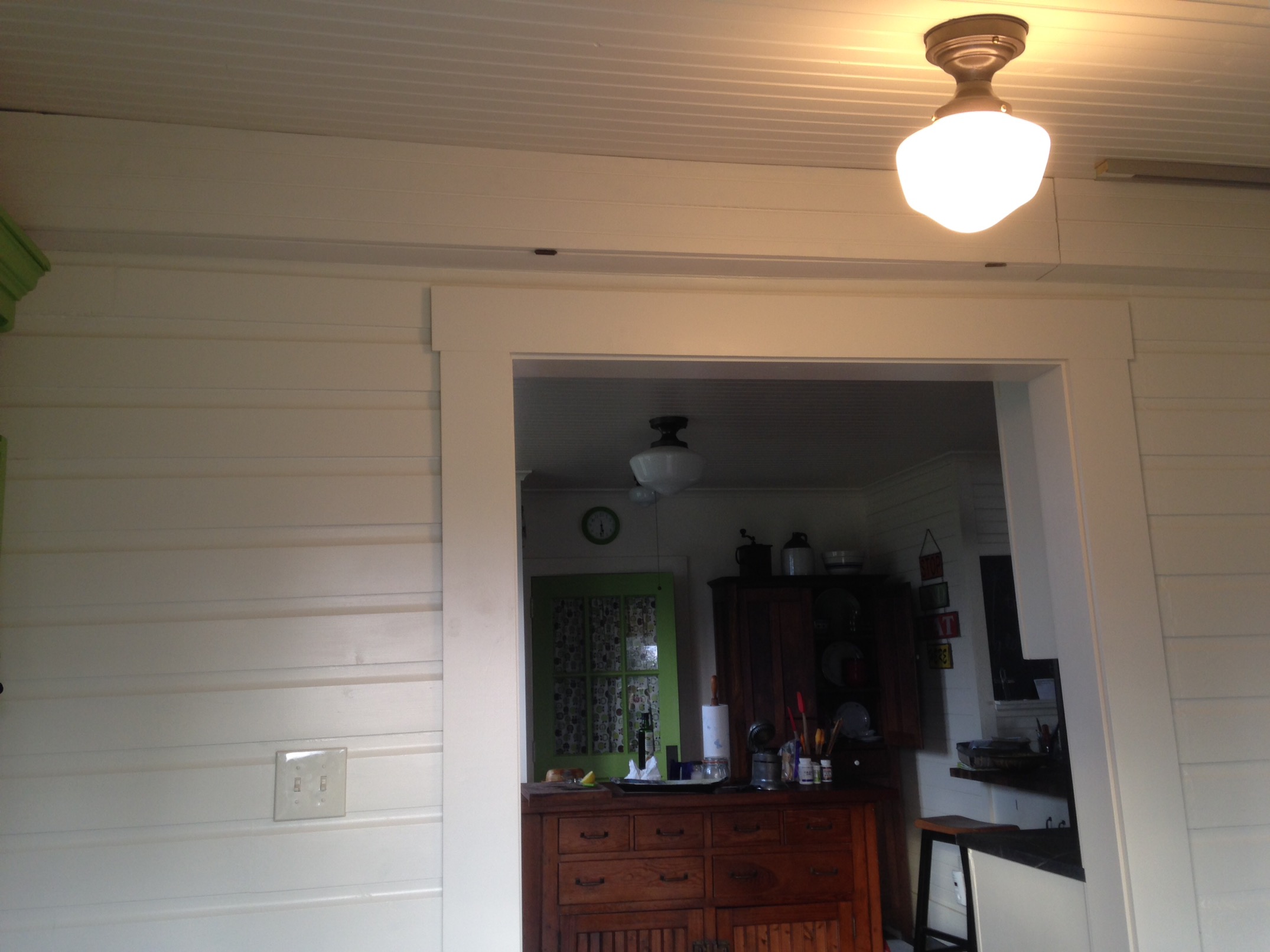
Unfortunately photos can’t do it justice either. Because it is all painted in Sherwin Williams’ lovely creamy white color — Steamed Milk. The same color as the kitchen walls. The same color as the dining room walls. The same color as the living room walls. The same color as the ceiling in all those rooms as well. Yes, we like creamy white walls. And ceilings.

In my humble non-decorator-just-average-person opinion, creamy white walls make a humble cottage look bigger, lighter and brighter, and just all-around more cheerful. And anyone who saw the cottage before, with its orange walls and wallpaper and 70s dark paneling would agree.

So without further ado, here are some befores, durings, and afters of our finally-finished-after-five-years mudroom entry to Apple Hill Cottage. (Trumpet sounds here…)

One can see that it is so new, there isn’t even any art on the walls.

This gallery below shows the progression of the outside wall of the mudroom — from the initial window, cedar shake walls, and plastic ceiling — to what it looks like now:

The next gallery of photos shows the progression of the second wall:

The floor has been done for a couple of years, but it still merits a before and after photo shoot:

The finishing of this room took so long because an exterior roof was necessary before the interior ceiling could be installed. Since the roof was finished this past summer, this winter we were able to proceed with the ceiling:

The last wall to be finished (February/March, 2017) was the wall with the most issues. There is an electric panel two feet from the wood stove; there were wires traveling the whole length of the wall that hooked into the electric panel; and this wall was also the orginal entry into the kitchen before the mudroom was enclosed and was just a porch. When we took off the cedar shakes, the wall was down to its original siding and it wasn’t pretty:

These photos below show the electric panel side of the doorway:

The sliding door that covers the electric panel is made from concrete board and trimmed with wood grain concrete board so it mimics the other interior doors in the cottage, but it is safe for being next to the wood stove. It hangs from the ceiling with pocket door hardware.

One of the best things about having the mudroom finished is that now the doorway into the kitchen is finished as well. In the last post on the mudroom,  I showed you the photo on the left. Now the far right is the finished picture.

Five rooms down, two to go. Three if you count the back porch; four if you count the laundry room.

But who’s counting?