6. Tearing Down Walls

We were a bit hesitant to tear out walls.
Dusty, everyone said.
Old Plaster, Mr. H.C. said.
What will we do with it? I said.

I was a bit hesitant to write on this topic of walls. So metaphorical, walls are. Especially tearing them down.

I could wax poetic, except I’m an unexceptional poet.

I could philosophize, except I’m an unexceptional philosopher.

I could spout theology, except I’m an unexceptional theologian.

I’m even an unexceptional photographer–it’s especially difficult to take pictures of walls that aren’t there any longer.

Wikipedia tells me that the word wall is from the Old English word weall and it is a vertical structure, usually solid, that defines and sometimes protects an area. In fact, if walls divide and separate us, I could discuss the new trend in houses that opens up kitchens to the living areas of a house. So do we want an undefined and unprotected kitchen? Yes.

I have read Jane Powell’s books extensively. I love them. I love her humor, I love her authenticity, I love her strict ideas against “remodeling.” Don’t do damage to your old house, she says. If you keep to its period, no one will hate you down the line in 50 years. No one will have to rip out the trendy 4×8 sheets of fake paneling that you have carefully installed in the family room. I especially liked Bungalow Kitchens, and yes, I read The Bungalow Bathroom too. I renewed them both until the library wouldn’t let me keep them any longer. She says, Never under any circumstances should one listen to an architect who suggests changing your bungalow to an “open plan.” (Not a direct quote, but pretty close…)

Two points are especially important here: 1. We don’t, technically, live in a bungalow. 2. We didn’t hire an architect.

1. We don’t technically live in a bungalow. Although it was built around the time of many bungalows, and it might fit the definition, as in being one story and a modest, affordable dwelling, it has no architectural presence. There’s nothing that makes it stand out except maybe the clipped gables (also called jerkinhead gables–I don’t know where to start with that one, so I think I’ll leave it alone…) No beautiful woodwork, no congruency–as Dad said, “Well, that house grew like Topsy…” (from Uncle Tom’s Cabin by Harriet Beecher Stowe). The closest the cottage gets to architectural charm is a couple of built-in cupboards and a big brick chimney, all of which we are taking great pains to keep.

The outside of the houses look similar, but the floor plans don’t match.

I did find a lovely rendering of an Aladdin kit house that was sold between 1949 and 1951 called the Potomac. It was an Economy house and sold for around $1500-$2000, depending on whether you bought the pergola porch. The houses look remarkably similar. I’d like to use this as inspiration for what the house should look like on the outside when we are finished.

2. We didn’t hire an architect. No, we didn’t. Brother-in-law Jim is the closest to an architect we could find for free and he said, “Oh, take out this wall. Yes, take it down.”

Yahoo notes that, “The most important thing to do before tearing down a wall is to determine if the wall is structurally necessary.”   Mr. H.C. is an expert on whether walls are structurally necessary or not. Daughter Maggie can attest to that! She hired a contractor who took out a structural wall. We happened to be visiting a week or so later. Mr.H.C. took a couple of looks and then they sped to Home Depot to buy studs to support the spot where the wall had been taken out. Then they had to hire a structural engineer  to figure out what to do next. THAT contractor was sorry!

So Mr. H.C. climbed up into the crawl space above our bathroom, dodging cobwebs and spiders and checked out which way the joists and rafters run. Turns out to be safe to tear ’em down.  Full Speed Ahead:  Open up the room; Let in the light;  Make the kitchen bigger; Cook with your friends!

Walls are human made things. There is nothing (that I can think of) in the natural world–in God’s creation–that was the prototype for a wall. They were made to define, to protect, to separate, to divide…. That’s not to say I’m totally against walls — walls around a bathroom are a fine idea :-) — but mostly God wants the walls around us gone.

It’s scary taking down walls. What if you take a support wall down and the structure starts to crumble? What if you expose what’s underneath? Let me tell you, it’s guaranteed to be ugly and it’s also guaranteed to be hard work, and there will be surprises. So why even try?

This is a picture of the floor where the wall was–yep, it’s ugly!
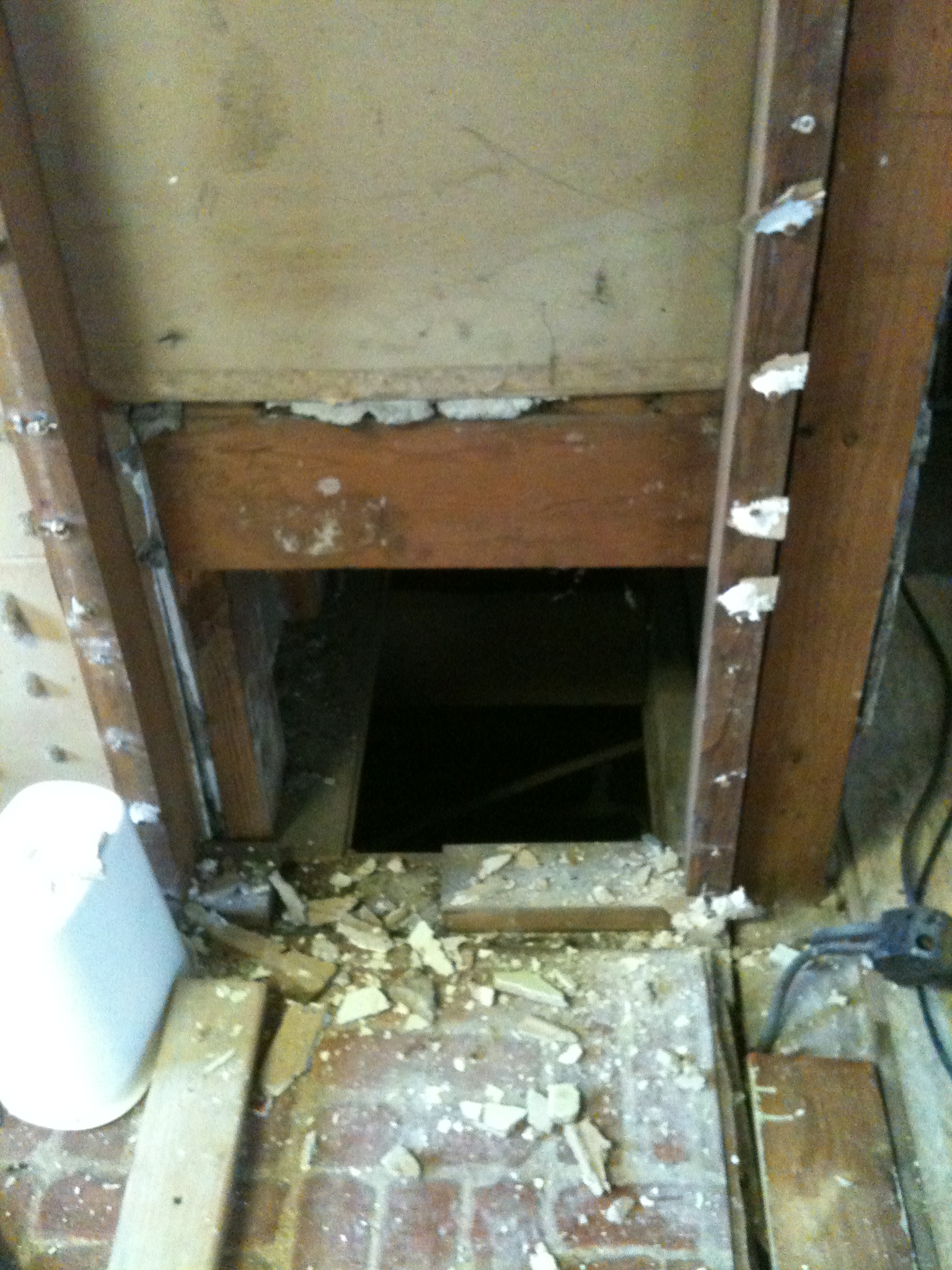
And this was the surprise. A real hole that was never finished. Now we know where all those bugs come from…

Why try? Because when that wall is down, it opens up the room that is your heart; it makes the room bigger; it lets light into your life;  it allows for true relationships, both with people and with God. So Full Speed Ahead, let the walls come crashing down!

Let in the light!

The walls we took out are still being supported by studs until the beam goes up, so any pictures posted here, will not look as if the walls are cleanly gone. But I can’t resist–Something there is that doesn’t love a wall / That wants it down. / I could say “Elves” to him, / But it’s not elves exactly… (The Mending Wall by Robert Frost.)

No it isn’t exactly elves. Here is Mr. H.C. taking out a piece of the wall. (We actually took out pieces of three walls.) 20120622-231320.jpgIt wasn’t wood lath and plaster, which is what most people think of as old, dusty plaster. This was plaster board coated with plaster. Mostly it came down in chunks. We researched it (it’s organic); tested the paint (no lead); and then wheelbarrowed it down to the hillside and tossed it over. We’ve since covered most of it with dirt and weeds, although I must admit, it was hard to throw those first few pieces. It just didn’t seem ‘green’. (But neither is Wasp Killer or Mole-Away…) Just think of it as fill.
Jim the architect said, “That is SO West Virginia.”

EEEYup. It is.

AWYSG (Always Wear Your Safety Glasses)
2. The Sanding Queen

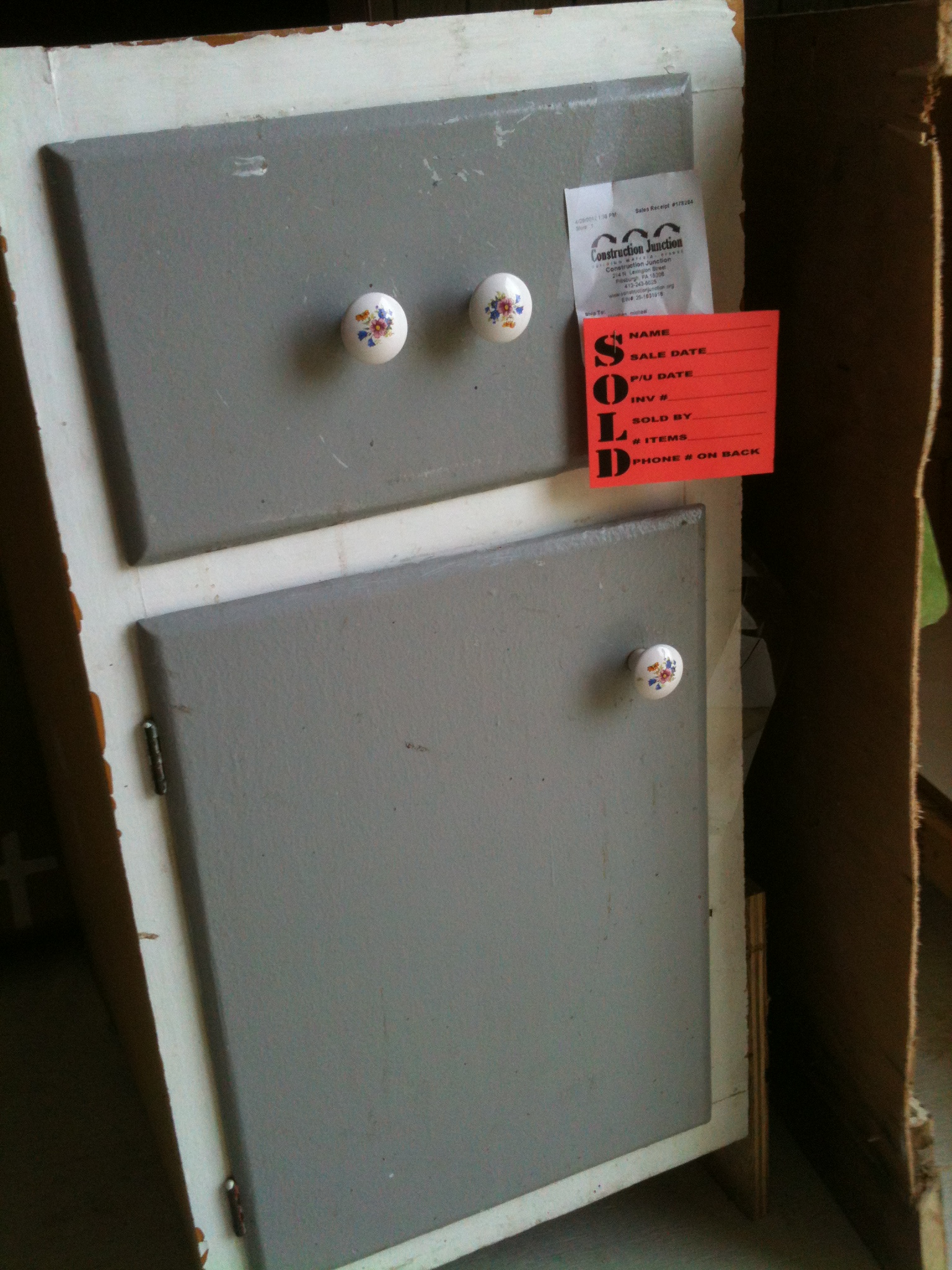
Fast forward to April/May of this year. A lot of stuff happened in between, and we’ll get to that in later posts, but for now, we are working on the kitchen. As in taking out walls–that’s a later post too–but for the past few weekends, I’ve been sanding. Not just smoothing rough edges, but taking off 4 coats of paint and the original varnish of kitchen cabinets. Oh did we dither about kitchen cabinets! They are so expensive, and I want white. The white cabinets that one can purchase at the BB stores are not wood; laminate, thermofoil, melamine, lacquer, acrylic–they have all sorts of fancy names and initials for what is really just junkboard. I’m a purist; I like real; I like old; I like authentic. So I wanted wood cabinets. The unfinished cabinets at Home Depot and Lowe’s were oak. It seemed a shame to buy oak cabinets and paint them white… So we haunted the Habitat for Humanity Restores in Washington and Edgewood and Construction Junction in Point Breeze. It took several visits in all places–and we found some other cool stuff in the meantime–but one day we came upon Really Ugly Cabinets. They were so ugly, we almost passed them right by.

Looks like a square robot from The Flintstones to me…

But when we stopped and figured it out, they were almost a perfect fit for the sizes of cabinets that we needed. Straight out of the early fifties–made from sandable birch plywood all through. They weren’t quite the doors I wanted, but for $225 they will work. Since we saved so much money on cabinets, the plan now is to buy really expensive countertops!

So now I am the sanding queen. You know the song. Unfortunately the only words I know are the sanding queen, da da da da da, she’s the sanding queen, da da da da da da the sanding queen. I didn’t even know it was an Abba song until I saw Mamma Mia! with Meryl Streep. But in my defense, it probably came out in the late seventies, early eighties when I was busy with babies.

I made the mistake of putting stripper on the first one. Oh, it worked okay, but it was very messy. Turns out, the coats of paint were put on right over the varnish, (NO PRIMER!) and they just peel right off with a scraper, which is much easier!!! 4 different colors–grey, red, lavender, green, and then the varnish. Any takers for those porcelain eyeballs?

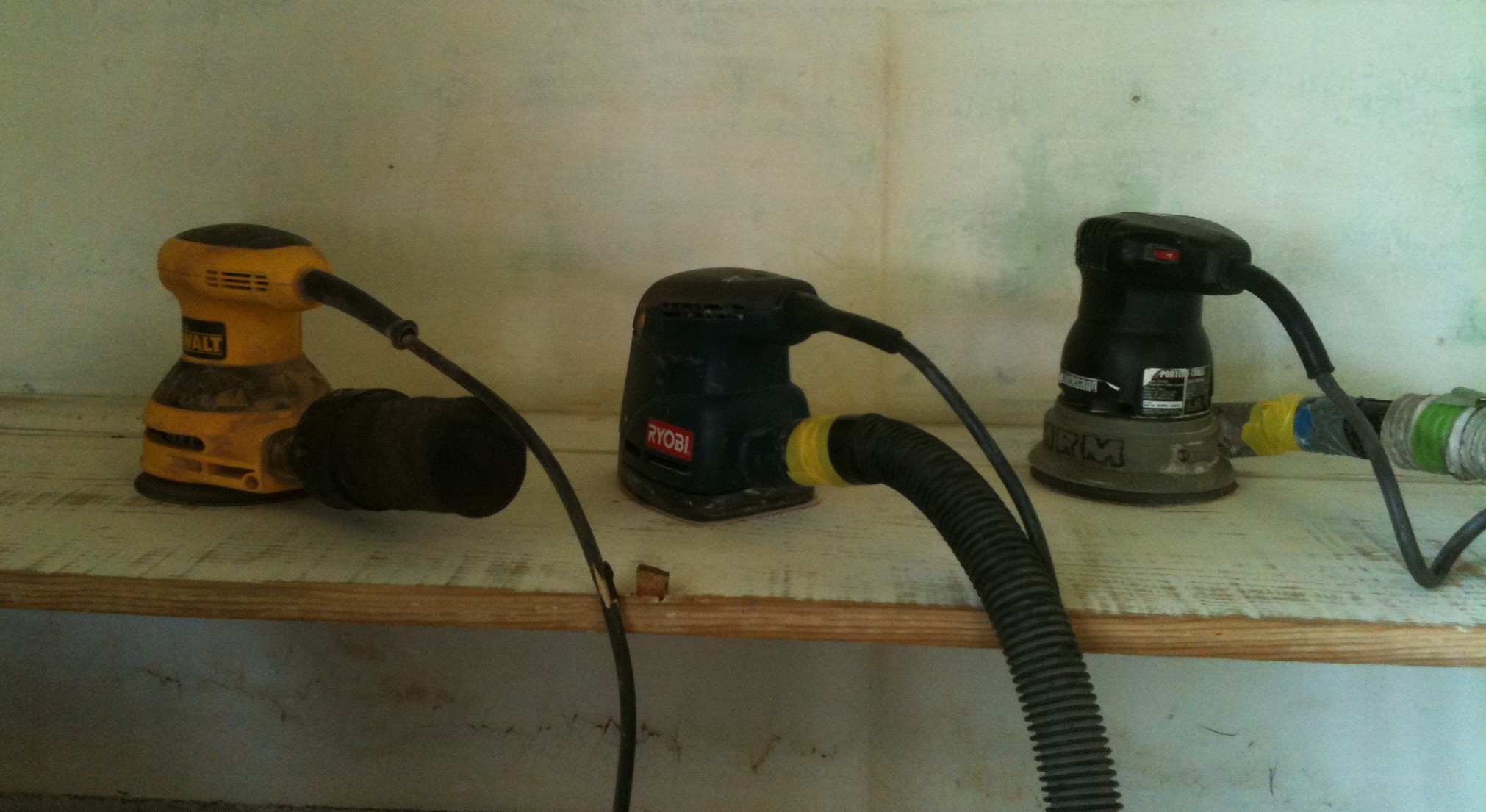
We set up my cabinet shop on the side of the back porch until this past weekend when the temperatures soared into the nineties. I moved into the air conditioned comfort of the living room and Michael hooked up the sanders to a vac. It’s a complicated system of hoses and extension cords and duct tape. He’s done it for me twice now, and the last time I was supposed to be paying attention so I could do it myself next time. I think I’ve got it. The biggest problem is that the two main sanders I use have different sizes of exhaust holes and I have to figure out which one goes where with what vacuum hose and they all get entangled with the extension cords. But Michael was the original Mr. Tool Guy–and he can always rescue me. The best part about the vacuum is that I can take off my breather mask! Always wear your safety glasses (AWYSG).

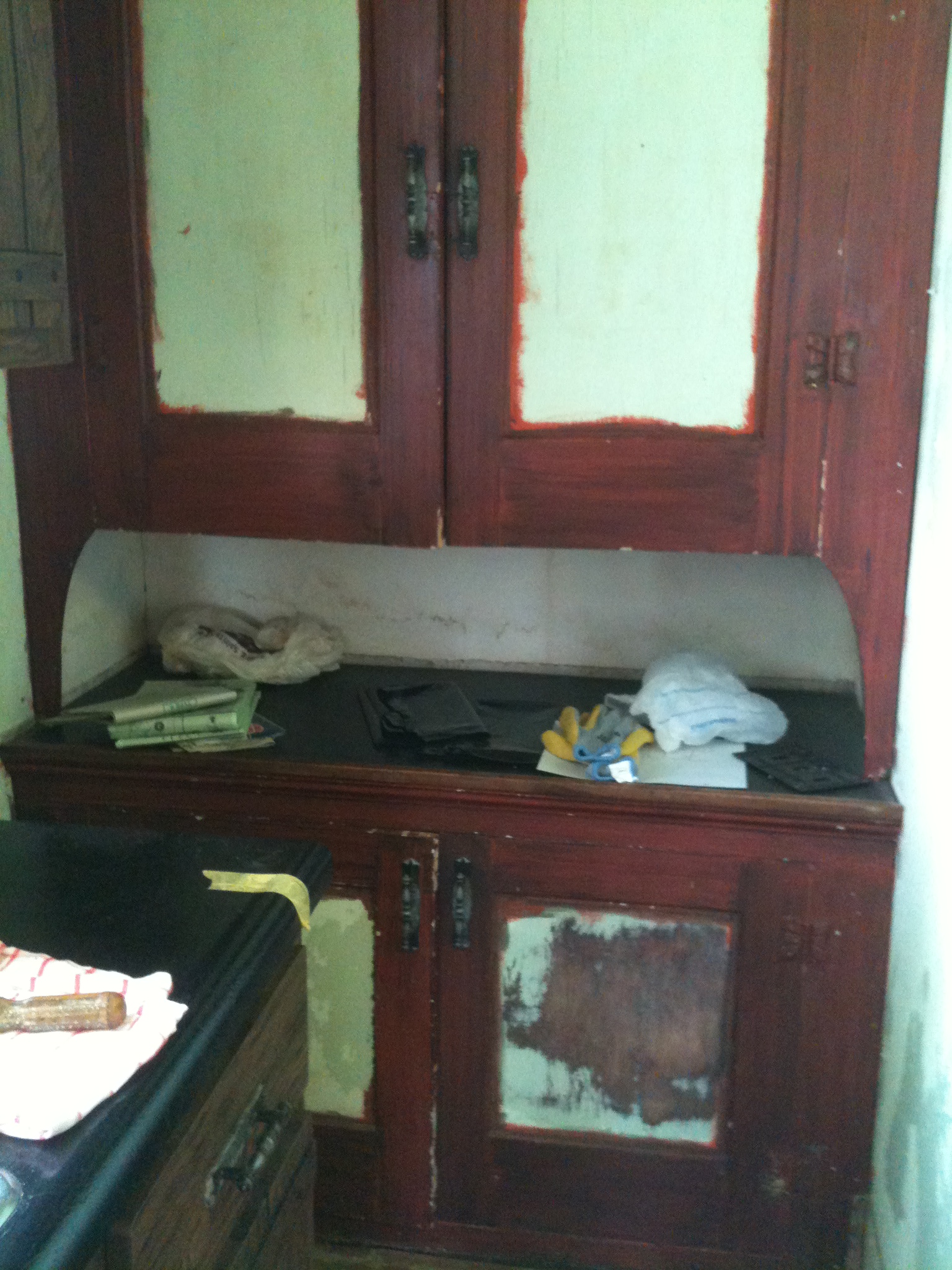
Just for variety, I’m also sanding the four doors to the built-in kitchen cupboard in the corner.

These doors have antiquing from the seventies, bright orange paint, and then two layers of green. On both sides!

Here’s a better picture–you can really appreciate the color.

I have also learned about grit. The lower the number on sandpaper the rougher it is. For instance, if one is taking off 4 layers of paint, one wants to choose 80 grit or below. Once the piece is down to bare wood, 180 or 220 is for finishing and making the wood really smooth. I’ve been liking the little “Mouse” sander that has a point and gets into corners. (Michael just returned from HD this evening as I am writing this with a new sander for me. A square “finish” sander. He said it was for me, but the second sentence out of his mouth was “I’ve never ever had a finish sander.”)

BEFORE

Michael must have been jealous of all the fun I was having sanding, because he got into the act also. Last fall we bought a big table at the Restore for $35.00 — a great deal. It’s been sitting in the living room with a table cloth over it (protecting the beautiful finish!) I was planning on staining or painting the top dark, dark green and calling it an old reclaimed table. But just see what Michael the carpenter can do–(even without a finish sander).

AFTER

Now my old reclaimed table idea has to be rethunk! I’m not sure what to do with it now. Michael likes natural finishes, but I sort of wanted it to be dark. I went to look at all the stains, but just couldn’t decide yet. That’s for another day when inspiration hits.

Sanding is boring. The arm gets tired. The sander is loud. The vacuum is louder. The back starts to hurt. The mind wanders. There’s plenty of time for thinking, for praying, for counting blessings, for wondering, for comparing sanding to real life. Cleaning off layers of grime, old paint, and junk to expose the beautiful wood beneath. That’s what trying to live a holy life is like, isn’t it? Always we’re scraping off the gunk that the world leaves on us. Some of it’s been there for years–applied incorrectly, but still it sticks until we really try to scrape it off. And, oh boy, is it hard to get out of the corners! I’m thinking of the book I read last year called Somewhere More Holy by Tony Woodlief. It is some of the most beautiful writing I’ve ever read; he talks about home being where the sacred and the mundane meet when we search for God in the small everyday things–like sanding, like cleaning, like taking something ugly and reclaiming it. Next weekend I’m going to be sanding again. And the week after. And the week after. I’m sure I’ll tire of it. I just have to keep remembering what the finished product will be. Beautiful. Free of gunk. As good as I can make it. And I’ll post some pictures.

1. The Story of Apple Hill Cottage

It’s hard to start writing a brand new blog when it’s, well, brand new. I’m brand new at it also, which makes it doubly hard. But Apple Hill Cottage has come into our lives. It is a cottage with history — combined history for both Michael and me — and I want to write about it — document it — as we try to respectfully honor those who lived in it before, as well as making it our own.

Apple Hill Cottage, Late fall, 2011.

Apple Hill’s Story–the brief version (Longer versions will appear randomly later…)

Originally built as a little bungalow in the forties thirties by my grandfather (we called him Pa), it was a place “out on the farm”, which later became his apple orchard, Longanecker’s Fruit Farm. Pa added an indoor bathroom when the orchard became successful, and someone needed to live there to help run the orchard and sell the apples. Later on a back bedroom was added and a partial basement under the bedroom. Oh and a garage. “Growed like Topsy” my dad said.

My grandmother’s brother, Leslie, his wife Mary, and their son Bob lived there from sometime in the fifties until 1974 when Pa sold the orchard. I remember being there many times as a kid–we spent time at the apple orchard “helping”. Pa always paid us: fifty cents, a dollar, sometimes two dollars if we really had helped!

This is what the house looked like when Uncle Leslie and Aunt Mary lived there, and how I remember it as a kid.

We spent time in the big barn grading apples, taking the apples to the cider mill, and then helping store the jugs of cider in the little barn, which was refrigerated. There’s a picture of me with Pa in front of the apples for sale on the stand that was built around an oak tree. (I’m looking for it…) Occasionally we had family picnics in the front yard.

Mom and Dad at Apple Hill, ca. 1949.

My Dad (1921-2012) said he first met all of Mom’s extended family at a family picnic here, but he couldn’t remember whether it was before they were married — September 18, 1949 — or after. While looking through old photos for Dad’s funeral, we came across this one, which was taken at the cottage. I like to think it was taken that day of the family picnic.

In 1974, Pa was 82 years old and wanted to retire from the orchard business, so he sold the apple farm to Joe and Clara and their partner, a local attorney. Joe and Clara’s son, Michael, was a senior in college and helped them do various remodeling projects. One of the projects that he has confessed to helping with was wallpapering the living room. It pains me to say we didn’t take a picture of the wall paper before we stripped it off — one of the first things we did — but I’ve found a picture of the wallpaper in the background. It was ORANGE. Seventies Peter Max Orange. And I’m told it’s back in style, but …you decide.

We are in Clara’s living room just after we got married in 2002. The wallpaper was on most every wall, and even on the ceiling in the section of the living room not pictured here. Michael said putting that wallpaper up caused him to be color blind.

I remember thinking it was a bit strange when Mom told me that Pa had sold the orchard to Joe and Clara. Michael and I had dated in high school for two years and had a tortured break up when we were freshmen in college. But in 1974 I was only 22 and not ready to go back to run an apple orchard that I knew nothing about. I do remember wishing I was a bit older and wiser and ready to take it on…

Joe and Clara remodeled the cottage in the seventies style. They turned the garage into the “garage bedroom” and put the ubiquitous paneling on the walls. They replaced a lot of the windows, but not all, and installed 5 (count’em–5!) sets of sliding glass doors — one at every entrance! When we took out the carpeting in the garage bedroom (orange shag) we found they had dated the underneath of the step down into the room. It said, “Joe and Clara started remodeling. March 1, 1974.” We added our names next to theirs —  “Michael and Carol started remodeling, August 11, 2011.”

They also built a wonderful, huge deck at the back of the house, which we are reaping the benefits of now.

View of the little barn from the porch

It looks out over the hills of Greene County. To the left is the little barn where cider was stored. Now our neighbor stores his tractor there. There are wild cherries, oaks, maples, hickories, walnuts, catalpas, and honeysuckle. The birds sing all day. We have a family of bluebirds! I haven’t seen bluebirds since the last time I lived in the country! The binoculars just stay on the porch and the bird book sits nearby on the porch swing. It’s peaceful and serene for these two folks who’ve lived in the city for ten years. The porch looks east and there’s nothing better in the early morning than sitting on the swing drinking coffee and reading Jesus Calling. Yes, I can hear creation singing.

Not just breakfast coffee, but every meal…

Joe and Clara also enclosed the Oak Tree Apple Stand in cedar shakes that matched the house and painted the inside turquoise. It was the seventies, after all… They used it as a garage and also as a permanent garage sale where Clara sold her treasures. They called it the Gazebo; it will have its own post later on. Since Joe died in 1995, it has fallen on hard times. Every once in awhile one of us will come up with an idea for it, but so far it is just storage for carpet, tile, and a couple of unfinished kitchen cabinets. Sister Diane (interior designer that she is) suggested a guest house. Friend Rick was more down to earth — “This is just what Michael needs to store his junk,” he said. Yes, we’ll talk about that later, too…

As Clara got older she couldn’t manage living in the country anymore, and the house sat vacant for several years. Her good neighbors kept an eye on the place and mowed the grass. When it seemed obvious last year that she would never go back to the house, Michael and his sister Rita put the house up for auction. It was to be auctioned on July 12th, but first it had to be cleaned out. A dumpster was rented and almost everything was cleaned out or sent to the auctioneer — including all her Fiesta ware. I will forever be sad about that…

Clara died on Friday night, July 8th. On Saturday morning Michael and I sat up in bed, looked at each other, and simultaneously said, “We don’t have to sell the house anymore…” We called the auctioneer and cancelled the auction; Michael had to write him a check for $5200 (that was a hard check to write…) but all in all, it was a small price to pay for a house with such a story. We buried Clara on the day that the auction was supposed to take place.

I think she is smiling.