This is a Remember when we were kids? post. If my memory is faulty, and I’ve gotten anything wrong, there aren’t many people around any more to tell me so… Just a couple of sisters, who have good memories of those times too.

We three sisters grew up about three miles from my grandfather Pa’s apple orchard. (Pa called us Cee, Dee, and Fancy.) He used to drive his old farm truck up our driveway and ask Any of you girls want to go for a ride? Sometimes there were two of us, sometimes three, but those were the days when we just hopped in the back of the pickup. Most of the time he would make us sit down underneath the window (while we were on the road) but when we got to the orchard, we were allowed to sit on the sides of the truck, holding on for dear life over the bumpy orchard paths, and laughing as the wind blew our hair. No one can ride in the back of a pickup truck without smiling…
The big barn was magical to us, even though we weren’t allowed to climb the ladders to the hay loft. There, right in the middle of the main floor, was the huge apple grading machine. With a flip of the switch the machine turned on, bushels of apples were poured in, and the apples rode along a wire mesh train; if the apple was too small, it fell through the mesh to the bin of small apples. I remember the sorter as having three stations, with the last station as the final place for the large, Grade A apples. After searching the internet, I found this photo of a similar machine from Long’s Family Orchard in Michigan.

It was a grown up job to be allowed to stand at one of the stations and pick out any bruised or stained apples, and change to an empty basket when one was full. And the fate of those small, maybe bruised apples? The Cider Mill.
We all remember riding to the cider mill in the back of the pick up truck. I guess Pa figured with all the apples in the back of the truck, we were caged in and couldn’t fall out. We don’t, however, remember where it was. I think it couldn’t have been too far away.
I remember it as being an old, falling down building that was pretty much in disrepair. But we ran through the pressing area to the smaller room on the side where the spigots were. And also the bees. Hundreds of bees. (As I look back now, after my adult experience with cider pressing, I’m sure they were yellow jackets.) It was our job to take the glass jugs and switch them out when they were full. Oh the smell…
Here is where my memory fails…I don’t remember putting the filled jugs in boxes or crates. But surely we didn’t just put glass jugs in the back of the truck? I don’t know, but somehow we got back to our destination, which was the little barn at the orchard. This is the barn that has graced many of my own photos here at Apple Hill. In the back, on the ground floor was a refrigerated area for the cider.


We also sold cider on Sunday afternoons at the bottom of the long driveway to the house where we grew up. We stored the sign and the bleachers and the apples in the little garage there, right on Rte.19. Pa’s brother-in-law, Uncle Jim, had painted the signs–just the word APPLES and a pointing hand painted above a bushel of apples. It was in the days before interstates, and Rte. 19 was the main road from Erie to Florida. While Pa was putting together the small stand—three rows of bleachers—we would put out the signs, the apples, and the cider. Bushels went on the bottom shelf, peck baskets went on the middle shelf, and the shining glass jugs of cider on the top. 75 cents a gallon. And still, people would ask for a taste before they plunked down their 75 cents.

There were metal chairs in the front yard that we sat in while waiting for our customers. We counted cars, kept a list of license plates, ate apples, and sold apples and cider. Those were the days that the apples were sold right in the baskets. You bought a bushel of apples, and you got the basket too. I checked online last week–bushel baskets currently go for $9.49 each… I found a lower price of $7, but they were out of stock. And the cider was in glass gallon jugs. You can buy a case of 4 glass gallon cider jugs these days for $24.
And of course, we have stories…
We always replenished the cider on the top row with gallons that were stored in the refrigerator of the little house kitchen. (It was the house where our grandparents stayed often on weekends during fruit season, so they could be near the orchards.) All of us girls had gone in to the refrigerator in the kitchen to grab a gallon or two of new cider throughout the afternoon. As dinnertime approached, Nanny came out into the yard and whispered to us, “Girls, do you see my gallon of iced tea up on that rack where the cider is?”
It wasn’t there. Her iced tea was famous for being too weak, too sweet, and awful. No one liked it but my grandfather, and she had made it in a glass gallon jug and put it in the refrigerator. And one of us had sold her terrible iced tea to a customer. No one ever came back to complain, so we decided it must have been an out-of-town customer. Secretly I hoped it had been sold to the black Studebaker sedan from Ohio with the kid in the back seat who had stuck his tongue out at me.


Last week I checked out two books from the library in an effort to combat the diseases our apple trees are prone to have. One sentence struck me: If you want to start planting new apple trees, don’t plant them near an old orchard.
I guess that may be true; the old trees will give the new trees their diseases and their insects. Plus we probably have 75 generations of deer who’ve lived here and grown fat on the apples from those 19 acres that are now whittled down to 3. I wish Pa was still around to give us advice. But I certainly have him to thank for all these memories…

 Part Two
the grandfather is waiting for her to tire of riding circles
in the orchard. he figures it will take twice (maybe three times)
and she’ll be ready to listen to the lesson that peaches teach.
he has the ladder ready when
she drops her bike next to the dusty green farm truck.
“Help me pick some peaches?” he asks.
he steadies the ladder and guides her small hand as they reach,
touching the fuzz gently, gently, every squeeze will bruise these
peaches easy as you bruise those knees.
gently gently she places the peach in the basket looped over her
skinny arm.
he moves her hand to another hanging low on the branch.
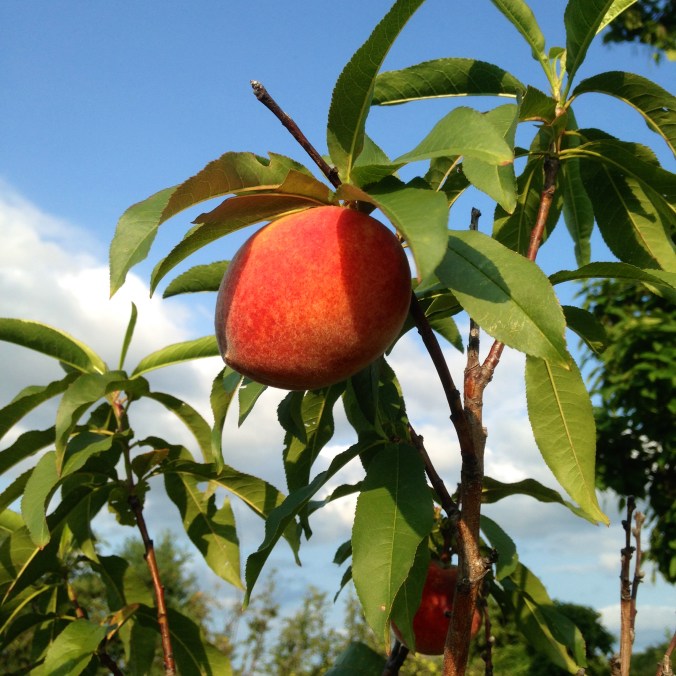
see this green? see this fuzz? peaches have to ripen on the tree.
their juices have to be warmed by the hot August sun. they take
their time ripening and can’t be hurried. you can’t pick the tree
clean, you have to go again and again to the same tree.
peaches teach patience.
together they fill the basket, moving the ladder around the tree
taking their time — savoring the tree-ripened juicy chin-sticky
sweet yellow sweltering August patience-teaching peaches.
patience is not his usual shape, this short round man in the straw
hat and farm clothes teaching peaches to the skinny girl with bruised
knees.
she learned peaches. she learned love. she still stamps her foot at
patience
and she can’t abide sickly grocery store peaches.
Part Two
the grandfather is waiting for her to tire of riding circles
in the orchard. he figures it will take twice (maybe three times)
and she’ll be ready to listen to the lesson that peaches teach.
he has the ladder ready when
she drops her bike next to the dusty green farm truck.
“Help me pick some peaches?” he asks.
he steadies the ladder and guides her small hand as they reach,
touching the fuzz gently, gently, every squeeze will bruise these
peaches easy as you bruise those knees.
gently gently she places the peach in the basket looped over her
skinny arm.
he moves her hand to another hanging low on the branch.
see this green? see this fuzz? peaches have to ripen on the tree.
their juices have to be warmed by the hot August sun. they take
their time ripening and can’t be hurried. you can’t pick the tree
clean, you have to go again and again to the same tree.
peaches teach patience.
together they fill the basket, moving the ladder around the tree
taking their time — savoring the tree-ripened juicy chin-sticky
sweet yellow sweltering August patience-teaching peaches.
patience is not his usual shape, this short round man in the straw
hat and farm clothes teaching peaches to the skinny girl with bruised
knees.
she learned peaches. she learned love. she still stamps her foot at
patience
and she can’t abide sickly grocery store peaches.
 the circle of life