Are Floods and Disasters the New Normal?

It’s been a long while since I have published in this space.

Oh yes, I’ve had several false starts, and many thoughts running through the old brain; “…that might make a good blog post,” I think. And then, nothing. I’ve had no energy to write, no words of comfort or peace to a world gone crazy, nothing to say that hasn’t been said…

At least part of that changed last week when we spent five days in Eastern Kentucky working with Disaster Relief at Christian Appalachian Project. CAP, as it is known by friends and family, workers and volunteers, has been in Eastern Kentucky since 1964. Father Ralph Beiting was assigned a parish in Berea, Kentucky and soon envisioned a volunteer organization that would assist with poverty relief in the poorest areas of Eastern Kentucky.

CAP’s mission center in Martin, KY
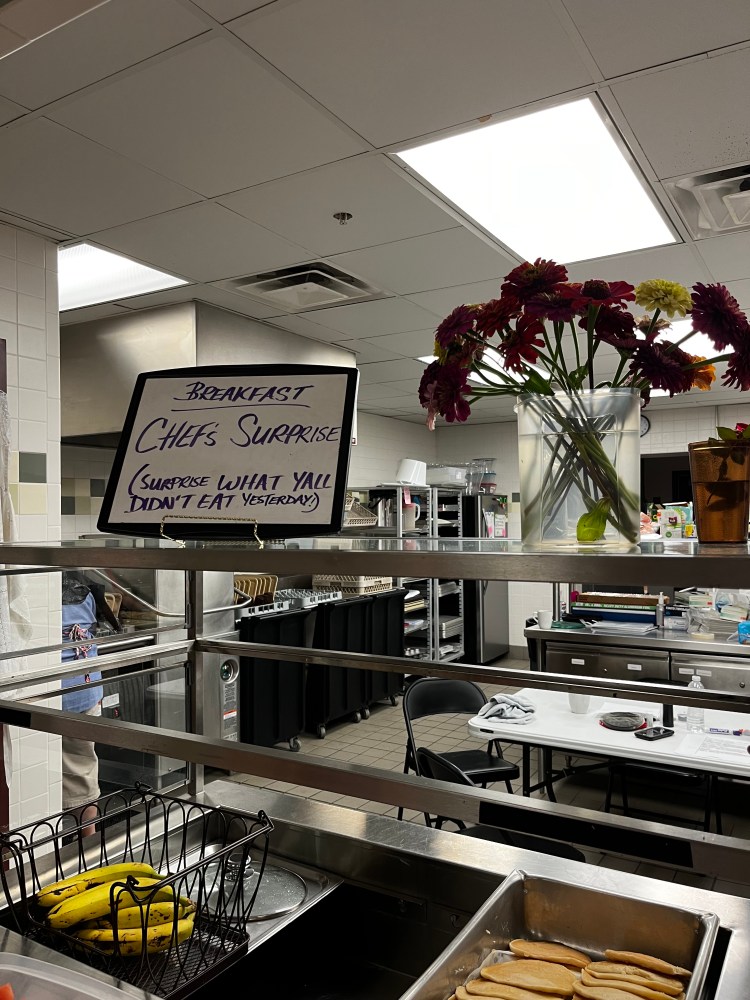
It was a beautiful place to have no electricity…unfortunately we had to cook for 60 people.

Mr. HC and I had been to CAP four times in the years before the pandemic. We went with groups and worked on houses. We built ramps, repaired roofs, led a team of college kids on spring break, and cooked for those kids too. One March we weathered a surprise snow storm that left six inches on the ground and no electricity for two days.

It was a Thursday evening in late July and we sat down to watch the evening news. It was the second day of flooding in Eastern Kentucky and there was the Governor at the Pikeville Community Center. Paintsville, Martin, Floyd County–they were all familiar to us. We sat in silence, almost in tears, wondering if these were people we’d met, houses we’d worked on…

Later that evening I checked my email and found one from Becky at Christian Appalachian Project. “Dear Carol,” it read. “CAP’s Disaster Relief Command Center is currently set-up in Floyd County at our CAP facility in Martin, Kentucky. We will begin assessing the damage August 1. Soon after, the cleanup will begin. We need volunteers to assess properties, begin cleanup, help distribute needed items to families, cook, and help in the volunteer lodging facility. WE NEED YOU!”

I read it to Mr. HC. And then I said, “This might be an email from God….”

That night we replied to the email. The next day we filled out online paperwork, that afternoon our registration was accepted. We were going in a week. Friends from our two churches donated money and supplies and we left on Sunday with a truckload of mops, bleach, gloves, buckets, brooms, and garbage bags, wondering if our two old bodies and minds could do what they would ask of us. It all came together so quickly, we didn’t have time to panic.


We worked at the Distribution Center all week. Unloading trucks and cars of donated supplies, moving items around every hour. 50 mops disappeared in 2 hours. $700 in sheets and comforters were gone in a morning. Boxes of underwear were unloaded and passed through windows. More diapers were delivered so we had to move other things around to accommodate them. More clothing was delivered, so we had to change how we stocked it. On Wednesday my iPhone registered 14,978 steps. You’re walking more than last week, it told me.
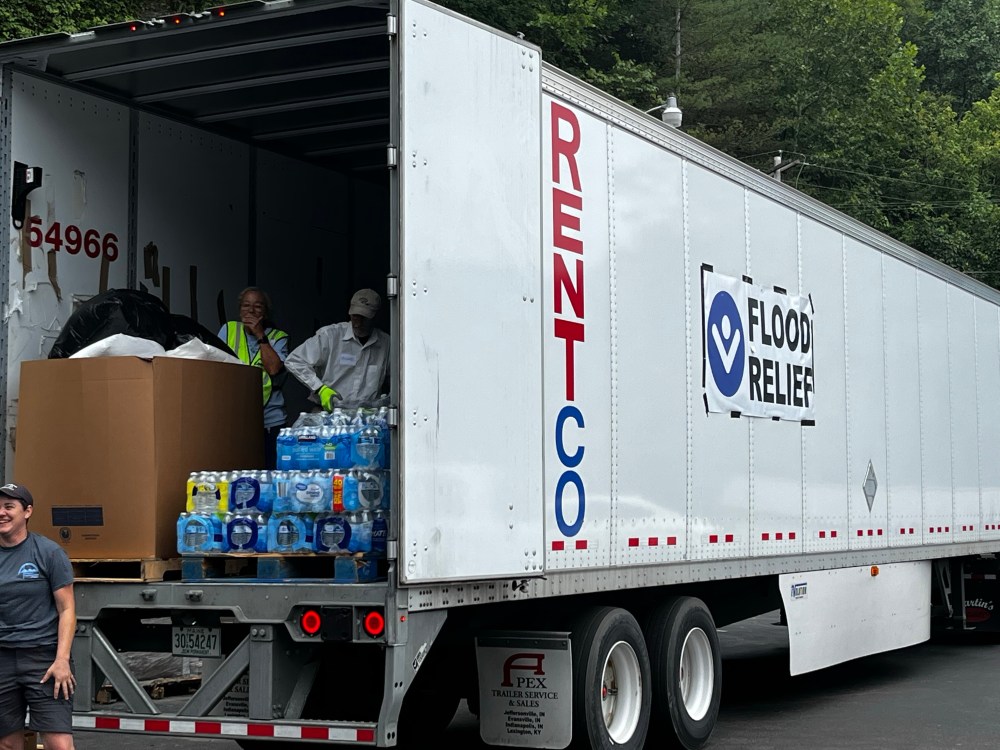
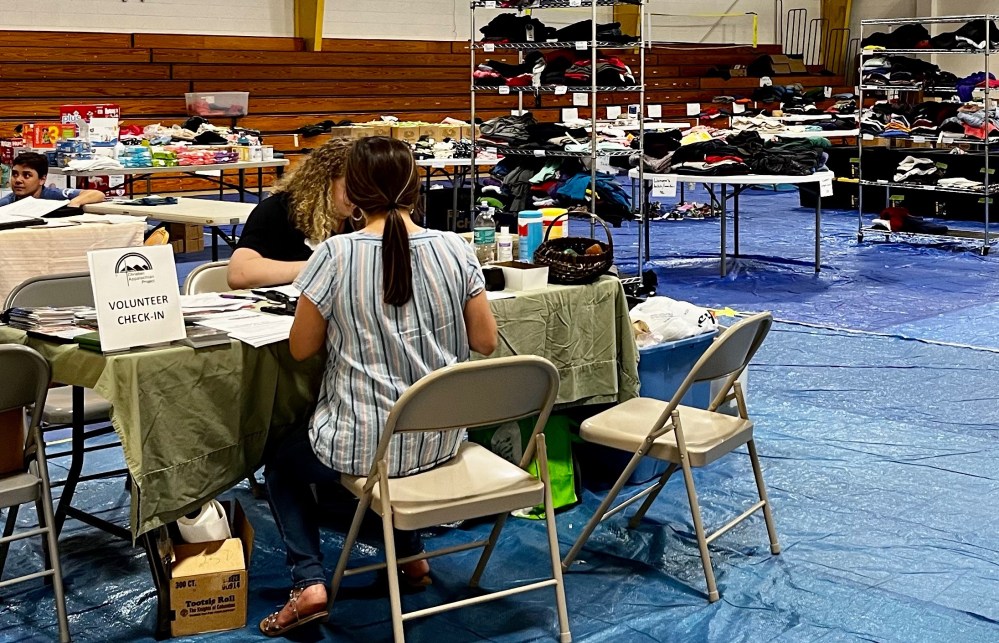
Because we worked at the Distribution Center we did not go out with the teams who were mucking out or gutting houses, so we didn’t see the damage. But we heard firsthand the stories from the folks who came in for help. They were heartbreaking. Some had no transportation because the car was flooded and no longer worked. One family still had no electricity after three weeks. They were eating Army MREs (meals ready to eat) that someone had given them. We were able to give them some fast food gift cards; most everyone just wanted cleaning supplies, until they saw that we also had sheets, towels, personal care items, and clothing.

One family had moved the kids to the grandparents’ house, so they could take up carpets and throw out ruined stuff without the kids seeing it. Their other grandma was sleeping on an air mattress in their living room until they could find her a new place to live. A young pregnant woman was staying with her dad until it could be decided if her house was salvageable. He was letting her borrow his truck for work because her car was ruined.

Like the damage done by Katrina, this damage will be around for years. At the Distribution Center were also state offices and FEMA, but these ruined houses aren’t going to be rebuilt quickly. Here are some other articles to read for more information:

And here are some other organizations that are working on flood relief:

You can send any of these items directly to the Foley Mission Center, Distribution Center, 6134 KY-80, Martin, KY 41649

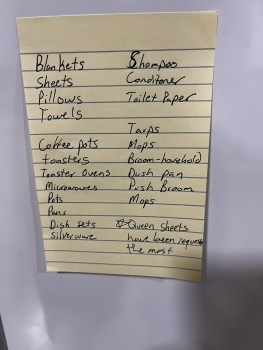
Unlike just the disaster relief organizations, CAP is in it for the long haul. They’ve been around for almost fifty years rebuilding houses, running youth camps, food pantries, thrift stores–and it’s mainly done with volunteers like you and me who give up a week or two, or a year or two of their lives. Before we left, the team there estimated that the Distribution Center at CAP would probably be open for several more months. Here was the list they tacked up on Friday, the day we left.

The work is hard, the fellowship and the camaraderie is amazing, laughter and tears are prevalent, the food is great, and you collapse exhausted in your bunk bed (hopefully a bottom cot) around 8:30. Coffee is on around 6; breakfast is at 7. See you then.

Season of Winter

The day says goodbye with a painted sky

The colors more glorious than has been the day

God affirms his presence, confirms his essence,

And beauty breaks through.

Yet God does not promise roses in winter,

Each season holds elements hard and cold.

But He asks us to find the intricate design

In beauty breaking through.

Perhaps the season is painful and harsh,

Perhaps the gray days have us weary,

But we can choose hope–for all seems new

When beauty breaks through.

Binge-reading Ishiguro…

If you watched 60 Minutes the other night, you might have seen a disturbing episode on Artificial Intelligence. Anderson Cooper interviewed Yuval Noah Harari, a philosopher and historian of the future (and author of Sapiens) about what technology may bring. You can watch the episode, “The Future of Sapiens” here. As I watched uneasily, I couldn’t help thinking of the two novels by Kazuo Ishiguro that I had just finished: Klara and the Sun (2021), and Never Let Me Go (2005)

I read Klara and the Sun first, based on a glowing NYT book review. I was stunned with the beauty and simplicity of the writing in what is an intricate and complex plot. Set sometime in the near future, Klara is–for lack of a better word–an automaton, or Artificial Friend. These Artificial Friends are marketed toward the older child/young teenager to serve as a friend, companion, or nanny. As technology moves forward, new models of Artificial Friends replace older ones, and stores continually push the new product, the newest model. Klara has already had her chance in the store window and has now been shoved back toward the middle of the store, when the young girl, Josie, and her mother purchase her. Klara’s storekeeper assures the hesitant mother that Klara’s model is actually preferred by many because of their sentience and compassion. Indeed, the humanoid robot Klara seems, at times, more of a compassionate character than the humans she lives with. It is a familiar, yet chilling world, in which the haves give up some of what makes them human in order to have more, and the have-nots face the choice of keeping their humanity at the expense of always being considered less. What would you do, as a parent, to make sure your child succeeds in life? And what does success look like? Indeed, what does being human look like? This is a 5-star read.

I had to be on the wait list for Never Let Me Go, but to be honest, it is my favorite of the five I have read so far. (I have not seen the movie–I watched the trailer, immediately after finishing it, and the first scene was not even in the book…so I’m not going to watch it, at least for awhile.) This novel, also set in the near future, raises similar issues–What does it mean to be human? Just because we can use genetic engineering, does it mean we should? I’m not going to give you a plot summary because there would be spoilers. It’s the type of novel that uncovers what is actually happening a little at a time, page by page. To give a plot summary would be to ruin the tense, dystopian atmosphere that Ishiguro has mastered in Never Let Me Go. This is a 5-star read that is hard to put down. Don’t pick it up if you have anything important to do….


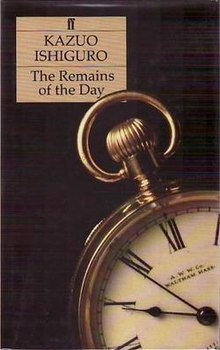
In between the two dystopian novels, I read The Remains of the Day. I’m ashamed to say I’d never read it, and it’s one of the few times I saw the movie without reading the book first. I guess Anthony Hopkins and Emma Thompson persuaded me…The film came out in 1993, so the only thing my aging brain could recall about it was an older English butler who worked for a Nazi sympathizer. I was glad that was all I could remember; for this is a brilliantly nuanced memoir of how we can so easily fool ourselves with our own thoughts and memories.

The aging Mr. Stevens is still the butler in charge of the grand old English manor, Darlington Hall, but the old Lord Darlington has died, and the manor has been purchased by a rich American who really has no idea of how things should be run properly. He suggests that Stevens take a vacation, a road trip, and even provides the roadster. As Stevens travels from Darlington Hall near Oxford to the West Country, he relives his life and his relationships with seeming honesty and (sometimes) painful introspection. I think that this is probably not a book for everyone. It is a quiet, introverted book, and not much happens plot-wise. But the language transported me, a modern American, to a time gone by in England. What follows is a particular paragraph that is likely to let one know if one would enjoy this book.

“But this small episode is as good an illustration as any of the hazards of uttering witticisms. By the very nature of a witticism, one is given very little time to assess its various possible repercussions before one is called to give voice to it, and one gravely risks uttering all manner of unsuitable things if one has not first acquired the necessary skill and experience.”

Kazuo Ishiguro, The Remains of the Day

And if that resonates, here is another:

“One need hardly dwell on the catastrophic possibility of uttering a bantering remark only to discover it wholly inappropriate.”

Kazuo Ishiguro, The Remains of the Day

Ah yes, the wholly inappropriate bantering remark… This is a 5-star read, and yes, I’m going to watch the movie again soon.

After the third Ishiguro novel, I was excited to read The Buried Giant. It was billed as an Arthurian fantasy or fable, and I have always been a fan of classic fantasy and myth. The Mists of Avalon, The Last Enchantment...yes, I read them both and loved them, and I think that’s why my expectations were high. I suppose we should be wary of great expectations, for I was actually disappointed in this one, and I’m not sure why. The plot is fine: an aging dragon breathes out the mist over the land that keeps people’s memories foggy. This was Merlin’s last enchantment to keep the Angles and the Saxons at peace. Indeed it has worked all these years, for no one can remember to hold a grudge, but neither can anyone remember their children, or love, or why they live as they do. The aging couple Axl, who was a peacekeeper in Arthur’s court, and his wife, Beatrice (whom he irritatingly calls Princess) set out on a journey to find the son they vaguely remember. On their journey they are joined by a warrior, a young boy, and Sir Gawain–each of them on their own journey to reclaim memory. Each one of them has clarity about the past at different times, but they are all the epitome of the Unreliable Narrator. The reader is never sure if what is remembered is true or mist. Ishiguro himself said he was writing about collective memory and how societies cope with traumatic events by forgetting. Reading this book is like having a conversation with someone who has Alzheimer’s. It’s well-written, but I never felt much empathy for any of the characters. It was as though having their own struggles with memories made them keep everyone–even the reader–at arms length. I give this one three stars.


When We Were Orphans takes the reader back to England in 1923, where we are introduced to Christopher Banks, a young man who has just graduated from Cambridge and is about to embark on his long-dreamed of career as a police detective. And though you might see this billed as a detective novel, it is not. The reader really only hears vaguely about his career and the cases that have made him famous. What we have instead is another theme on our memories and how they often fool us into misinterpreting facts and the world around us. It’s called cognitive bias, and this article by Charlotte Ruhl says that “…it results from our brain’s efforts to simplify the incredibly complex world in which we live.”

The first few sections of the novel take us back and forth between England and young Christopher’s childhood in Shanghai, where he lived with his parents in the International Settlement. (An aside–this novel’s rich details about early twentieth century Shanghai make it worth reading just for the exotic locale.) When he was nine, his father disappeared, and a few months later his mother was kidnapped. Young Christopher is sent back to England where he is sent to boarding school and raised by an aunt (whom we never meet).

Twenty-some years later, after Christopher has established himself as a renowned detective, he returns to Shanghai, in the midst of the Sino-Japanese war (ca. 1937) to solve the disappearance of his parents. His return to China begins the dreamlike episodes of the book, for up until now, the reader has assumed that everything Christopher has told us is true. And it is true according to his memory, but his memory is also that of a nine-year-old boy who has experienced great trauma. I’m not a literary critic; I’m not even an ex-English major who sees the symbolism for the light at the end of the dock; but when Christopher returns to Shanghai, he is transported back to that nine-year-old life and refuses to see the changes and the differences to this new city at war. What makes him think that his parents are still alive after all these years? And the truth, when it comes out, might be even stranger… This is a 5-star read, too.

I think next I will read An Artist of the Floating World. Does anyone have any suggestions? My suggestion to you is to pick up one of his books. He won the Nobel Prize for Literature in 2017, and he isn’t called Sir Kazuo Ishiguro for no reason.