We’ve been watching Charlotte on our porch for the last three weeks.
She’s been there. Spinning and waiting, waiting and spinning; I could learn patience from her.
She hasn’t moved more than an inch or two in all these days, unless she goes off dancing midweek and then comes back on weekends to pretend that she hasn’t gone anywhere.

She does her spinning and waiting on the porch, very close to the steps. Her spot is protected, although she faces north and when it’s windy, she certainly rides the north winds fairly well. You can see that she isn’t a very good writer yet — or perhaps “It is quite possible that …(she) has spoken civilly to me and that I didn’t catch the remark because I wasn’t paying attention…”
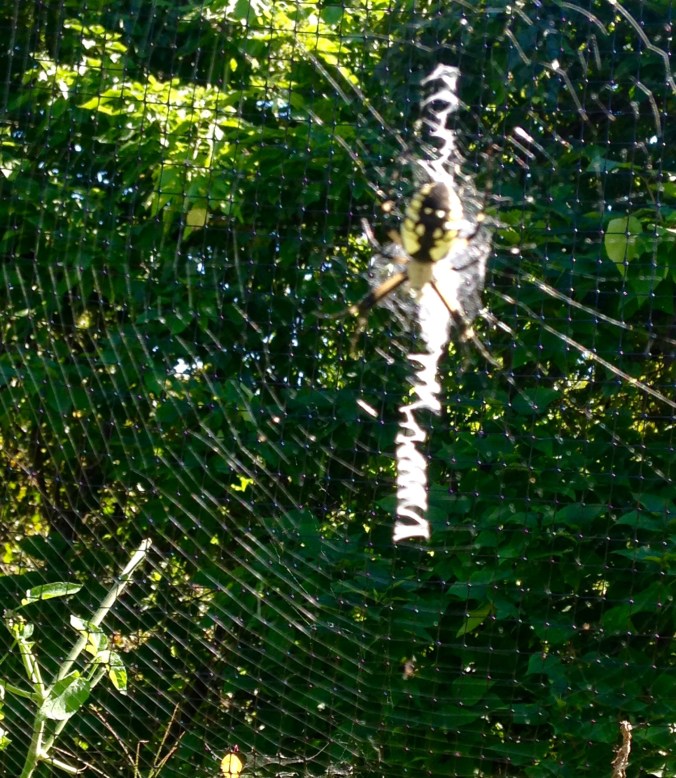
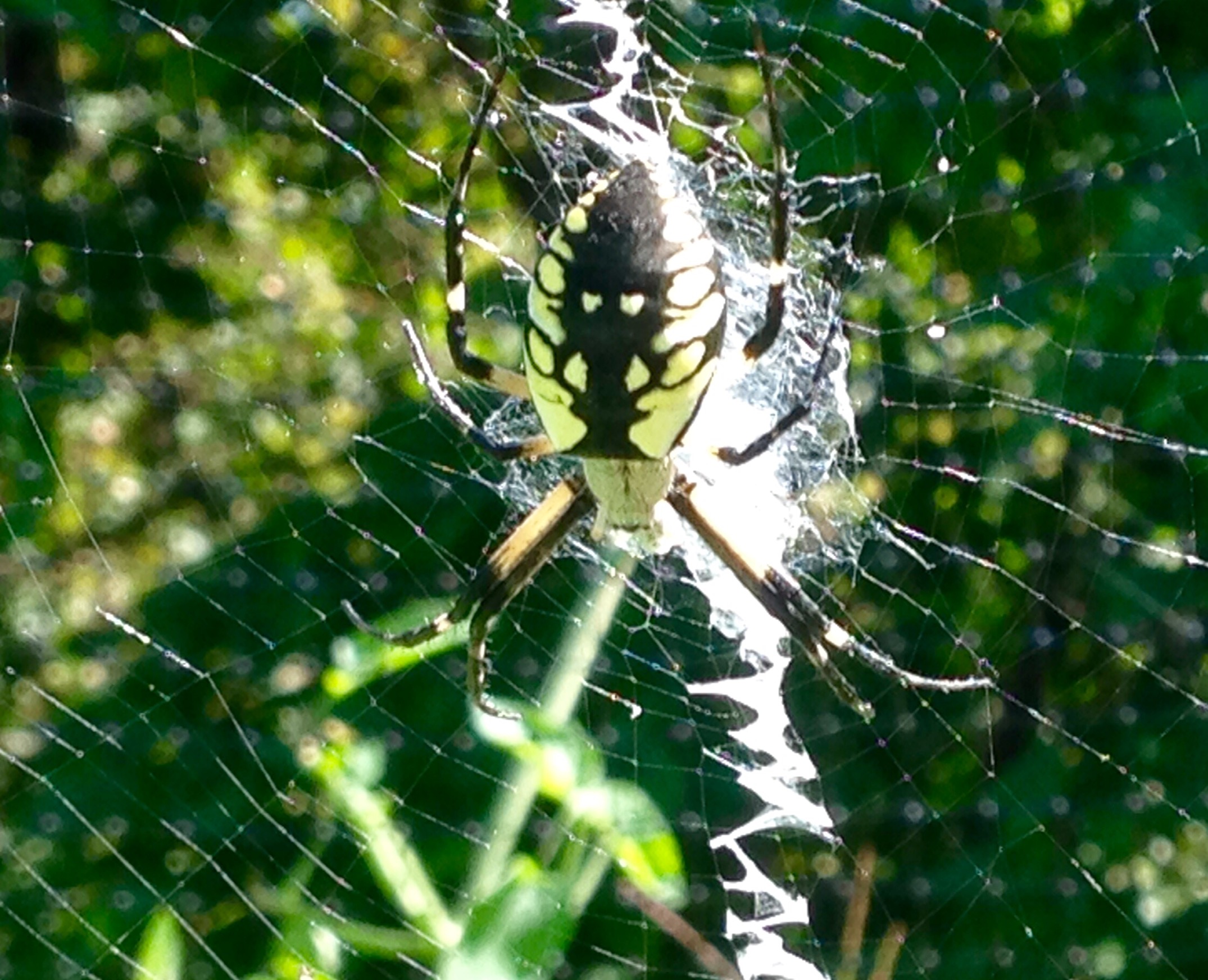
The first time we met her, we I was not expecting a friend. In fact, I considered, uh, getting rid of her somehow. But the more I thought about it, the more I liked the idea of knowing where she was — right there on the porch by the steps in plain sight. She is an ordinary black and yellow garden spider (argiope aurantia), but neither of us think she is ordinary at all.

Michael started throwing her bugs last weekend. She doesn’t act grateful, but how do I know what grateful is for a spider? I do wonder if she wonders why she gets all these good treats on the weekend. She won’t bother with stink bugs though; apparently no one likes stink bugs.
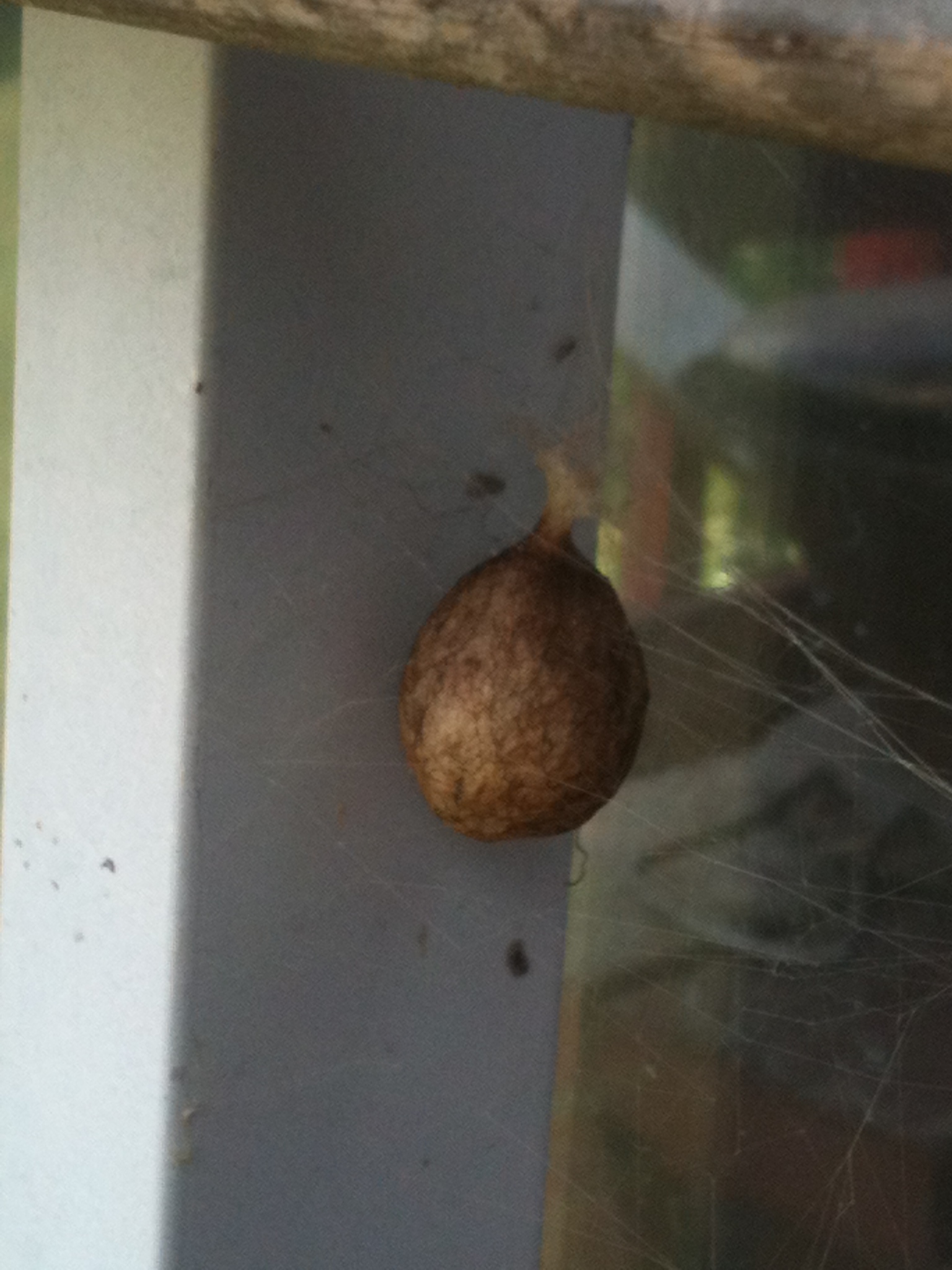
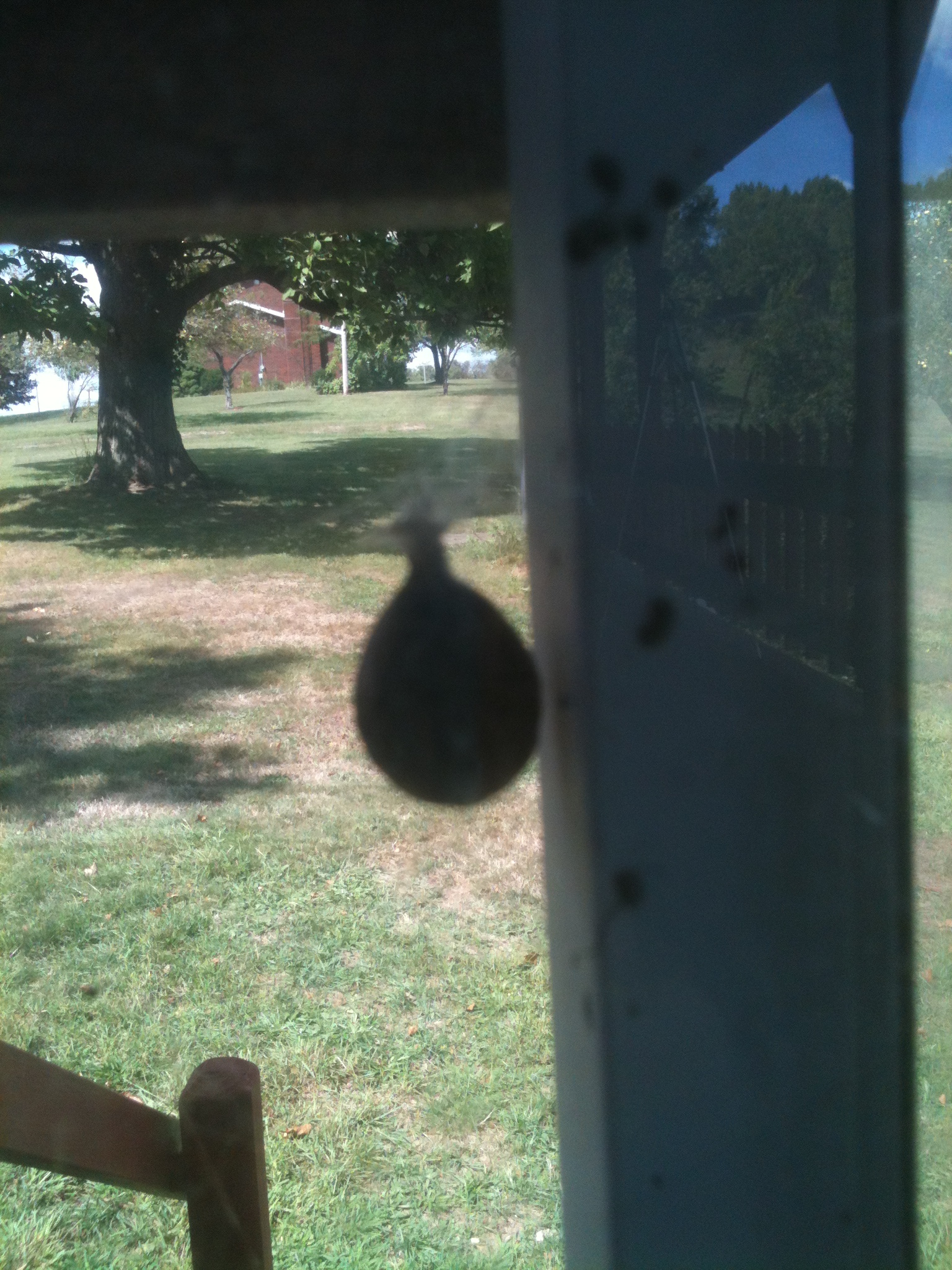
This weekend, overnight, a little something appeared in the top corner of her domain. At first look, we thought it was just a big, rolled up treat, saved for winter.
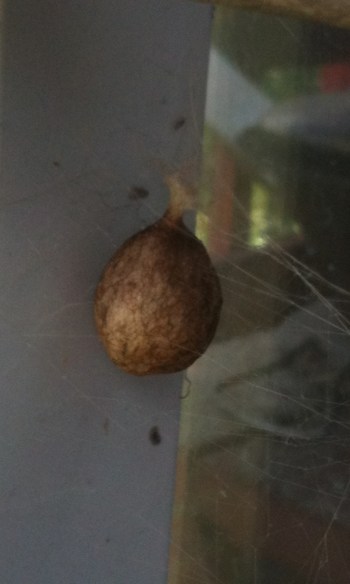
But then I remembered the real Charlotte, her namesake, and realized: Of course, it is her egg sac, filled with hundreds thousands of tiny spiders. More potential friends! If only they ate stink bugs…
I’ve looked it up, and I know that once Charlotte has laid her egg sac, she will die. But her children will hatch and stay in the egg sac until spring. At first I thought that maybe we could move them to a nicer spot for the winter? (Away from the house!) But baby spiders fly away on little balloon strings — the real Charlotte called her relatives aeronauts — so perhaps that isn’t necessary and they will fly away on their own?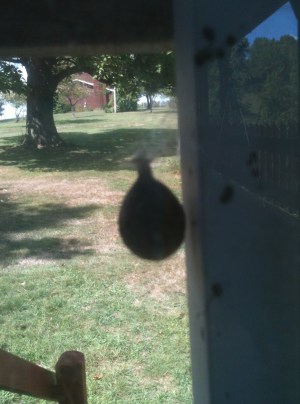
Charlotte and her children eat lots of nasty insects — aphids, flies, mosquitoes and the like — and they hardly bite friendly humans at all. Especially ones who throw them food…
I don’t remember reading Charlotte’s Web as a child. But I do remember reading it out loud with my children. When we finished the book, I closed my eyes and thought, ‘that’s the perfect book.’ A young, runty, good-for-nothin’ pig is saved twice by friends: the first time by Fern, a young girl who is trying to “rid the world of injustice”; and the second time by a spider whose life was a mess, but who told Wilbur that “…by helping you, perhaps I was just trying to lift up my life a trifle. Heaven knows anyone’s life can stand a little of that.”

This crisp, clear picture of a black and yellow garden spider was not taken by me, although this is the first time I’ve put in someone else’s photo. I just wanted you to see how lovely they really are! (Photo credit: Wikipedia)
I’ve been re-reading
G.K. Chesterton‘s essay on fairy tales,
“The Ethics of Elfland” in
Orthodoxy. This essay is deep and complex, and I have to go back and re-read every single paragraph to get it — and even then I can’t say I get it. There could be a month’s worth of posts just on this essay, and I won’t go into detail except to say that everyone should read it. Janey Cheney from
Redeemed Reader summarized it like this: “…Here’s what he learned from generic, plot-driven, ages-old fairy tales: 1) The world is magical; 2) the world is meaningful; 3) the world is beautiful; 4) the world is worth our gratitude; 5) the world is to be cherished.”
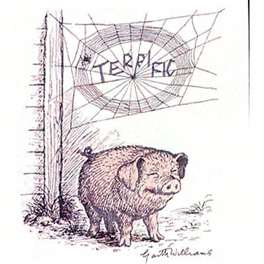
I would add that these truths are not just descriptive of fairy tales, but any story, written or told, lived or loved, true or not. E.B. White knew it. The words Charlotte wove in her web to describe her friend Wilbur were: Some Pig; Terrific; Radiant; and Humble — all words of love between friends. All words that describe magic, meaning, beauty, and gratefulness. And when Charlotte wrote those words about Wilbur, he became what she wrote about him.
I’ve rambled a long way from Charlotte appearing on the corner of our porch — a seemingly insignificant trifle (and one that truthfully didn’t thrill me at first) — but this much has been made clear once again: As busy adults we forget the magic, the miracles, the beauty that are all around us. In the middle of the book, the wise Dr. Dorian tells Fern’s worried mother, “Children pay better attention than grownups.” That is also his quote at the beginning of this post — Fern’s mother asks him if he really believes that animals talk — and he replies that they very well could have spoken to him, he just wasn’t listening.
So listen. Be childlike. Turn off whatever needs turning off and hear the quiet. Be thankful for the ordinary. Cherish the mundane. Be grateful for the spectacular. Don’t miss a miracle because you weren’t paying attention.
(Thanks to Janie Cheaney from Redeemed Reader on the post The Invasion of Fairyland — it sent me back to re-read Chesterton’s essay.) All other quotes are from one of the best children’s books of all time, “Charlotte’s Web” by E.B. White. And I have to include the last lines — “It is not often that someone comes along who is a true friend and a good writer. Charlotte was both.”
 I wonder about that. I miss seeing friends. We just resigned from our church — our life for eight years — because we are never there on weekends, and it is a loss.. And neighbors — I’m never in the yard working on my flowers or garden, so I don’t see them anymore.





 the circle of life