I am reposting this story on immigrants and our country. It was originally written in August of 2016, but it’s even more relevant now in 2025 as we hear news of immigrants being detained and even flown illegally to Salvadorean slave prisons. Stories of tourists from other countries being detained for no reason. Stories of children here for medical treatment being sent back. Lord have mercy…
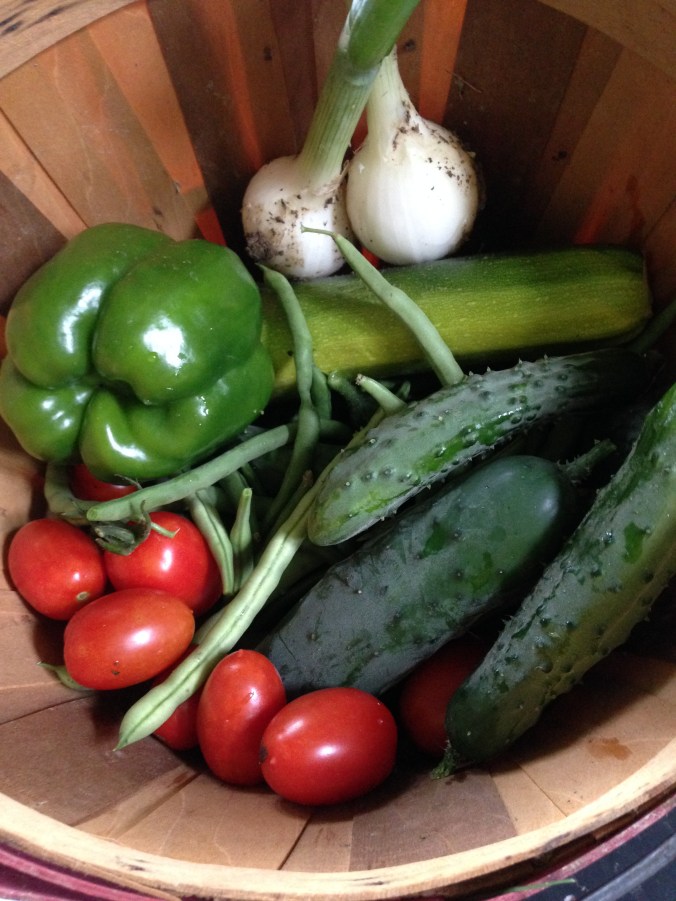
As I was making tabouleh (or tabouli) today for dinner, chopping cucumbers, tomatoes, a green pepper, green onions, parsley, and mint, my mind wandered back to the first time I was introduced to this delicious salad. I was about ten years old; it was a summer family picnic and Aunt Ethel had brought some stuff in a bowl that didn’t look like anything I’d ever seen before. Mom asked me to carry it in and put it on the table. I whispered to her, “Do I have to try this?” She smiled and shook her head. Much to my embarrassment, Aunt Ethel heard. Or maybe she just knew it wasn’t typical fare in our family. She smiled and said, “It’s your Uncle Abe’s favorite dish. He’d be glad to have it all for himself.”

A few months ago, I wrote a post with this photo in it. I labeled it Old Folks at the Cottage. My grandmother Carrie is on the left. See her sister on the far right next to her little boy? Her name is Ethel and sometime in the 1920s she married her own Syrian refugee, my Uncle Abe.
A large man with a white crewcut and wire-rimmed glasses, I remember him always wearing a suit — even to summer family picnics. He had a soft voice and a melodic accent, and he would stand in our living room and hold out his arms. We kids would race toward him and he would catch us and throw us up in the air. His deep-throated he-he-he would make us laugh even more. As a kid, I didn’t think much about his history, but I’d heard the stories: his parents sent him over on a boat around 1904 as a ten-year-old with ten cents in his pocket and instructions to find a relative in New York City.
As a grown up, I looked back on that and wondered what could have been happening in Syria to make parents put their ten-year-old son on a boat and send him off to another world, probably to never see him again…
So I looked it up. In 1904, the Ottoman Empire was crumbling fast. The Turks were conscripting young Syrian Christian boys for the army. And Armenian and Greek Christians were being killed at an alarming rate. Wikipedia even uses the word Genocide.
Abe eventually made his way to Southwestern Pennsylvania, where he found work in a mine. There he met my Uncle Leslie, who introduced him to his pretty, shy sister, Ethel. Not all the family was happy. Marrying an immigrant wasn’t common practice in the hills of Greene County. Though there were plenty of immigrants working in the coal mines, they were mostly Italian and Slovak. Certainly not Arabs…even Christian Arabs. (Leslie eventually married his own immigrant wife, Mary — whose naturalization papers from Italy I have — and who was one of the women who lived here at the cottage.)
I’ve finished making the Tabouleh for tonight’s dinner. (Recipe follows.) But I’m not finished thinking about how much our American culture has been shaped by immigrants. In fact, according to the U.S. Census of 2010, 2.9 million Americans identify themselves as solely Native American. The population of this country is approximately 320 million. That makes about 317 million of us who are descended from immigrants. We are a country of those who left. Has it been so long ago that we have forgotten?
Think on this: What would it take for you to leave your place, on foot, with your family, with no clear idea of where you are going or if you will be safe. It would have to be pretty bad, eh? Who are we, as a nation, that we cannot bring these immigrants/refugees to this country, feed them, clothe them, give them shelter, dignity, and a life free from constant war or poverty?
After the VietNam War, the U.S. took in 2 million Vietnamese refugees. When it became evident that there were thousands of “boat people” being rejected by other countries…
Look back at your family tree. My grandma Carrie was a card-carrying member of the DAR (I don’t admit that too often) yet still, I’ve had plenty of immigrants in my extended family. Welsh miners, Mennonite preachers, Syrian boys, Italian girls, Irish farmers, Czech steel workers, French Huguenots, Spanish son-in-laws… Even the English and Scottish ancestors came from, well, England and Scotland — there’s not a Native American in our branches, that I can find.
I am praying things will change; hoping talks of walls and closed borders and the unjust actions of ICE will go the way of the dinosaur; hoping that we remember those ideals. A verse from the Bible keeps going around in my brain. Jesus wept.
And today, in 2025, I’m adding another verse from the Bible: This one is from Matthew 25:40 and Jesus said it. “I was hungry and you gave me food, I was thirsty and you gave me drink, I was a stranger and you welcomed me.”
Here’s the delicious recipe for Tabouleh. While you are chopping vegetables for it, think of the wonderful mixture it is. And how it is better with more variety. Colorful and tangy, every bite is different.
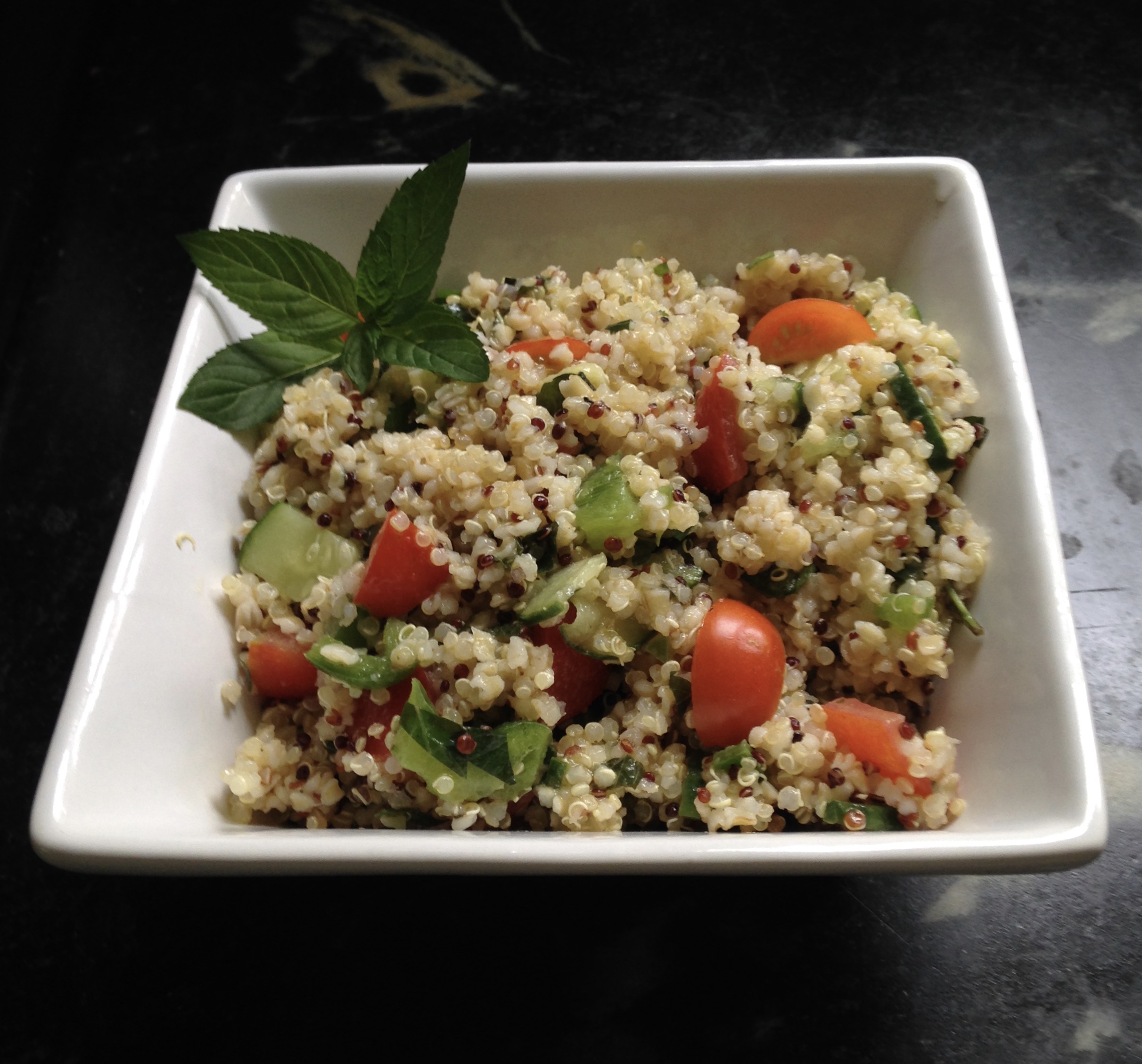
Tabouli (serves 6-8)
1 cup bulgur wheat, couscous, or quinoa, cooked (Bulgur is traditional.)
1 t. salt
1/4 c. lemon juice
1/4 c. olive oil
1-2 cloves crushed garlic
Cook the grains as directed. While warm mix in the next 4 ingredients (through garlic) and refrigerate for a couple of hours.1/2 c. chopped scallions
1/2 c. chopped mint
1/2 c. chopped parsley
When the grains and dressing are cool add the above herbs. You can vary the amounts, depending on what you have on hand and how much you like them. Some tabouli is very green and herb-rich. Other tabouli has less.The following ingredients are optional according to what you have in the fridge, or how you like it:
1/2 c. cooked garbanzo beans
1/2 c. shredded carrots
2 medium tomatoes, diced
1 c. chopped cucumbers or summer squash
1 diced green pepperI think the more vegetables added, the better. But it’s delicious with just tomatoes and cucumbers..
You can garnish tabouli with kalamata olives and feta cheese, but it isn’t necessary.
*Salmagundi –In English culture the term does not refer to a single recipe, but describes the grand presentation of a large plated salad comprising many disparate ingredients. These can be arranged in layers or geometrical designs on a plate or mixed. The ingredients are then drizzled with a dressing. The dish aims to produce wide range of flavours and colours and textures on a single plate. (From Wikipedia)



















 the circle of life