25. The ceiling is up and divorce is narrowly averted…

There were only two of us who showed up to work this weekend, and the grunt laborer should have called in sick. The pay isn’t good enough to work through sneezing, coughing, nose running, head aching, sore throat type of days. But this is no union job, as Mr. Homeworks Contracting reminded her several times.

There were four days to get the job finished. It was already a week behind schedule (lumber shortages), so when the truck pulled in with thirty 14 foot pine boards strapped to the roof, everyone was ecstatic.
Fourteen foot boards are long. Very long. Picture the old Three Stooges episode with Curly carrying a board, turning around, and hitting Moe in the head… Each of these thirty 14-foot boards got moved at least nine times during this project. When the laborer complained that we were moving the boards a lot, Mr. Homeworks Contracting got huffy. Mr. HC got huffy at least nine times during this project; the laborer complained — whined even — at least ninety-times-nine times during this project…

So, the laborer thinks, The wood is delivered, let’s get this stuff up and call it a day and have a beautiful new ceiling.

Hah, that’s why the laborer doesn’t get paid the big bucks!

First, Mr. HC goes over the boards with a fine tooth micro-lens to detect knots, holes, and the tiniest indentations. Each spot is circled and wood putty is put on the small problems, bondo for the bigger holes. The repairs have to dry and then be sanded. The entire boards are then sanded with fine grit sandpaper.


Then the boards are moved to a new spot and primed. Then the boards are moved to a new spot and sanded again. Then the boards are moved to a new spot and…wait, am I repeating myself? There are thirty boards. It’s a small house. We covered the front yard,the back porch,

and the living room.

It took three days of prep time before we could even think of putting them up onto the ceiling. Here are boards painted with the first finish coat of Sherwin Williams Steamed Milk semi-gloss latex. Of course, they had to be moved again — outside to the saw — and cut to the correct length.

So far you have only heard the board story; the ceiling story is bad too. Of course, it isn’t level. It’s an old house and the kitchen is not exactly on a foundation — more like attached to the foundation. Shims take a long time to put up. Luckily the laborer was busy painting and whining while the supervisor was quietly putting up shims and trying to not fire the laborer.
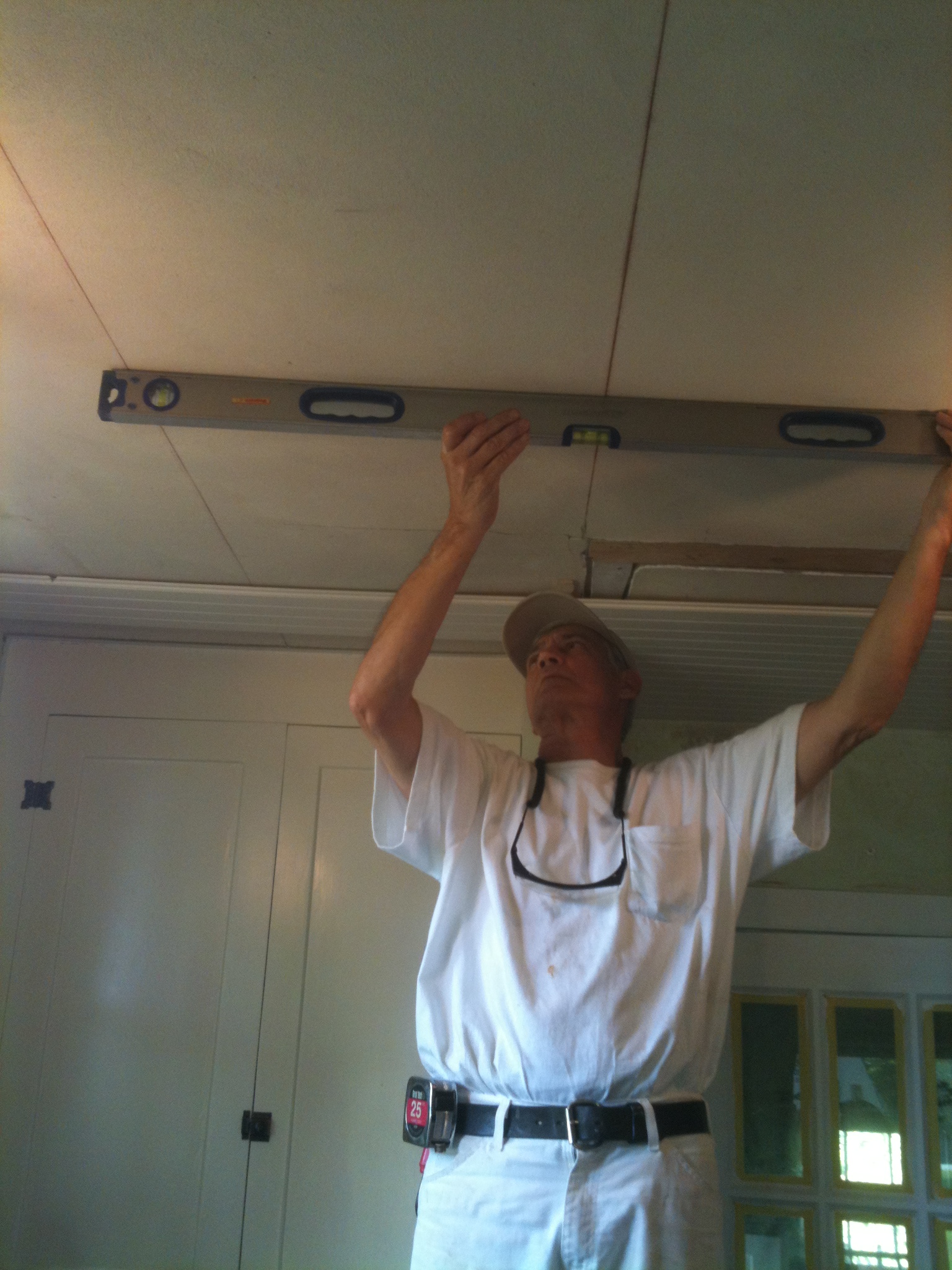
Anguish for Mr. HC who has to have everything straight within 1/16 of an inch.

Monday morning dawned early. It was a beautiful sunrise and the work crew was ready.

By this point, all expectations of finishing the job were gone; but here’s the point of this entire post: Prep work takes patience (I think I’ve mentioned before that I might be somewhat lacking in the patience department…) but if it’s done correctly, then the finish work goes quickly! Mr. HC has enough contractor experience to know this; the laborer is still learning.
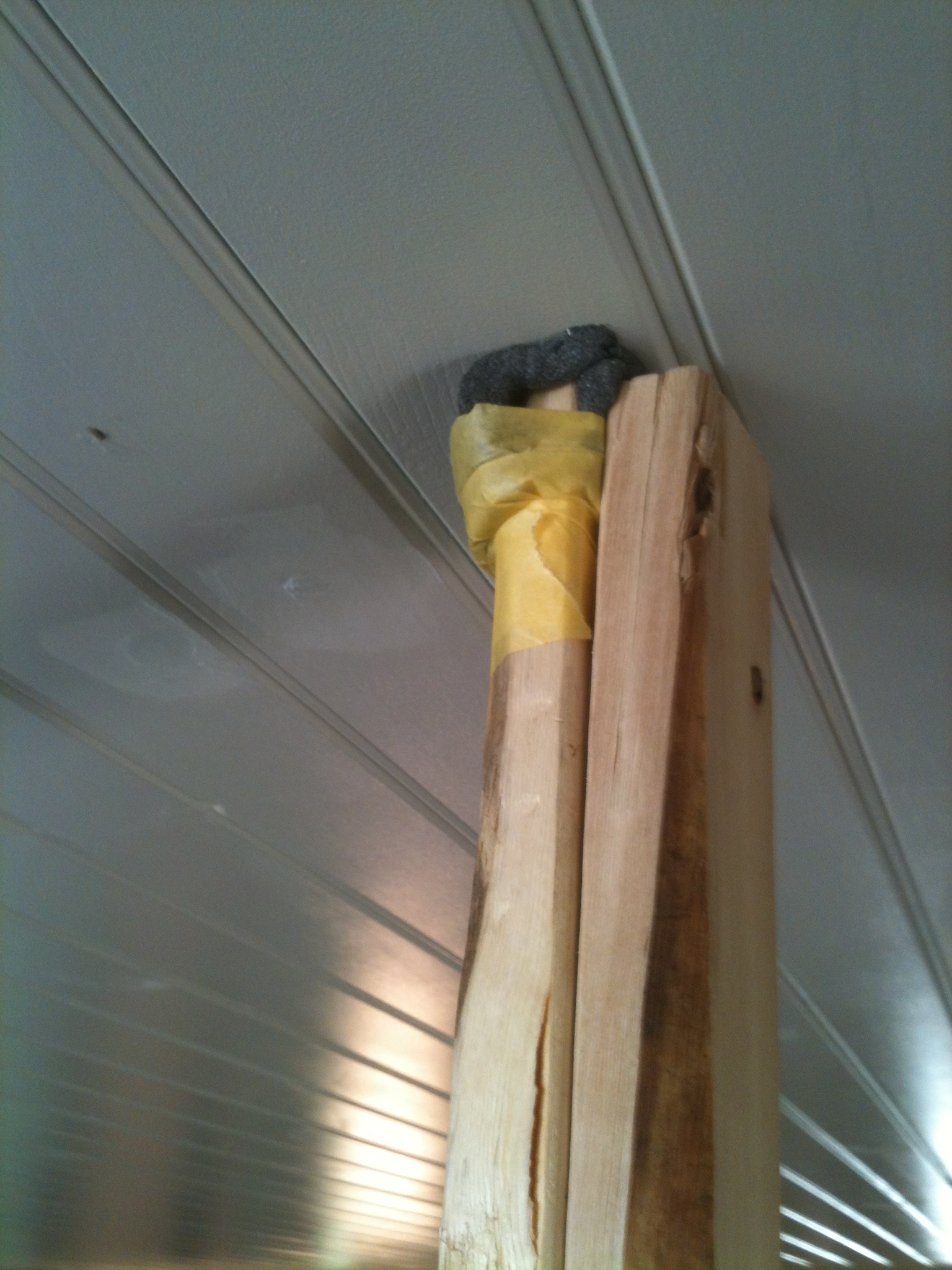
We worked well as a team on Monday (finally). Of course, the team effort had Mr. HC cutting the boards, as well as air nailing them in place. It was also his bright idea to wax the boards so the tongue would slide easily into the groove. All the laborer did was hold up her 7-foot part of the board and pound it in place. Mr. HC also invented a nifty little gadget to help hold the boards up in the middle. This gizmo went all the way to the floor and had foam attached to the top so it will hold the board in place without scratching the finish.

At 4:30 we were having celebratory glasses of wine while looking at our new ceiling, all complaining, whining, nitpicking, and disagreements behind us.

Just in case you forgot what the old ceiling looked like:

Before:

Before

And the fabulous new ceiling:

new wood ceiling

Ceiling boards, $350 from Wayne Lumber


Critics often accuse blogs of painting pictures of life that are too rosy, too upbeat, and too unrealistic. Not this post; this one is warts and all. It wasn’t an easy weekend, and there wasn’t much laughter. So what did we learn?

  1. Expectations ruin everything — and this includes all of life: work, play, marriage, relationships, friendships, sickness, health, future plans, you name it. Get rid of ’em.
  2. Patience is a virtue. Patience is a virtue. Patience is a virtue…
  3. Silence is a virtue too. Don’t whine. Don’t get huffy. Put in earphones.
  4. Call in sick when necessary.
  5. Love each other and forgive. A glass of wine helps; if you don’t drink wine, practice hugs.
  6. Celebrate together. Hurray, we have a new, gorgeous ceiling!

(My husband’s name is Mr. Homeworks Contracting and he approved this message.)

22. Two Sides to Every Window

I got a new job this past weekend.

We are getting close to starting the ceiling. (I know, I’ve been saying that for a month now…) So this weekend we had the lovely task of taking down everything that touched the ceiling. That would be:

  • the obtrusive wall cabinet where all our food and dishes were stored;
  • the ugly fake wood moulding around the windows;
  • the horrible fluorescent light fixture above the windows; and
  • the two-by-four that was nailed into the ceiling where the old wall used to be.

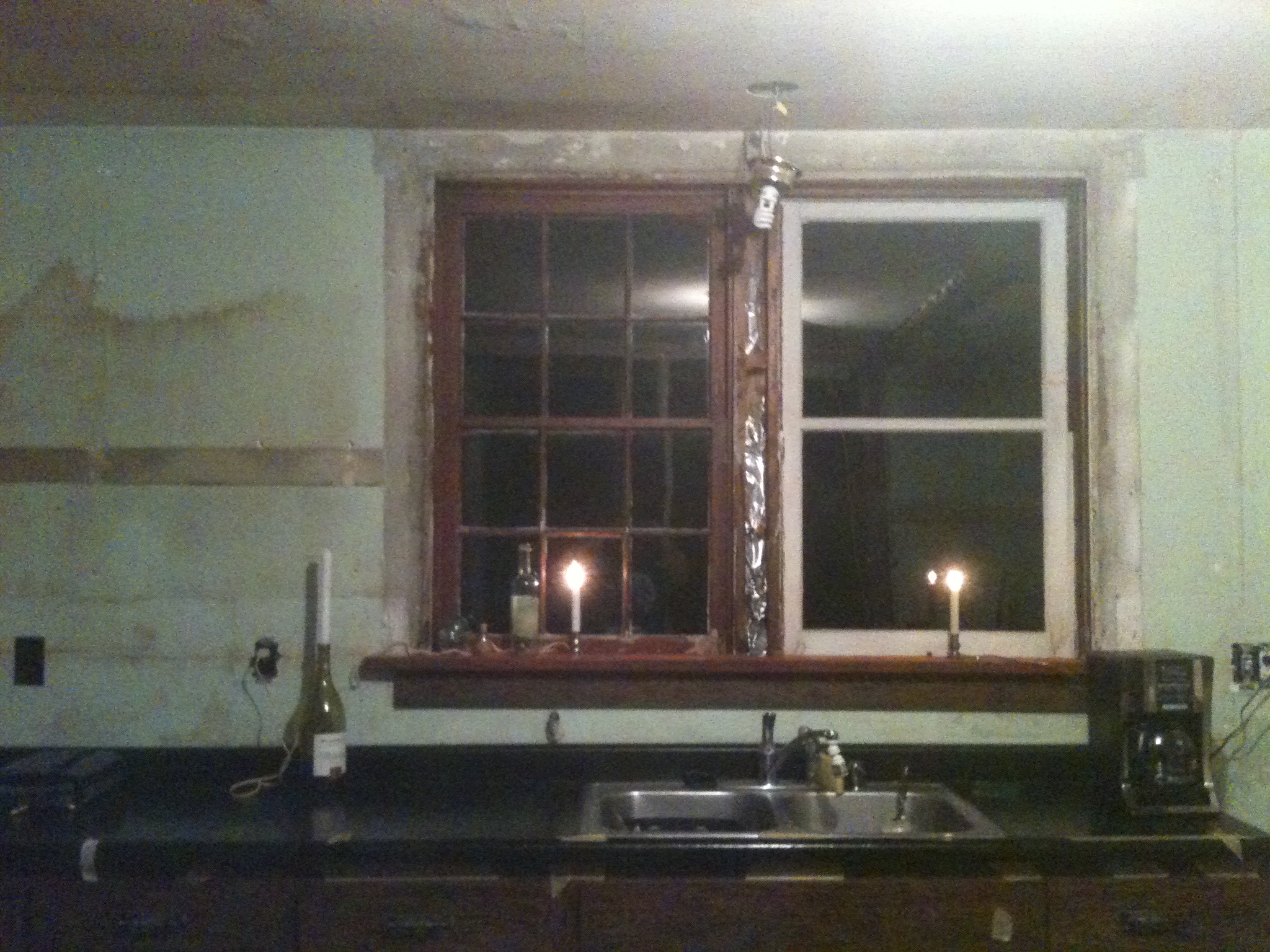
All those objects are now kaput. When the dark cabinet came off the wall, the whole kitchen lightened up! It was even better than we had hoped — who would have thought an ugly green wall with holes and stains would look so beautiful?

Ugly cabinet begone! Let in the light!

Oh yes, my new job…Windows. The windows in the kitchen are old wood double-hung windows with panes (in today’s terminology — true divided lights). They don’t match exactly, but you have to be my husband to notice. The really old window has wibbly wobbly glass, but they both are original to the house. That means they have been painted many times. The inside has four coats: white, sage green, mint green, and orange. The orange coat was then antiqued. Does that make five coats? I’m not sure. The paint is dried and cracked, and the window sill was always dirty with the little paint leavings that were chipping off the muntins.

This window has a storm window on the outside, so it was the first to come down.

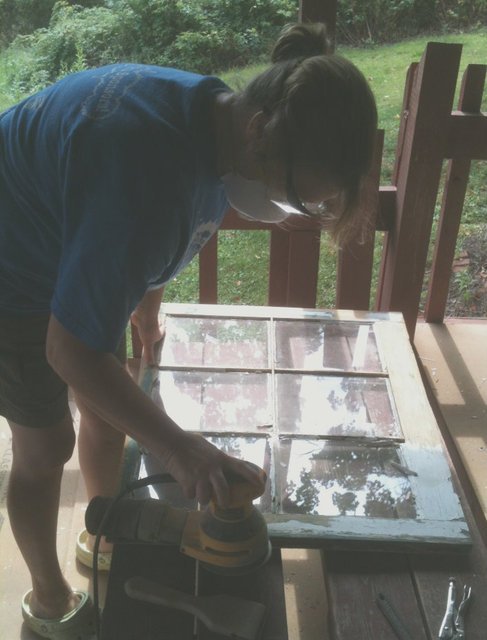
So one window of the two has been taken down, in two pieces, and is now back in the sanding department. I had just cleaned up the sanding porch in anticipation of priming and painting ceiling boards, and now it has become the sanding porch once again…

Restoration in process…

It is fitting that I am in charge of renewing these windows because I am the one who wanted to keep them. Back last winter when I was reading Jane Powell’s Bungalow Kitchens, I read to Michael her opinions on old windows. She loves them (big surprise!) and believes that the American home-owning public has been sold a bill of goods (by window manufacturers, installers, and big box stores) about the R-value of new windows. She believes that a properly fitted and sealed window, with a storm window on the outside, is just as good as any window we can buy new. (If anyone can seal these old windows, Michael can figure it out.)

He didn’t agree; he still doesn’t. But we looked at new windows. They are either ugly or prohibitively expensive. They look new. They look modern. The cottage is neither.

The original green paint

On the outside of the windows there are just two coats of paint: white and dark green. The exterior paint is actually easier to sand off than the inside. The old paint is weathered and easily chips off. I scraped first, then sanded. There’s plenty of time to think while sanding — and that green paint I’m sanding off is probably what my grandfather painted on the windows many years ago! It is forties dark green, and my goodness, is it ever stuck on those windows! The sander gets hot and that dark green paint bubbles up in lumps before it comes off.

Michael came out to the porch in mid-afternoon to see how it was going. “Well,” I answered, “there are two sides to every window…”

AWYSG (Always Wear Your Safety Glasses — and a breathing mask also if you might be sanding lead paint…)

Yes. Inside and outside, there’s been a lot of looking through those windows. Seasons passing — life being lived inside and outside. I know both the women who have lived in this house. It used to be that people lived outside more than we do now. There was a pump under that big tree where Aunt Mary drew water — every day, probably more than once. She had a big farm sink in front of those windows where apples were cleaned and peeled and sliced, hands were washed, a little boy’s knees were mended, meals were prepared, dishes were washed, and probably tears were shed. I think women cry while doing dishes — when they are alone and can just let the tears fall into the dishwater. Clara changed the kitchen sink to stainless steel, but the cold of a silver sink catches tears just as well as porcelain. Her husband Joe died while she was living there, and left her a widow in the country, rambling around in a house that I’m not sure she loved.

Clara told the story of Joe coming home and announcing that he was thinking of buying the orchard, and how would she like to move? When they went to see the cottage, Aunt Mary was there and not particularly welcoming to the people who would be buying her house. She had lived there for thirty plus years and was now going to have to move to an apartment in town. Clara was moving from the house where she had lived for almost twenty years, the house they had built, the house where she had raised her family, to a cottage in the country that needed repairing. Two women, two kitchen sink windows — what stories those windows tell.

We originally thought we would add a third window to let in more light. My window. But then we looked from the outside and realized that the two windows are perfectly balanced under the clipped gable of the roof, and a third window would destroy the symmetry of the cottage. So I am scraping, stripping, and sanding these two kitchen windows. And I will be painting them too. Those muntins between the panes are hard work, but I am being careful. Careful to respect the life, the love, the joys, the sorrows that they have seen. I won’t have my own window, but I will have put my sweat into the two original old wooden double-hung windows that are there. Still.

19. Wood Makes Everything More Beautiful…

Hardwood Lumber Company is a great place to order butcher block counter tops. They ship products all across the country, but we’ve ordered twice from them and picked up the counters at their mill both times. Located in either Burton, Ohio or Springfield, Ohio, depending whether you’re using their mailing address or a GPS, the company is in Ohio Amish country.  Burton is a charming little Ohio town, but the GPS didn’t like that address at all. It’s very unnerving to put in what one KNOWS is the correct address and the Garmin responds with Address Not Found… After consulting two maps and an IPhone, the navigator (that would be me) decided to try Springfield, as it was the next town over. Thank goodness, the GPS found that one. This is the unmistakeable sign (after we finally found the correct road).

Amish people don’t like to have their pictures taken, so I asked the boy who was weeding around the sign if he minded if I took a picture of the sign. He didn’t mind; alas, you can hardly see him–maybe that’s what he was thinking…

In the same complex is a shop filled with every style of moulding imaginable, and an Amish broom company, as well as the mill.

It’s a good feeling to see the piles of lumber that your finished piece comes from…

We had ordered two countertops made from Sapele wood, which is not a local wood, so I’m sure that our wood is not pictured here. Sapele is a sustainable substitute for mahogany — grown in Africa — and it is a rich dark brown after finishing. I talked to the secretary in the office several times — the sapele wood was a bit difficult to get and the order was delayed a couple of weeks. It didn’t matter to us at all, and they were so nice about it. They even offered to ship the counters for free if they weren’t ready by when we arrived.

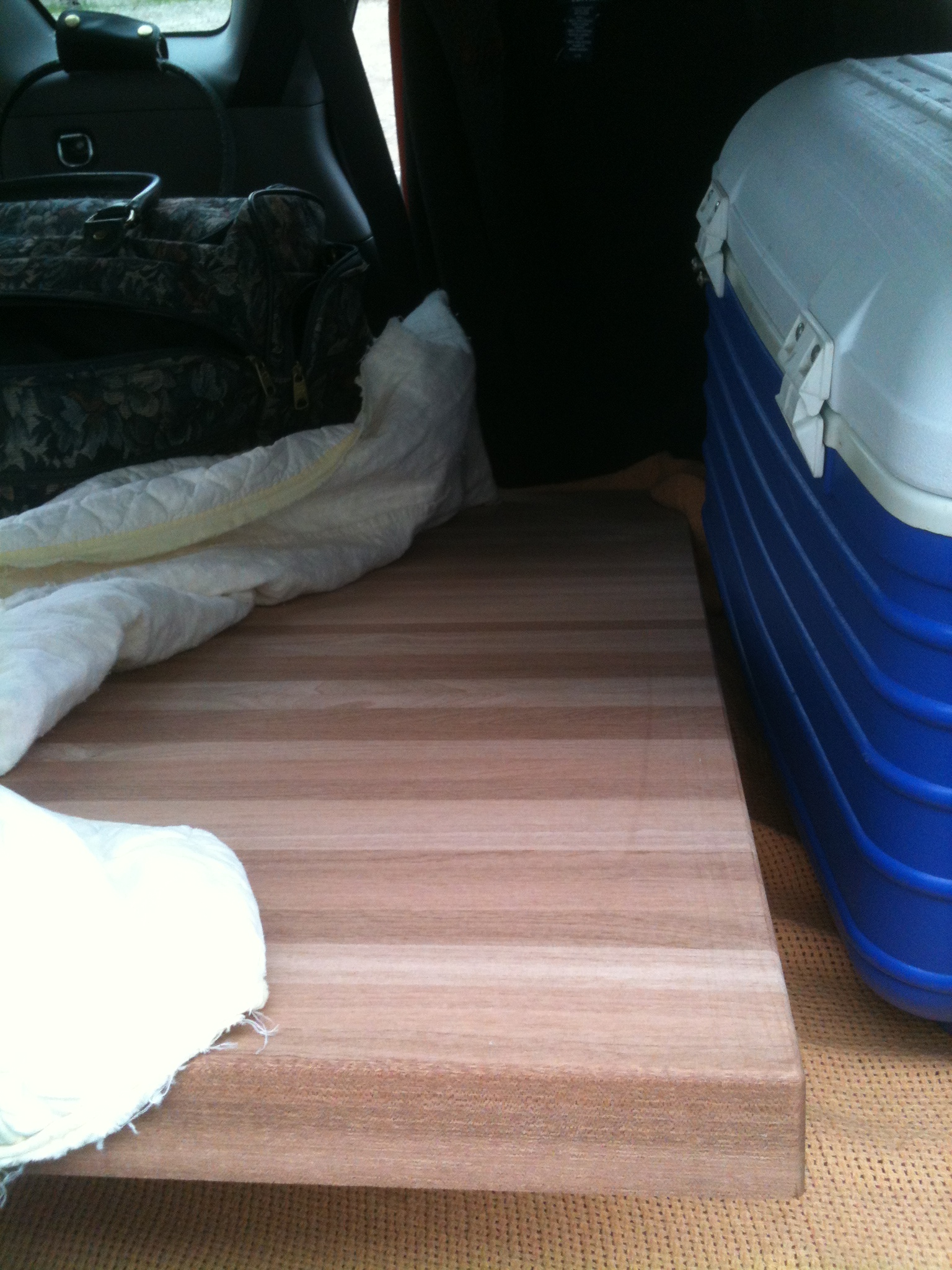
We were coming home from a visit with son, Casey, in Wisconsin, so we had to unload the car of all our suitcases and travel gear before we could load up the countertops. A young Amish man brought them out on a dolly and patiently waited for us to put our suitcases and cooler all over the parking lot. He and Michael loaded the countertops into the car, we signed the receipt, put back our suitcases, and we were off. It was quick and efficient, after the secretary finally located the paperwork, that is. I wasn’t worried; a nice man had called me the day before to tell me they were ready and to make sure we were picking them up.

Just a peek…

…and we’re loaded up and ready to head home.

Greeting me this weekend? A dead mouse lying in the middle of the living room floor! Readers, you will all be grateful to know that I did NOT take a picture of it. It didn’t smell very good and a fly buzzed around lazily. It’s a good thing my shovel had a long handle… But even dead mice can’t quell the enthusiasm that comes from a beautiful new piece of wood. It smelled like a woodshop in the kitchen as we took off the old piece of wood and put on the new.

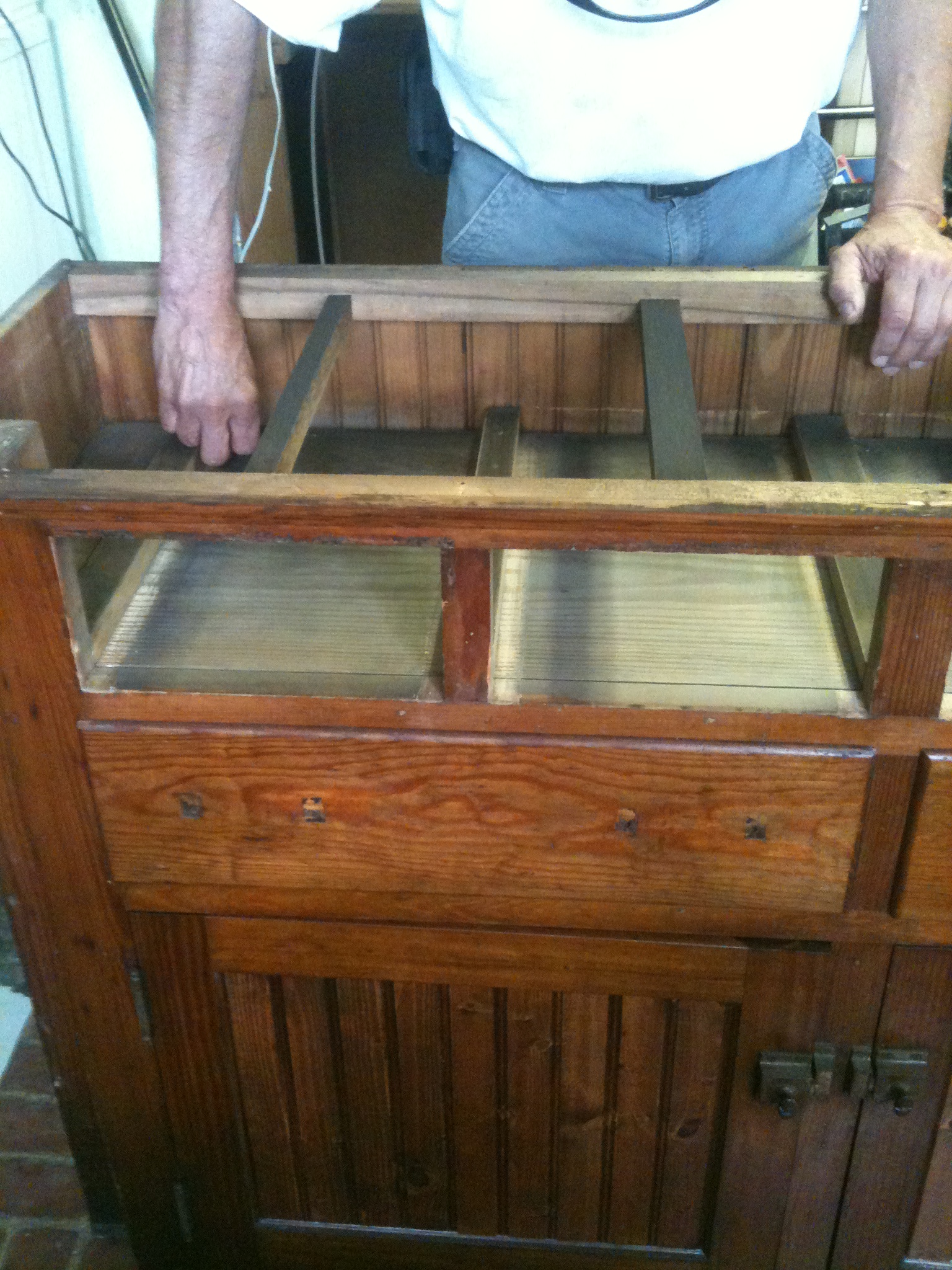
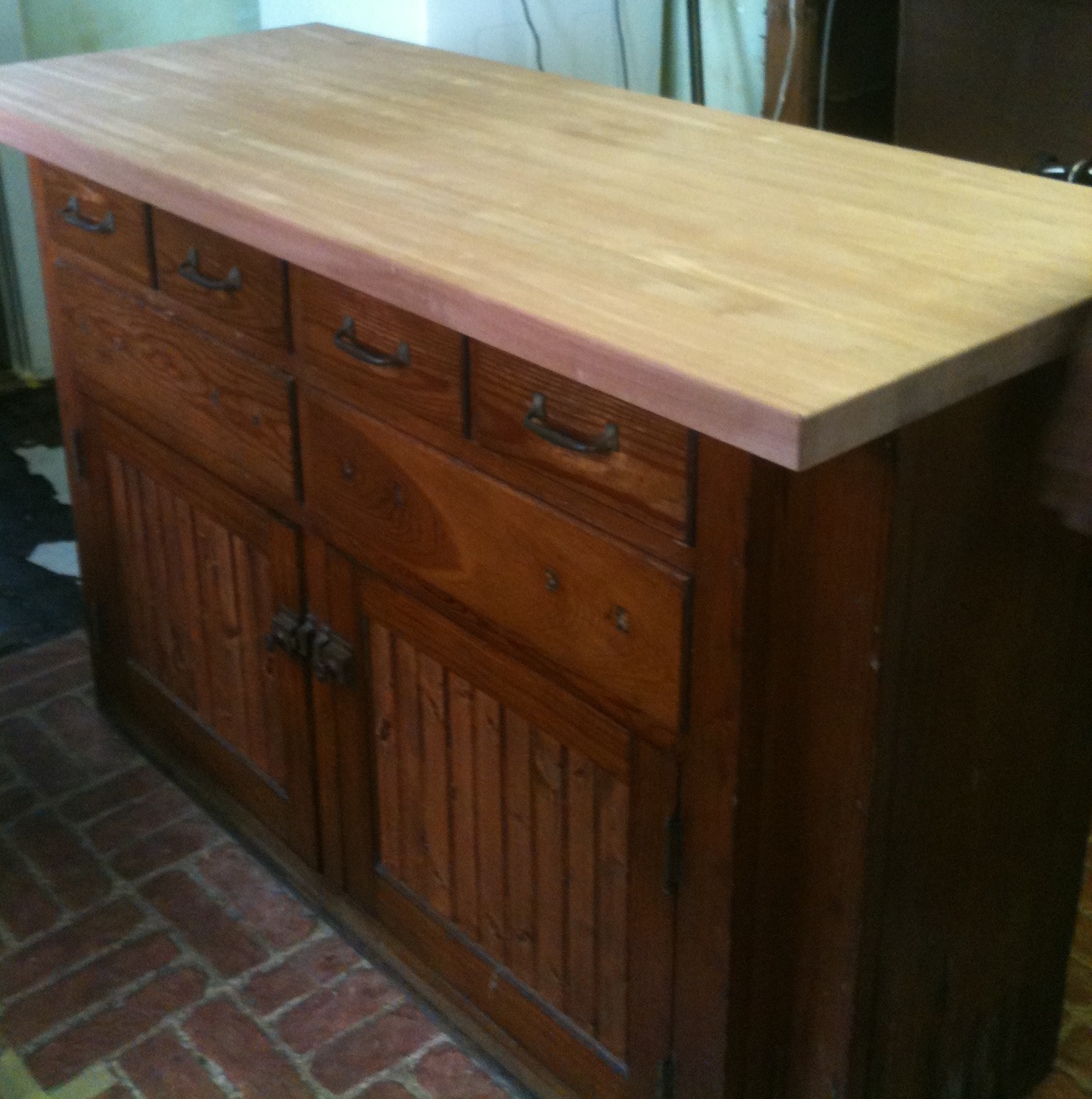
The stained and gouged old top (or rather, wood with a rich, dark patina and character) will have its jagged ends cut off and be re-purposed as a top to the built-in cupboard. Pictures of it coming soon…

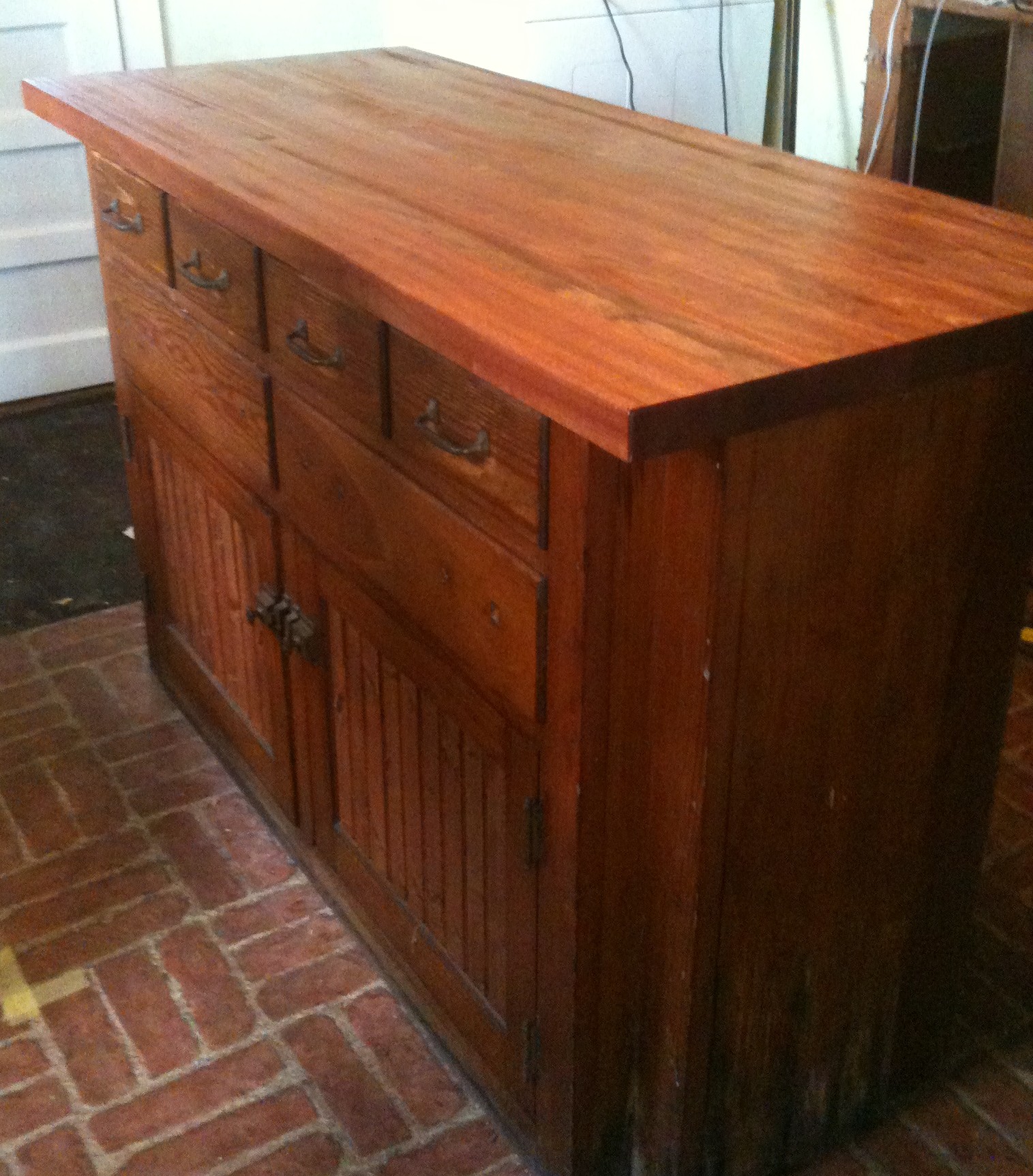
The next two pictures show the difference mineral oil makes on a butcher block countertop!

From the mill…

to this wonderful rich color!

This luxuriously rich-looking butcher block top is in our kitchen right in the middle of a construction zone! I felt the need to cover it with a sheet the next day; it IS an island — in the center of the kitchen — and everything from paint brushes to utility knives to glasses filled with iced tea will do their damage… We did cook on it though. For our first veggie chopping event, we chopped on an old cutting board we’d had for years!

But I believe in using what I have; maybe I should just gouge it with a knife and get it over with! That’s the best part about wood though–not only does it make everything more beautiful, it can be sanded, oiled, and made to look beautiful again!