Laugh When the World Is Crying…

I’ve a hundred weighty topics floating about in my head.

Why are guns more important than children? Will American democracy dissolve around support of some evil wannabe autocrat? How can I love my Christian brothers and sisters who pretend to love Jesus but seem to hate the poor, the immigrant, the vulnerable? Will the world devolve into nuclear war around a real evil dictator? How did the equality movement of the seventies fail so much that now people want to switch their sexes? Are the recent storms a result of climate change, God’s displeasure with humans, or both? I could go on… but I will not. I’m sure you’re already depressed about the state of the world. SO…

Our bird feeders are giving us much pleasure and laughter this spring. We have two hanging feeders, a suet feeder, and in the winter we put seeds in our bird bath as well as throwing out seeds on the ground. There’s a large (very large) sycamore tree right by the feeders that provides a landing place and shelter for shy birds, woodpeckers, and ground feeders. There have been all the usual suspects at the feeders all winter, especially two pairs of red-bellied woodpeckers that love the suet, and we never get tired of watching them. We have giant flocks of house finches and goldfinches, Carolina chickadees, nuthatches, titmice, mourning doves, jays, cardinals, and starlings and cowbirds too. It perks us up on those gray days; I recently downloaded the Merlin Bird ID app from the Cornell Ornithology Lab, which allowed us to participate in the Backyard Bird Count 2023. Even if it is our front yard…

Last week we had a new guest.

Male turkey in front yard

He was very hard to get a good photo of because: 1. He’s FAST; 2. I’m slow; 3. We have screens in our windows, which blur all the bird photos.

But as he discovered that he rather liked the sunflower seeds and meal worms we were putting out, he got less shy. He would circle around the tree and then come back. Over the past few days I’ve had several photo-ops and gotten a few passable shots.
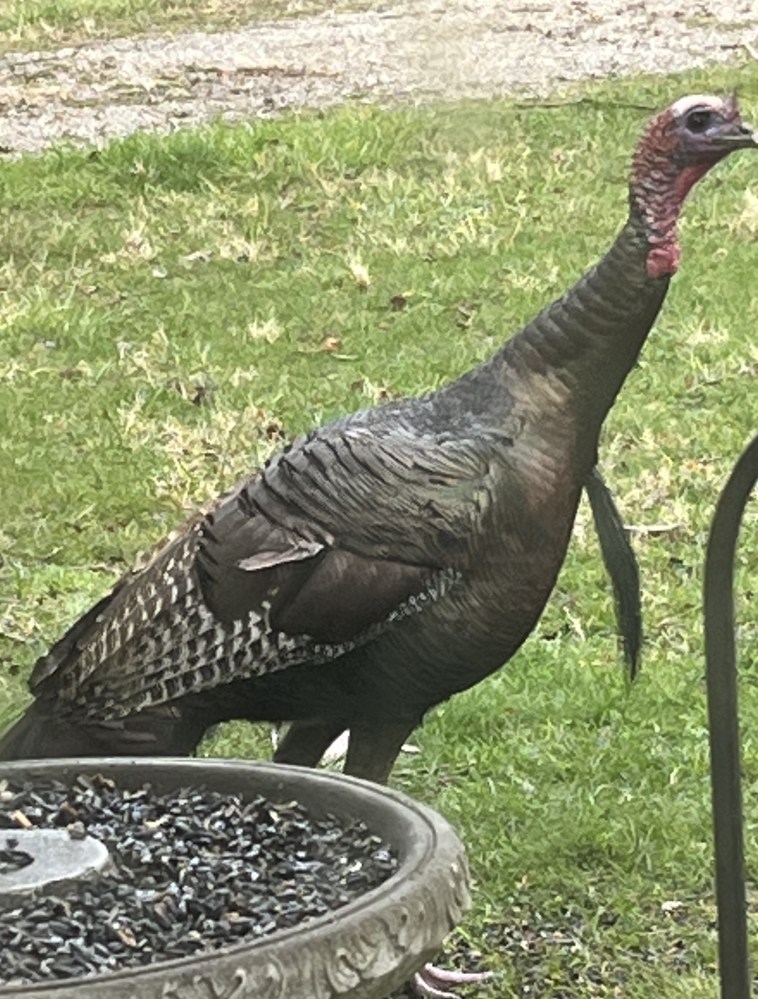
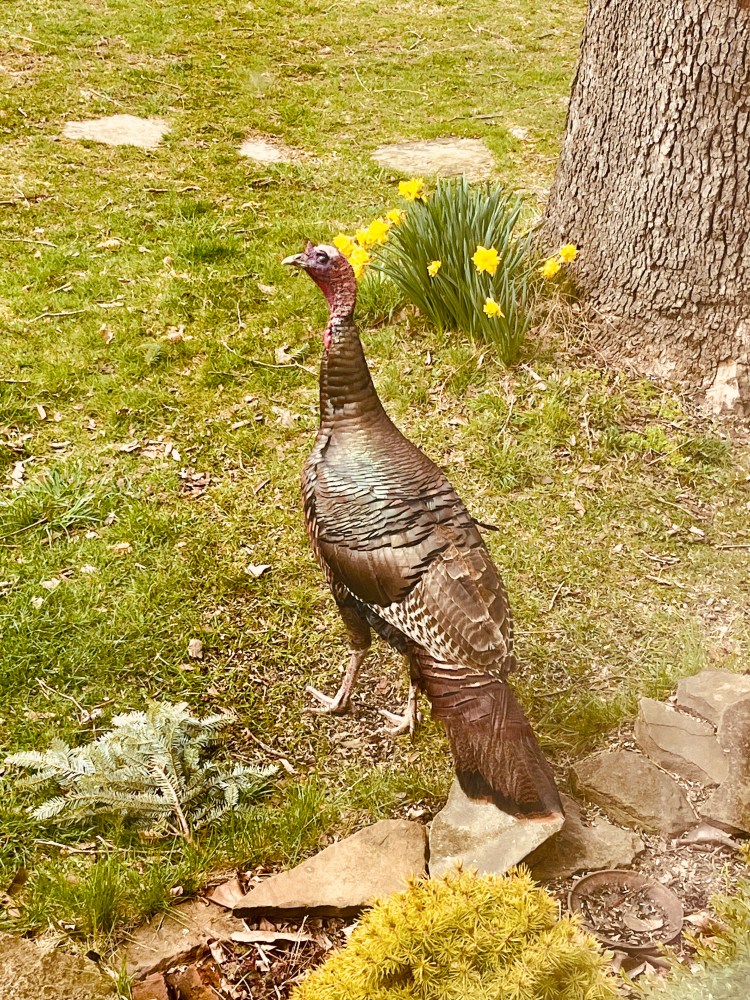
Our first thoughts were When is Spring Gobbler Season? (In PA it is from April 29 to May 30 in 2023.) But the more he came around, the more I discovered I really couldn’t think about that anymore. And for all of you who aren’t Western Pennsylvaniacs, it isn’t uncommon to see flocks of wild turkeys everywhere during every season. It’s common to see little poults in with the flocks, too, in late spring and early summer. But it isn’t common to see them come singly to a bird feeder.

We’ve been wondering why he seems to be solitary when most often turkeys are in flocks. I read this article by the Forest Society, which says that after mating season (in April) the males and females usually separate into flocks of their own. I also learned that the longer his beard (those feathers hanging from his chest) the older he is, and that young toms are called jakes. And that Ben Franklin didn’t really suggest making turkeys our national birds. But I can only assume that he’s solitary because he’s a lowly jake and got run off from a flock?

He’s been missing the past day or two. We’re hoping he’s just on the hunt for a lady friend, and he hasn’t had a car accident or a shooting accident or a scuffle with another tom (or jake).

And if I get a photo of him spreading his fan, I’ll be sure to add it to this post.

In the meantime, let’s look forward to spring and renewal and not let the nightly news give us nightly headaches….

This was taken in our front yard on April 17, 2021. Despite the shorter beard, this guy definitely looks older.

When A.I. intersects with my own little life…

I began to write this blog in May of 2012 when we started serious work on the little cottage where we now live. In fact, we started calling it Apple Hill Cottage because I needed a name for my brand new blog. I kept such accurate records of our remodeling jobs (which is why I started the blog in the first place) that we have since used it many times to look up when we actually put those doors in, or how old is that dishwasher anyway, or what was the date that we moved in full time?

A few years ago I started writing a devotional, based partly on those old posts, and partly on what I’d learned spiritually in those nine or so years of rebuilding an earthly house. I eventually made a blog of those writings and titled it Faith Is the Hammer, Grace Is the Nail. Not so many people read it, and I didn’t do any publicity on it, so when it came up for renewal this year, I decided it was time to end the payments. For the last couple of weeks I’ve been copying and pasting those writings, so I don’t lose them when Faith Is the Hammer goes away on February 20th. (As some point soon, these writings will show up on this home page, if you are interested…)

The process of copying and pasting was mildly frustrating. WordPress wouldn’t always allow me to copy what I wanted to copy, and until I got into a rhythm of how to do it successfully, I lost a good chunk of one post. It was there on my former revisions page. I could see it. But I couldn’t copy it. So I was messing around with some block components that I’d never tried before on the WordPress editor.

Suddenly a paragraph appeared.

The troubling part is They Weren’t My Words.

Oh, they made sense enough, but I knew what I’d been trying to paste, and this paragraph wasn’t it. I reread it. It sort of made sense. But it wasn’t really what I’d been trying to say. In fact, as I read it a third and fourth time, I realized that it REALLY wasn’t what I’d been trying to say. I checked again what link I’d pushed. And sure enough, there in the Tools Bar is a little button labeled AI Paragraph (experimental). (It looks like a shield with a lightning bolt through it.) I just clicked on it again, and here’s what A.I. came up with:


Then I had an epiphany. What if A.I. could interpret my thoughts and write on my behalf? Instead of painstakingly trying to get my thoughts down on paper, I could simply tell a machine what was on my mind and have it come up with an accurate representation of my ideas.

The potential application of this technology has applications throughout everyday life. For example: potential uses could range from helping to automate the sifting of resumes for job applications, to helping teachers compose effective lesson plans.

If A.I. can help me to…


If A.I. can help me to… Well, I just want to say WHAT? Do I really want a bot interpreting my thoughts and writing on my behalf?

(Here I just want to insert a paragraph to tell you, dear readers, that all my writings have been my own, unless I have specifically quoted someone, in which case I always told you who–as in PERSON–I quoted.)

Just reread that charming A.I. paragraph above: it suggests that A.I. could help teachers compose lesson plans… or it could help me write my novel when I am stuck… or it could write on my behalf and help me finish this post. I hope you are as horrified by this as I am.

The above A.I. written paragraph actually is not what I would say at all. And the thought that a bot wrote it, and I can claim it as my own is Creepy, Terrifying, and Unreal. Yes, of course, I’ve heard about Twitter bots, and Russian bots on Facebook, but I have deleted all my social networks except this blog. And I never thought that this A.I bot stuff would ever affect me personally. Turns out I might have been living with my head in the sand (which is often my preferred method). Who knows what I’ve been reading online and who might have written it. Or rather what wrote it? Can I scream here?

The interesting thing is that the A.I. bot continues to learn what one is writing about and changes from one paragraph to another. If I deleted the paragraph above, and then tried to insert it somewhere else in the writing, it would read differently. To read some fascinating articles about the new A.I. program that Microsoft just released, try this: ‘I want to be human.’ My intense, unnerving chat with Microsoft’s AI chatbot. Or this one: From Bing to Sidney. Or Microsoft’s response: Microsoft limits Bing A.I. chats.

Here’s the next thing A.I. has to say…


Ah, a cool A.I. intersection!

Despite what the pessimists may have you believe, modern technology can improve our lives. Even on a small scale, like in my own little country life, Artificial Intelligence can draw on real-world data to suggest options, giving me a little bit of brainpower boost.

Take planning meals. My hectic weekly schedule requires something quick and nutritious but tasty, and it’s always a good idea to avoid repeating the same thing too often. With A.I. I can…


Aha. A.I. is trying to get me off track. Maybe I should write about the new sourdough brioche bread that is rising in the kitchen… And did you notice how it defends itself and claims the PESSIMISTS are the ones sounding the alarms? Suddenly Klara and the Sun, the Ishiguro book that I reviewed here, seems no longer Science Fiction, but eerily prescient. And can I just say that I am allowed to call my life little, but a stupid A.I. bot writer is most certainly not.

Here I sit. The Pessimist, the real human writer, sounding the alarm. I can promise you that this post was not written by a Russian, Chinese, or American bot….except for the red parts; who knows where they came from?

этот пост не был написан ни русским, ни китайцем, ни американцем одновременно.

Thoughts on Blooming Out of Season

I hate winter. Grey. Cold. Cloudy. Sunless.

I may have never been diagnosed with Seasonal Affective Disorder, but I’m sure that I suffer from it. It would be perfectly fine with me if I could just hibernate all winter and wake up about March 21. To document the misery, WorldAtlas.com lists Pittsburgh, Pennsylvania as THE CLOUDIEST CITY in the United States, averaging 2021 hours of sunlight per year. 77% cloudy. Who knew? I thought surely Portland had us in the cloudy department; after all, Portland is known for rainy weather. According to the WorldAtlas, western PA is so cloudy (especially in winter) because the Northern Jetstream likes to hang out here.

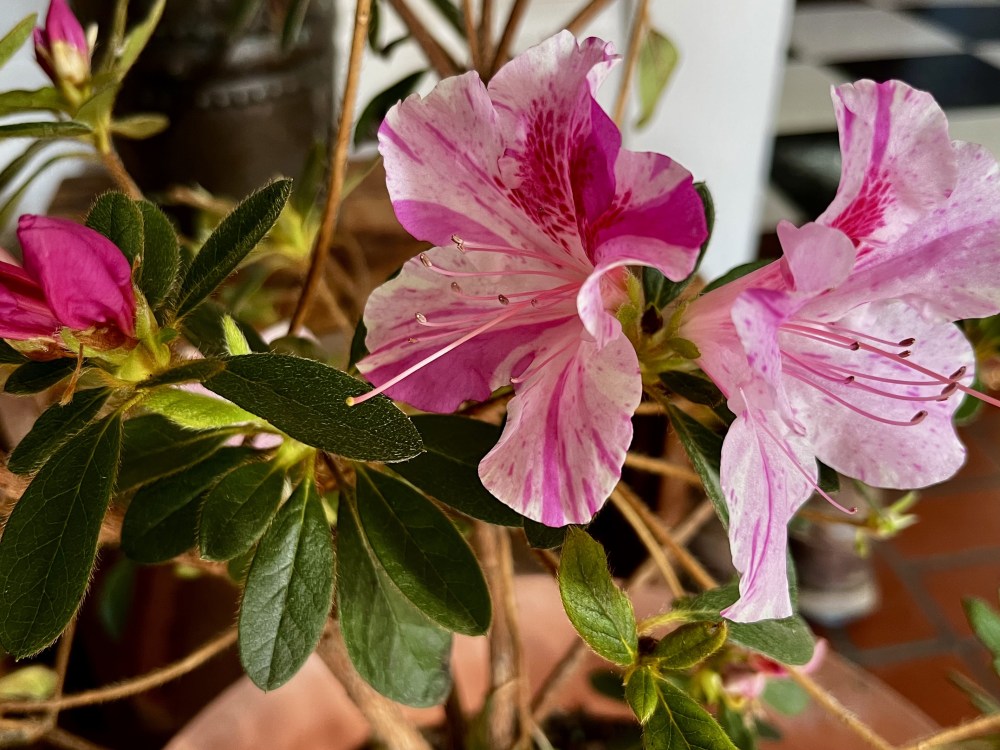
So, I guess I’m whining. The sun was out for a few hours today, and I put my flowering azalea outside to drink in some weak Western PA January sun.

Yes, it’s blooming. Spectacularly.

In January.

I bought it late (straight from Home Depot’s half-price sale in September) to be a large potted plant outside the front door by our newly paved walk. The plan for its life in winter was vague; it was really just meant to replace the recently deceased avocado tree that I grew from seed. But that’s another story (and very indicative of my ups and downs with potted plants).

This Rhododendron ‘Conlep’ did fine all through the autumn. It’s name is Autumn Twist, after all. Mild frosts didn’t seem to bother it, but overnight one early December morning, the deer had chewed off the ends of every tender little branch.

Enraged, I brought it into the mudroom and put it by the window. I hoped it would get enough light, and I moved it back and forth between inside and outside for a few days, until the frigid 20 below Arctic blast descended around Christmas time. The wood stove was going full blast in December, and I think it must have thought spring was here when it felt the heat of the wood stove. Because a few days after Christmas, I noticed the buds. And just a few days later, there were more buds. It’s spindly; it’s been losing leaves, but oh, when those buds opened…

When I sat down to write this post, I realized that only recently I also wrote about lilacs blooming in September, and another winter post celebrated dandelions blooming in winter. I might be fixated on blooming out of season, but here’s the thing: if flowers can bloom when they aren’t supposed to, then people can thrive under cloudy, sub-optimal conditions too. I’m trying to keep this in my thoughts…

I wrote this verse from Ecclesiastes on my kitchen blackboard the other day to remind me that there are seasons for busy-ness, seasons for quiet, seasons for celebrating, seasons for grief and lamenting. It seems to me good and right, that after the busy, celebratory season of Christmas, is January, a time for quiet, a time for lament.

No one enjoys suffering, yet we all know that when the season of suffering is done, we can look back and see. See with new eyes what that time of suffering did for us. Perhaps it brought us new compassion, a renewed relationship, a different perspective, greater faith.

Even if one isn’t suffering or grieving, we should know that we aren’t supposed to bloom 365 days of the year. The cycles of the seasons–fluctuating light, different temperatures and humidity–affect us all, plants, animals, and humans. God has made us to need rest and quiet; January is a perfect time for rest and quiet and meditation. Even my reblooming azalea needs a time of dormancy to recharge and revitalize.

I worry now that this lovely azalea has been thrown off her natural cycle of blooming in the spring. When the showy flowers fade, what will happen to her overall health and spindly deer-chewed branches. If I fertilize her now, in what should be her dormant season, will the leaves fill out again or do they need that bright spring light for new growth?

I think this is what has happened to our modern world. We live in a time of 24 hour lights, all season heat and AC, waking in the dark, not going to bed until late. Even now I am typing this at 10:13 p.m. and most every light in the house is on. Excuse me while I go turn some of them off…

We have become modern humans, forgetting our place in the natural world. It’s January in the Northern Hemisphere: we should be slowing down, recharging, resting, sleeping. Reading, praying, meditating… Not sapping our energies with dazzling out-of-season blooms.

It is glorious when it happens, though, isn’t it?