Where Violets Grow and other thoughts from the garden

Who bends a knee where violets grow, a hundred secret things shall know.” – Rachel Field
I’m putting in a little herb garden at the cottage.
Parsley, Sage, Rosemary, and Thyme.
Basil, Dill, Cilantro, and Chives, too.

It rained this morning and I bought plants in the mist. It seemed right somehow, to be buying seeds and plants in the spring rain.

In early early spring Mr. H.C. tilled up a long space of dirt in front of the peonies, day lilies, and the lilac bush. These old favorites were here when we moved in — just a long line of perennials that had weeds and grass in the bed and really needed something else to make them look pleasing. It’s in the back of the house, so I mulled around various ideas: a cut flower garden, more perennials, even transplanting the peonies so they could bloom where people could see them. Because really, peonies need to be seen, not hidden away in the back yard. But from what I’ve read, peonies don’t really take to being transplanted. And these two peonies are Very Large, Old Favorite varieties from way back when…

What do you think of a long line of herbs in the front?

Yes, I liked the idea too. And because there is lots of space, four blueberry bushes will be planted there next to the herbs. And caged. Because we have deer, raccoons, squirrels, chipmunks, rabbits, and a groundhog (with two babies!) who live under the tool shed. And a large opossum knocked on the front door last night. I really don’t know if opossums like blueberry bushes, but my guess is they probably do… And the rabbits around Apple Hill are unafraid of anything. Look how close little Flossie let me get to her last night:

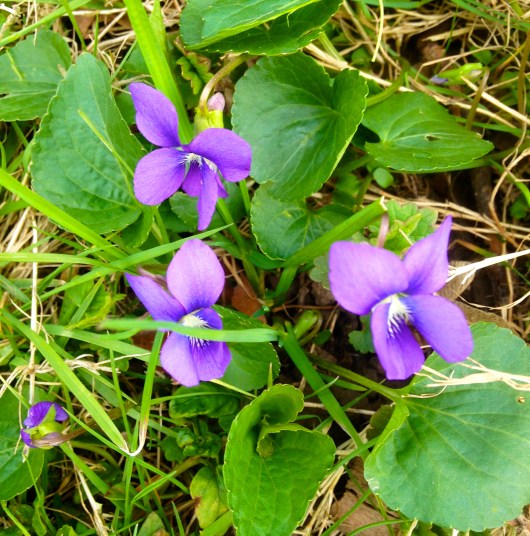
So I’ve been weeding this new herb bed. I don’t really mind for it lets me breathe, think, pray, drink in the beauty of spring, and lean on the shovel. For awhile I was pulling up all the little violet plants, and then I wondered why in the world was I pulling them up? Violets are among my favorite spring wildflowers, and I certainly don’t care if they grow among the herbs. Violet flowers are edible and look beautiful in salads or sugared on cakes. In my old back-to-the-land hippie days I made violet jelly once. It didn’t taste like much, but oh, it was the most beautiful shade of fuchsia. The leaves are edible too, so I tried a couple of young tender violet leaves. They don’t taste like much either, but then neither does spinach raw from the garden…

My second favorite wild flowers are daisies. I’ve found several patches growing wild around the cottage, so I moved them into the bed as well. And if the little herb garden gets taken over by daisies and violets, well, that’s fine with me. It’s called the Que Sera Sera method of gardening.

My herbs are planted, seeds and plants both, and the blueberries are being planted as you are reading this. And there’s plenty of shovel-leaning going on too…

Capturing Mist

The wispy mist floats

Fog fingers through the valley

Heaven blowing smoke


Air marries water

Leaves whisper melancholy

Mountains rise above.

Droplets sing, haze slips

Silently over the green

Defeating the sun

Tomorrow the gray

Has become just a skirmish

Sungold glow returns

Capturing the mist

Is finding the diamond world

Reflecting the sky.

Eat Two Things

Supper, or dinner — no matter how many people are in your family, or how elegant or plain the fare, the evening meal is important in the life of your family.

Sociologists have long told us that. We get to converse with those we love most about our days and share laughter. Families bond over meals. The modern family that doesn’t sit down together for dinner loses out on an eating-together-relationship that can’t be replaced by other activities.

Yet how do we make time for cooking dinner when we work and get home tired and unorganized; or have to pick up the kids and take them to practice; or have evening meetings, classes, or homework; or…fill in the blank here.

Maybe our standards are just too high… Where is it written and how did it come to be that a good dinner includes salad, meat, potatoes, another vegetable, bread, and dessert? Restaurants who are trying to make money? Oh yes, throw in an appetizer there too. Few of us cook meals like that at home for family. And we shouldn’t. It’s wasteful; it’s too much food; and we’re all too fat anyway…But that’s the ideal, isn’t it? Little feasts as everyday dinners. More is better.

Lately I’ve been reading about the Rule of St. Benedict — medieval rules for monastery life. Not because I want to become a monk and not because I believe rules are inherently good for us, but because I’m interested in simplicity. I’ve been trying to simplify my life for at least five years now, and I’ve only partially succeeded. One of the intriguing rules of simplicity from the Benedictines is Eat Two Things. Bread and soup. Soup and salad. Rice and vegetables. Oatmeal and fruit. Cheese and fruit. Eggs and vegetable. Rice and beans. They are lovely duos, aren’t they? (Surely salad and dessert fits in here somewhere too?)

This intrigued me because I had just been considering the fact that when I made three things for dinner, I felt that I could call it a Nice Dinner. But just two? I was usually mildly guilty — as if I could have done better. Not that we were still hungry. We weren’t. But call it what you like — American society, Western food habits, Restaurant-itis, Foodie culture — two dishes didn’t look like a real meal to me. My go-to thoughts were not of gratitude, but guilt — that I didn’t make that salad, or those brownies, or the extra vegetable. And can I just say that we don’t usually go hungry at the cottage?

So for the rest of May, we will be trying this for our dinners. Two things. For the sake of intentional eating. Simplicity. Health. Gratitude.

*except for Saturday evening when we are having company for dinner and yes, we’re having appetizers, bread, salad, steaks, mushrooms, potatoes, and two desserts. Eight things. For hospitality’s sake…

**just in case you are interested, here are the appropriate words about food from the Rule: (notice the suggestion of vegetarianism for all but the weak and sick…and that indigestion is caused by excess…)
Making allowance for the infirmities of different persons, we believe that for the daily meal, both at the sixth and the ninth hour, two kinds of cooked food are sufficient at all meals; so that he who perchance cannot eat of one, may make his meal of the other. Let two kinds of cooked food, therefore, be sufficient for all the brethren. And if there be fruit or fresh vegetables, a third may be added….
If, however, the work hath been especially hard, it is left to the discretion and power of the Abbot to add something, if he think fit, barring above all things every excess, that a monk be not overtaken by indigestion. For nothing is so contrary to Christians as excess, as our Lord saith: “See that your hearts be not overcharged with surfeiting” (Lk 21:34).
Let the same quantity of food, however, not be served out to young children but less than to older ones, observing measure in all things.
But let all except the very weak and the sick abstain altogether from eating the flesh of four-footed animals.