Cider Days, Part Two

Click here to read Cider Days, Part One

The internet search for a local cider press yielded exactly one option: Sally’s Cider Press in Harmony, PA, about an hour and a half away. They only press on Saturdays through the end of October, so on Friday I got busy sorting and packing apples.

Those buckets of apples that had been stored downstairs for a month needed to be gone through, leaves clipped off, and bad ones thrown out. There were surprisingly few bad ones, but unlike when we did our own pressing and cutting, we couldn’t just cut out the bad spots for this cider pressing. Twisted, ugly apples were fine, and so was mild bruising, but any apples with rotten spots were culled. The truck was packed the night before–pressing starts at 8 AM and we figured there would be a line.

Here’s the truck as we left on Saturday morning at 6:15, both of us about as crabby as those apples in the orange bucket…

I also picked some now ripe apples from the Winesap tree, some from our old green apple tree that no one knows its variety. (Yellow transparent? Grimes Golden? Rhode Island Greening?–I really need an apple DNA website…) Mr. H.C. had picked the crabapple clean two days before, and I threw in some of the Jonathans and misshapen Honey Crisps that we had left.

We pulled up at Sally’s Cider Press at 7:45 with about ten vehicles in front of us: everything from a dump truck filled with apples to small SUV’s with 4-5 tote bags. Sally’s will press any amount with a minimum fee of $25.

It was a beautiful mid-September day with everyone shedding their hoodies about 10:00. It was just about then that it was our turn…

The owners were so nice to talk to–Mister complemented us on our variety and told us that they have been so busy this year, it’s been overwhelming. We talked about the amazing apple season and he noted that last year they were lucky to press three trucks a day. I agreed. Last year, I said, we had no apples. Sally cheerfully took our photo while we filled the containers. We ended up with 24 gallons of cider, for which we paid $78. It’s a solar powered mill that does UV pasteurizing, so if we wanted to, we could resell it.

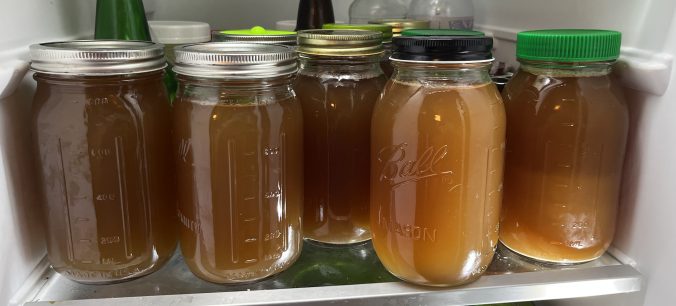
Eleven gallons went into the freezer; I’m canning three or four gallons; I’m fermenting four gallons (First timer!); and that leaves 4-5 gallons to drink and give away. (And, of course, later we found another large bin of apples that had been sorted, stashed away, and forgotten.)

So both ways of cider making were fun — and exhausting in their own ways. We’ve still got apples on two trees, but it’s manageable now. And I’ll let you know how my fermenting experiment goes…

Cider Days, Part One

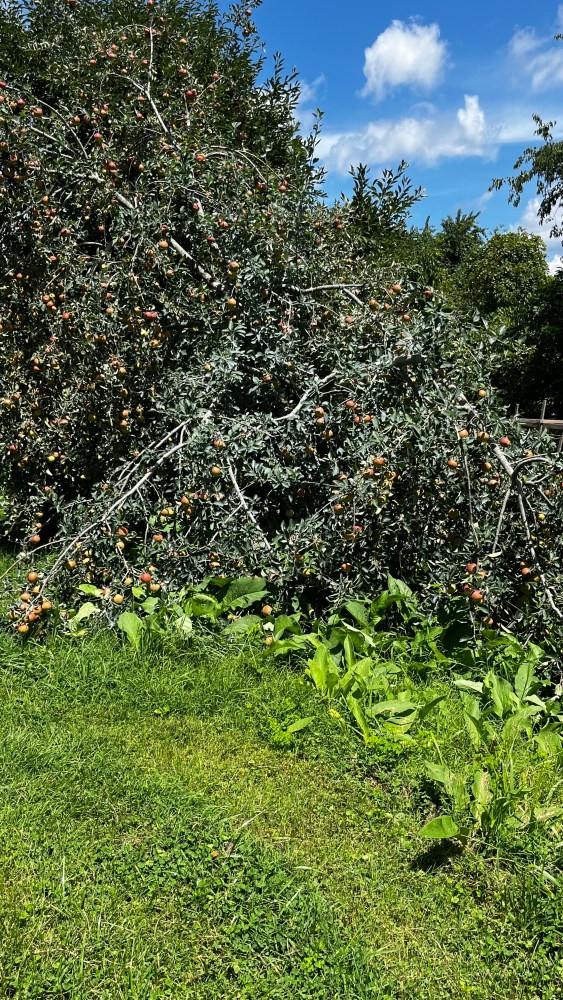
We knew we would have a huge apple harvest when the tree limbs started bending under the weight of the apples.

I picked off many, many, many little green apples, but I didn’t get the ladder out and cull the high branches. I should have!

This poor Winesap tree used to stand tall and reach for the sky. Now it may be bent and weeping forever…

In mid-August the main Winesap branch broke right off, and we had to emergency-pick seven five-gallon buckets of half-ripe apples. We had to prop up several other branches on other trees and pick others before they were quite ready. By late August I had 10 bags of pie filling in the freezer, yet I had not enough time to even think about making a fresh pie. All I managed were a couple of crisps.

We knew we had too many apples and that the answer was cider.

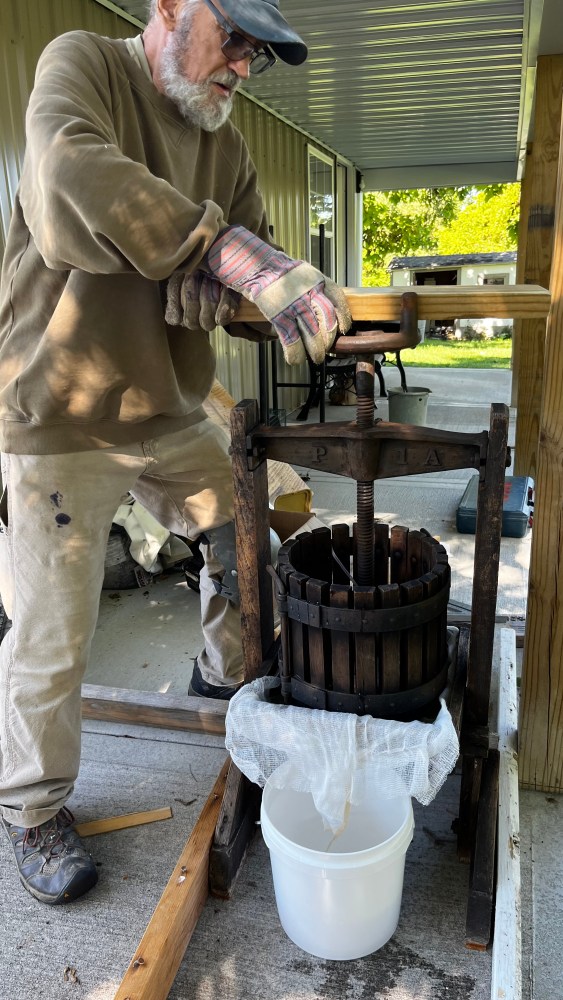
We had a vintage press that we’d never even thought of using. In fact, a couple of years ago Mr. H.C. varnished a tree round and added it to the top of the press. Suddenly it became a high table with benches out on the porch instead of dust catcher.

One evening as we were staring at it, Mr. H.C. said, “I think there’s another piece to this up in the attic.” Sure enough, within 15 minutes, we were staring at the other vintage piece–a hopper. Both were made by Red Cross Manufacturing Co. in Bluffton Indiana, probably around 1920-40. We spent the better part of the next week cleaning the cobwebs and crud with a garden hose, a power washer, and an air hose. We did a final rinse with vinegar and water; bought some cheesecloth sacks; some sanitizing tablets; and couple of new buckets. We were ready for the grand experiment…

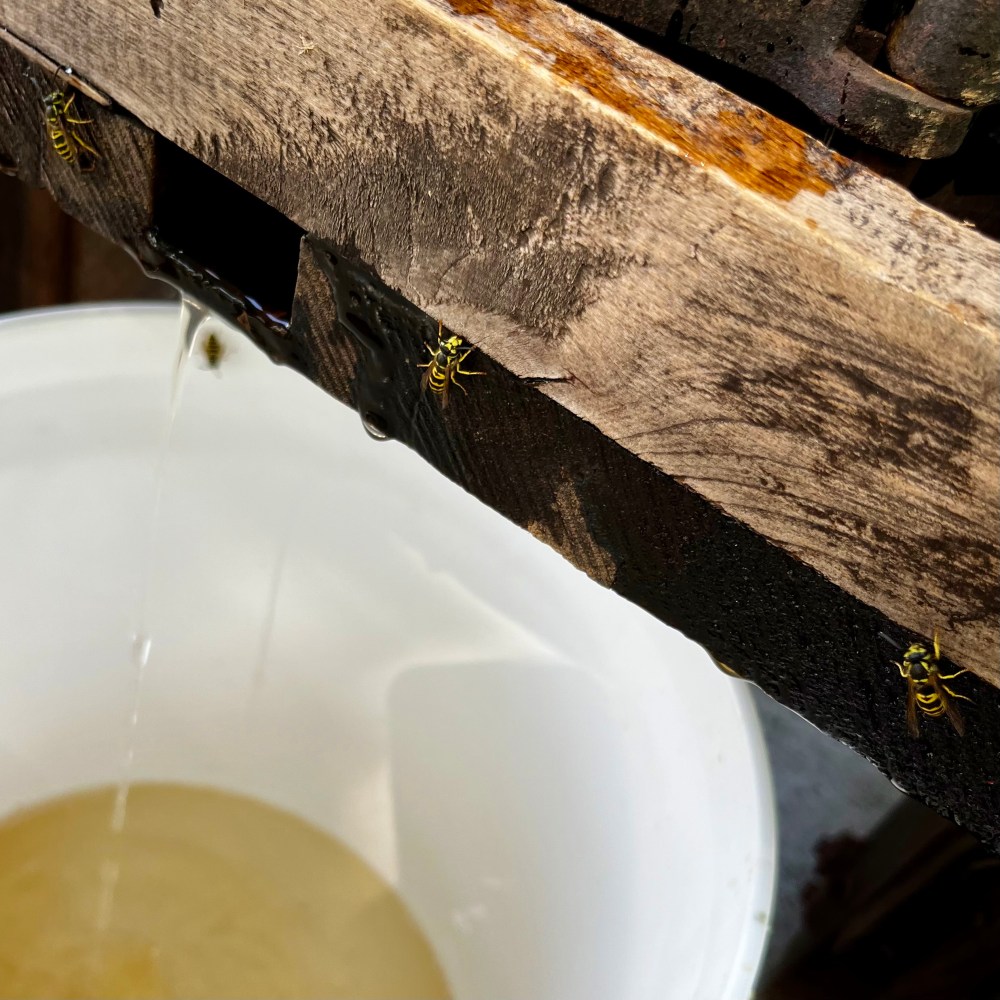
What we didn’t know was that the chopper/hopper was made for grapes. It really didn’t like to chop up the apples as they should be. So we had to chop the apples by hand–the smaller the better–before the hopper would grind them at all. And it really didn’t like the hard, green semi-ripe apples. So we used pears, and the other ripe apples that had bad spots and we just cut out the bad spots. We cut, and chopped, and pounded, and pressed for about 10 hours over two days. And no one got stung.

We ended up with about 2 gallons of pear cider, and about 4 gallons of an apple-pear mix. I canned ten quarts, and pasteurized the rest for half-gallon containers. (To pasteurize cider, heat it to 160 degrees for 30 minutes.)

But we still had so many more apples, and honestly? We were exhausted.

Yes. We did this to ourselves. What were we thinking? But truthfully, this is the first year it’s ever been like this. We think it is a combination of a very good year for Pennsylvania apples (Every wild tree is loaded with apples!) and that our trees are just now coming into a very fruitful maturity–5 to 7 years.

So we started an internet search to find a local cider press… Stay tuned for Cider Days, Part Two

The Vintage Firetruck and its story

Today–Memorial Day, 2023–I am reposting a story I wrote ten years ago in honor of my uncle who I never knew.

We’ve been fighting with our stuff these last few weeks, and it’s been getting me down. I haven’t written about stuff lately: I’ve been shredding it, organizing it, recycling it, boxing it up, throwing it out, giving it away, … And truthfully?

It doesn’t look like I’ve done anything.

And then I came to this:Antique Steelcraft Toy Mack Firetruck This is the cleaned up version. For the last three years it has been relegated to the floor of my upstairs sewing room where it’s been catching dust rather than putting out fires. And let me tell you, this baby catches a lot of dust.

What to do with this cool old maybe-worth-some-money toy? (It is now sitting on top of my son’s refrigerator.)

This Mack Hook and Ladder truck was manufactured by Steelcraft in Cleveland Ohio sometime between 1928 and 1935. It has two ladders on the sides that attach to a ladder in the back. When these ladders are put together, they are over three feet high. A kid could put out some mighty fires with this thing.

The ladders also can be cranked up and down — the deluxe model. But in 1930, there were no warnings on toys; this Mack truck could do some damage… It has string that could choke; small parts that could fall off and hit; clips that could pinch fingers, and seriously sharp ladder edges that could poke an eye out. But it also has a real brass bell that dings and a hose that unwinds… Generations have played with this truck — my kids played with it and lived (with no serious injuries). Vintage Steelcraft Mack Firetruck

It belonged to my mother’s brother, Uncle Donnie. I never knew him; he was killed in World War II in France in 1944.

Jean and big brother DonI don’t know much about him. My grandma, Nanny, always started to cry when his name was mentioned, so we never talked about him much. Mom only said that she was the kid sister, and just as she was getting old enough for them to be friends again, he joined the army and went off to war. He was a smart kid, an intellectual-type, who graduated from high school in 1943, went to college for one semester, and then went to war. A young boy who probably never wanted to be a soldier… and yet, he went, he served, and he died. At age 20.

He served with General Patton’s Third Army in the infantry. On October 26, 1944 the local newspaper published an excerpt from his letters home. It is a very long article, and I’m skipping here and there for these quotes below.
Waynesburg Republican, Oct. 26, 1944

…the French people stand in front of their homes (some of which have been bombed) with pitchers and glasses of cider and wine. The only trouble with the cider is that it’s hard instead of soft… Since I wrote you last we have done a lot of riding over France. Also a lot of walking both day and night. I never before realized France was such a beautiful country. Excellent terrain for fruit trees and agricultural rolling land, mostly level, with acres of wheat, oats, hay and grape vines neatly taken care of. We were about a month too soon for the plentiful supply of apples, grapes, etc…. Where I am now acres and acres of fields of wheat, oats, etc. are going to waste because of fighting around them… Last night I slept in a trench for the first time and didn’t sleep badly. A fox hole will probably follow…

PFC Don Longanecker, Jr.
We had our first hot water showers yesterday since our arrival in France. You can imagine how we felt. We’re hoping to get some clean clothes soon…The past ten days or two weeks have proven rather rough and tough for some of us. Especially in the way of sleep. Strange thing about it though is that when we get a chance to sleep, we just can’t seem to close our eyes…

Yes, the war news is good, but don’t let the newspapers make you believe the war is about over. I’ll tell you one thing, if we didn’t have air supremacy, I don’t know what we’d do. You don’t see any German planes by day and few by night…
Sept. 24. A lot of guys are getting souvenirs lately such as German pistols, knives, belts, etc. I don’t think I’ll bother with anything like that… Besides I’m not interested in souvenirs — just am anxious to get this thing over as soon as possible and get back home…

His obituary says he was killed on November 8 between Nancy and Metz in Northern France.

And I have a few photos. A yellowed newspaper article. A letter from the War Department. His obituary. And his firetruck.